‘Seating is not just about where we sit, but how the built environment dictates our capacity to learn.’ In today’s article, Victorian teacher and designer Andressa Bassani discusses 3 of the most common seating layouts educators use when teaching a lesson primarily from the front of the classroom – and analyses them through the lens of architectural functionality and student engagement.
In the world of interior design, the layout of a room can dictate human behaviour. A narrow hallway suggests movement; a plush armchair suggests rest. In the classroom, the way we arrange our tables can act as a silent pedagogical script.
It tells students whether to focus, to chat, or to disengage.
Designers know that form follows function – when the physical layout contradicts the intended activity, it creates dissonance. Seating is not just about where we sit, but how the built environment dictates our capacity to learn. Research suggests that when a teacher organises a room to fulfil educational aims rather than for organisational convenience, it facilitates learning and enhances cognitive development (Higgins et al., 2005).
When considering seating arrangements in your own classroom, the goal isn't just to fit furniture into a square; it is to use architectural thinking to make learning the path of least resistance.
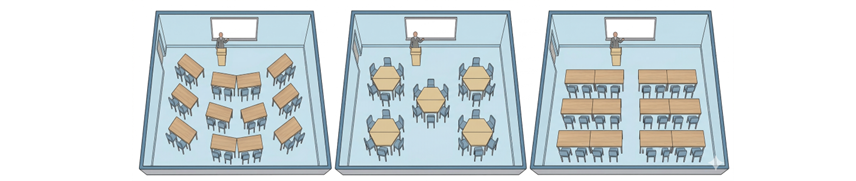
Here is my review of the 3 most common seating layouts educators use when teaching a lesson primarily from the front of the classroom. I have analysed them through the lens of architectural functionality and student engagement.
Clusters – the physical tax
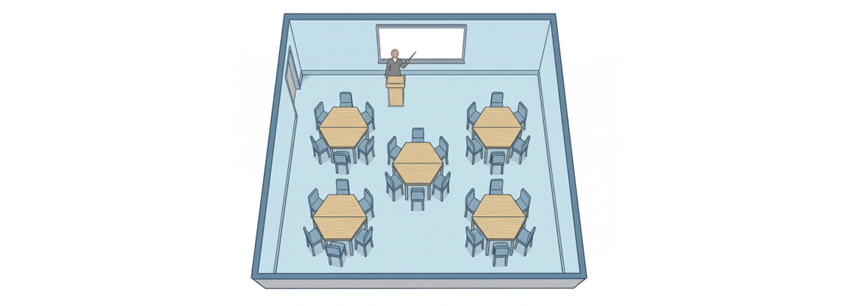
Driven by the noble goal of collaboration, cluster seating in groups of 4 or 6 has been the default classroom layout. However, in interior design, we know that a round table is designed for conversation, not necessarily for deep work.
This is exactly why you rarely see large, collective round tables in the ‘quiet zones’ of a library. When students are physically oriented toward each other, it creates an environment that facilitates chat over deep thinking. There is a mismatch of intent.
Clusters also create a physical tax on learning. During direct instruction, students at the front of a cluster must rotate their shoulders, necks, or chairs to see the board, creating a path of resistance toward engagement. Students in clusters often have their backs to the door or the main classroom displays. They lack a full picture of the room’s energy.
In democratic spaces, everyone should have equal access to the horizon of the classroom. A seating plan that turns a student’s back on the instructional core is, in essence, a plan designed for disengagement.
Rows – the minimalist solution
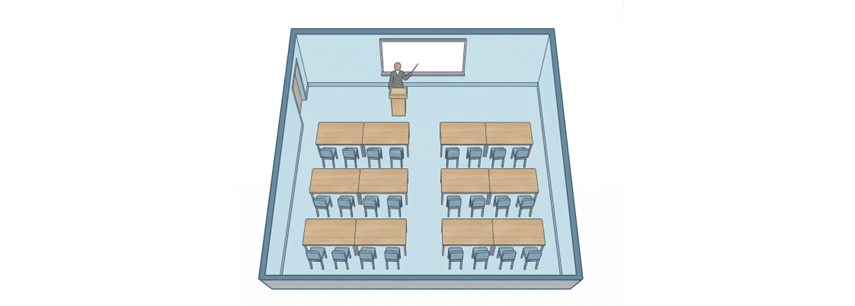
This setup is the intuitive geometrical response to the rectangular architecture of the modern classroom, aligning the desks with the natural lines of the walls. Rows are the ultimate expression of Foucault’s (1977) ‘art of distributions’.
By placing students in a grid, the school achieves a way of individualising students so they can be easily counted and supervised. This layout minimises peer interaction to maximise the teacher's ability to monitor behaviour.
Rows represent the minimalist solution to the ‘cluster problem’. In terms of clarity, they are surprisingly effective – every student faces the same direction, and the teacher can curate exactly what is in their field of vision.
However, rows have a distinct perspective flaw. In a standard rectangular room, students at the far ends of a straight row often view the whiteboard at an angled perspective. This distorting visual can make it harder to decode text and requires a physical turn of the body to maintain focus.
Furthermore, the layout creates a visual hierarchy that limits peer-to-peer connection. Those in the front row will rarely see the students in the back rows unless they turn their bodies a full 180 degrees, effectively cutting the classroom community in half.
Rows, but better – the semi-circle
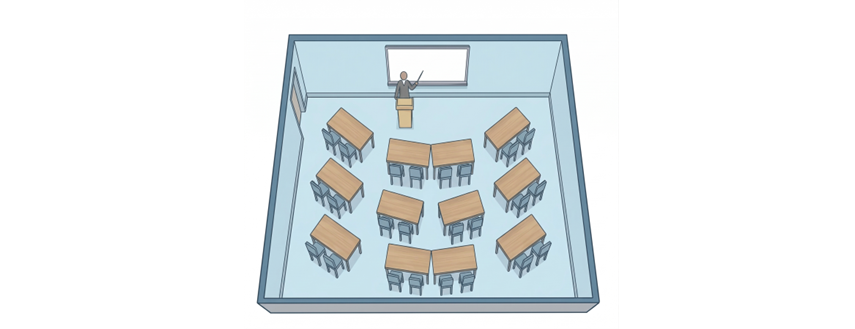
This shape is not a modern fad; it is a return to a structure that defined human gathering. From the Greek theatres to the Roman forums, architects understood that a curve allows us to listen to a speaker while remaining viscerally aware of our peers.
If we want to combine the focus of rows with the communal energy of a shared space, the semi-circle is the superior architectural choice. It is essentially rows, but optimised.
When every chair is naturally angled toward the centre point of the room, the physical effort required to see the teacher is eliminated, preserving that energy for the lesson itself. In a straight row, a student primarily sees the back of a head. In a semi-circle, students sit in each other’s peripheral sightlines. This arrangement encourages interaction without the forced distraction of clusters.
It is also easy to stagger student positioning so that no one is directly behind someone else, ensuring that every student remains in the teacher's field of vision. This creates a loop of belonging – you are not just a face in a line; you are part of a visible collective.
This formation is designed so students can see each other and the teacher simultaneously. This specific orientation has been found to significantly increase student-led questioning and participation compared to traditional rows (Marx et al., 2000).
When in doubt, do as the Romans did
When thinking about an upcoming lesson where you plan to teach primarily from the front, how will you arrange your tables to optimise learning?
I have found that by rotating your tables into a semi-circle, you create a space that is cohesive to attention and respectful of the human voice, the peer group, and the democratic idea that everyone deserves the same view.
References
Foucault, M. (1977). Discipline and Punish: The Birth of the Prison. (A. Sheridan, Trans.). Vintage Books. (Original work published 1975).
Higgins, S., Hall, E., Wall, K., Woolner, P., & McCaughey, C. (2005). The Impact of School Environments: A literature review. The Centre for Learning and Teaching, University of Newcastle.
Marx, A., Fuhrer, U., & Hartig, T. (1999). Effects of Classroom Seating Arrangements on Children's Question-Asking. Learning Environments Research, 2(3), 249-263.
Looking at your classroom layout, are students are required to twist, turn or reposition themselves to see you teaching from the front? If so, what small changes could you make to give everyone an equal line of sight?
How well does the way you arrange your classroom seating match the learning intention of the lesson – for example, focused listening, questioning, discussion or collaboration? Which seating arrangement works best in your classroom when you want students to see, hear and engage with you?