International TALIS insights – relationship-building skills and strategies

Every teacher knows that when students can communicate clearly, listen to others, or cooperate and manage conflict, they are better able to participate in learning. And these relationship skills not only help students, but they also influence the classroom climate, peer relationships and free teachers to focus on instruction rather than behaviour management.
When these skills are missing, teachers notice too. They are usually the first to spot when a student withdraws or disengages. How teachers respond in these moments can either escalate problems or help students develop more positive ways of relating to others.
To better understand how teachers respond to relationship challenges, the OECD Teaching and Learning International Survey (TALIS) 2024 introduced a scenario-based task. The scenario featured a male student who frequently ignores them and gives minimal responses yet seems more engaged with another colleague. Teachers could choose multiple non-mutually exclusive responses:
- A: Monitor his behaviour over the next 2 weeks to see if it improves
- B: Arrange a meeting with the other colleague in order to talk about the strategies they have used to encourage more positive behaviour from him
- C: Have a discussion with him after the next lesson to investigate reasons for his limited engagement
- D: Other
The scenario-based task was an opt-in element of the survey; 43 countries and territories chose to participate. Australia was one of the countries and territories that chose not to participate.
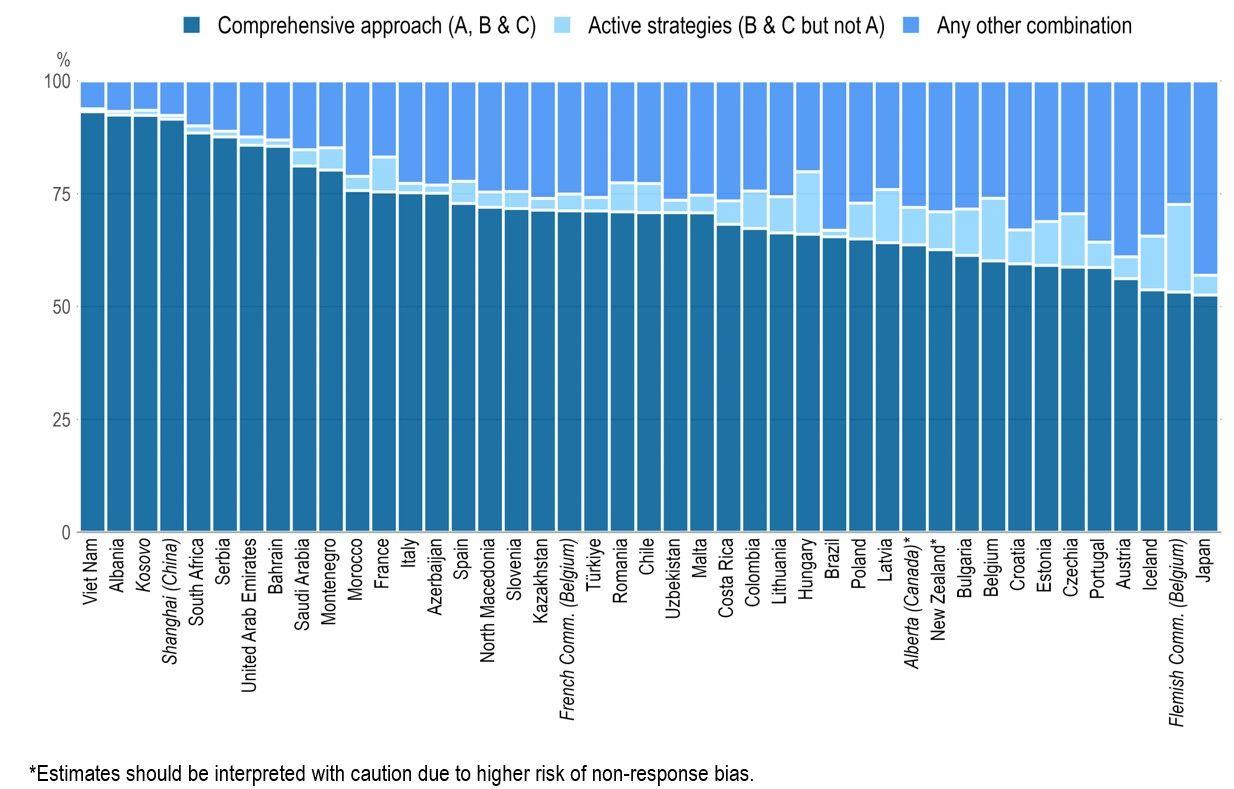
The results are shown in Figure 1, below. Across education systems, most teachers report that they would use all 3 approaches. The share of teachers who report that they ‘would’ or ‘probably would’ monitor the situation (A), seek colleague support (B) and engage the student directly (C) ranges from 53% in Japan to 93% in Viet Nam. So, teachers tend to balance observation with action.
Direct conversations with students can clarify misunderstandings or unmet needs, while seeking advice from colleagues adds another layer, helping teachers draw on shared experience rather than working in isolation. Observing behaviour allows teachers to avoid overreacting and provides a feedback loop to monitor the effectiveness of active strategies.
In some systems, a notable group of teachers emphasised more active strategies, such as consulting a colleague and engaging with the uncooperative student directly, without extended observation.
Figure 1. Teachers’ approach to developing students' relationship skills
Percentage of teachers who report that they ‘would’ or ‘probably would’ do the following in a scenario where they notice a student engaging more positively with another colleague
Source: OECD, TALIS 2024 Database; Table 1
Interestingly, TALIS data show that male teachers are less likely than female teachers to report a comprehensive, multipronged approach. This may reflect differences in how male teachers perceive their role in supporting students’ social and emotional skills, or broader gender differences in empathic tendencies. Results from TALIS 2024 show that, on average, male teachers report having lower empathy with students than their female colleagues and they also tend to use practices that foster students’ social and emotional skills less frequently.
Supporting relationship skills often requires empathy, active listening and sustained dialogue. If some teachers feel less confident or see this work as less central to their role, students may receive uneven support.
Can teacher training explicitly address how relationship-building fits into teaching for all educators, regardless of gender or subject taught? According to TALIS, teachers who feel well prepared as a result of their initial education and training are more likely to adopt a multi-strategy approach. This positive link holds irrespective of teachers’ gender in around half of the education systems (23 out of 43).
That matters for classrooms. Teachers who feel equipped are more likely to initiate conversations with students, involve colleagues and persist in addressing relationship issues rather than avoiding them. In contrast, limited preparation can lead teachers to rely on fewer strategies or delay action.
Participation in continuous professional learning focused on social and emotional development shows a similar pattern. Teachers who participate in this type of training are more likely to use multiple strategies to strengthen students’ relationship skills. This suggests that professional development can also help teachers support students’ social and emotional learning.
For policymakers, these findings highlight the importance of embedding social and emotional learning in both initial teacher education and continuous professional learning. For school leaders, they underline the value of creating time and space for teachers to reflect together on student relationships and behaviour, helping to reduce isolation and improve consistency across classrooms.
References
OECD. (2025). Results from TALIS 2024: The State of Teaching. TALIS, OECD Publishing. https://doi.org/10.1787/90df6235-en.
When a student shows signs of disengagement or withdrawal and you’re unsure how to support them, how often do you talk to colleagues to get their perspective?
As a leader, how does your school support teachers in building effective relationships with students? Where might there be room to further strengthen these systems of support?