Education systems are rushing to integrate artificial intelligence (AI) into classrooms, motivated by the promise of personalised learning and improving outcomes. The potential is real, and this ambition is welcome. But in our haste to apply AI to children – optimising instruction, automating assessment, accelerating content delivery – we risk overlooking an equally urgent priority: equipping children with a fundamental understanding of how these technologies actually work. If we get this balance right, we have an extraordinary opportunity: a generation of children who understand AI well enough to build a better future with it.
In this Q&A, Andrew Sliwinski, Vice President and Head of Product Experience at LEGO® Education, answers questions about computer science and AI instruction in the classroom, and what we can do now to empower student agency in a changing world.
What is the single biggest misconception about AI education we need to overcome?
The prevailing misconception is that AI education means using AI on children – adaptive tutors, AI-generated lesson plans, or chatbot instruction layered onto the existing model. That is one dimension, but it is incomplete. While obsessing over computers’ capabilities, we lost track of what children are capable of.
One narrative in education right now frames AI as a tidal wave coming to wash away human relevance, and our job is to frantically teach children how to tread water. This perspective casts the child as a passive participant of progress rather than its primary architect. We need to balance using AI on children with children using AI and understanding how it works and how it doesn’t.
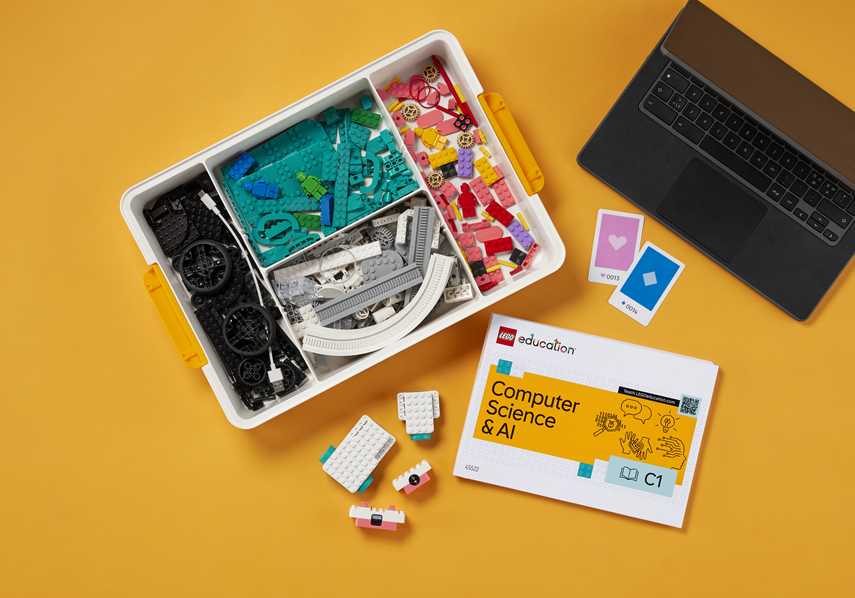
Foundational AI literacy is not about teaching children how to use a magic box. It is about handing them a screwdriver to dismantle the box and build things from the pieces. Decades of research show children develop deeper understanding through building, testing, and reflecting on tangible artifacts rather than passively receiving instruction.
Why should governments and education systems elevate computer science and AI from niche electives to core literacy?
If we want children to build these technologies (and not merely consume them), then we need to elevate the foundations of AI (computer science, probability, data, sensing, and algorithmic bias) to core literacy. It should be as fundamental to a modern education as reading, numeracy, problem-solving, creativity, and collaboration.
What steps should governments take to make this a reality?
This is, perhaps, a once-in-a-generation opportunity. Governments can use AI to prop up the existing system (marking tests faster, writing reports more efficiently) or recognise this moment as the single greatest opportunity to reimagine education. That starts with investment in AI literacy at scale, backed by national policy and funding that elevates computer science, data literacy, and computational thinking to the same level as reading and numeracy.
But it also requires a more fundamental shift in pedagogy. We need to support educators and students through an inclusive, guided pedagogy that creates space for children’s curiosity. Many educators and parents feel ill-equipped to guide children through AI, even students are already using these tools. Nearly half of all computer science teachers do not feel confident teaching AI even after training, according to a LEGO Education survey (LEGO Education, 2026).
We cannot wait for adult expertise to catch up to the speed of innovation. Instead, we can reframe our role from all-knowing experts to partners in learning. After all, one of the most powerful things you can say to a child is, ‘I don’t know. Let’s find out together’.
How can schools address the skills gap and encourage more interest in STEM careers?
The answer is empowerment and engagement. For too long, computer science has been perceived as a subject for a narrow subset of children – the ‘nerds’ and the ‘geeks’. We need to change that narrative by connecting tools to the things children genuinely care about: their passions, their interests, and their communities.
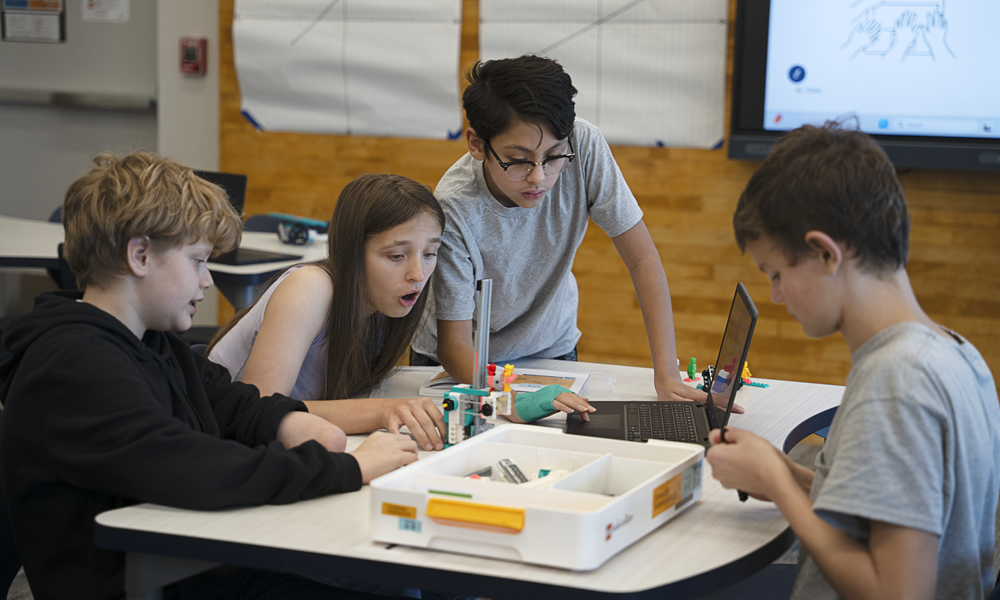
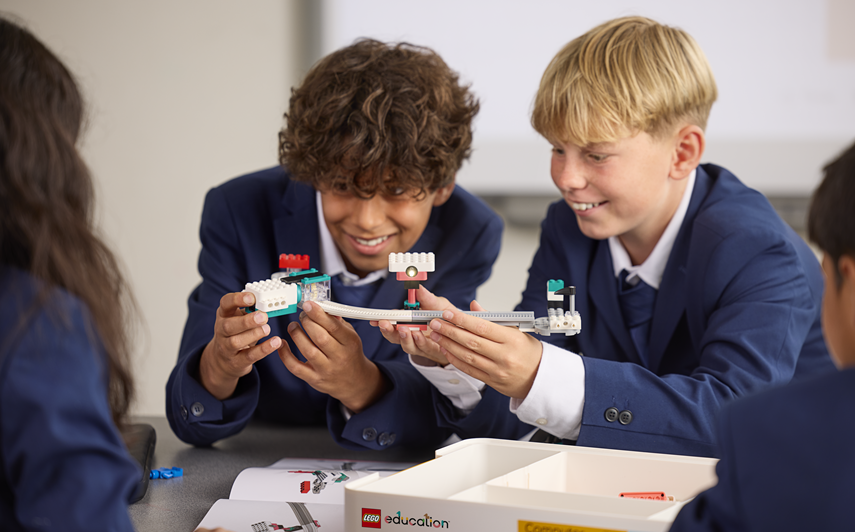
Hands-on, project-based, collaborative learning engages more learners and builds deeper understanding of these concepts.
When a child builds a physical model and sees it come to life because of the code they wrote or the AI model they trained, computer science stops being abstract and starts being tangible. We need every child to feel a part of this – not just as future software engineers, but as future artists, innovators, scientists, and citizens.
How does hands-on learning foster critical thinking and the foundational understanding necessary for innovation?
A substantial body of international research supports the connection between active, hands-on pedagogies and the development of higher-order thinking skills. The OECD’s multi-year project on Fostering and Assessing Creativity and Critical Thinking found that when students are encouraged to come up with their own solutions and iterate on their ideas, they connect more deeply with subject matter and are more likely to develop durable creative and critical thinking capacities.
UNICEF’s Policy Guidance on AI for Children further emphasises the importance of child-centered AI design that promotes agency and active participation, rather than positioning children as passive recipients of algorithmic instruction. These findings are consistent with broader constructionist research showing that when learners build, test, and reflect on tangible artifacts, they develop not only technical competence but also the metacognitive skills essential for innovation such as the ability to decompose problems, reason about uncertainty, and evaluate the assumptions embedded in the systems around them.
What does successful teacher training and continuous professional development (CPD) in AI literacy look like?
The challenge is not just access to tools but access to confidence. Research consistently shows that teacher self-efficacy is one of the strongest predictors of technology integration in classrooms. Less than half of computer science specialist educators currently feel prepared to bring AI topics into their teaching (LEGO Education, 2026). This confidence gap is the bottleneck.
Effective CPD must go beyond one-off technical workshops. It requires sustained, curriculum-embedded professional learning that positions teachers as co-learners alongside their students. The OECD’s professional learning framework for creativity and critical thinking emphasises that lasting change in teaching practice depends on experiential, cooperative, and applied models of learning, not passive instruction.
Teachers need ready-to-use, curriculum-aligned content, and the scaffolding to build their own understanding progressively. When teachers feel confident, students become confident. Closing the confidence gap is not a secondary priority; it is a prerequisite for everything else.
How does LEGO Education Computer Science and AI meet high standards for safety, privacy, equality, and wellbeing?
Our approach is anchored in 3 non-negotiable commitments. First is prioritising privacy. At the LEGO® Group, we believe privacy is a fundamental right, and that right extends fully to children. At LEGO Education, we guarantee this through ‘local inference’: a child’s data never leaves the classroom or trains AI models.
Second, we do not anthropomorphise AI. We do not give AI systems a face, a name, or describe them as ‘creative’. Creativity is for humans. Creativity is for children. Research shows that anthropomorphism can lead to a range of cognitive, behavioural, and emotional side effects, including children forming parasocial attachments to AI systems and substituting those interactions for real human relationships.
Third is transparency: the models children interact with are accompanied by clear documentation (for example, model cards) describing the data used to train them and the biases they may contain. If we want children to understand how these tools work at a fundamental level, then we need to show them – not hide behind proprietary black boxes.
The question before policymakers, educators, and industry leaders is not whether AI will transform education – it already is. The question is whether we will use this moment to simply optimise the systems we already have, or to truly empower children and shift towards more effective pedagogy.
If we equip the next generation with the foundational literacies to understand how AI works, the creative confidence to build with it, and the critical judgement to know when and how it should be used, the possibilities are extraordinary. More than ever, we need children learning together, not staring at screens in isolation. We need their voices heard, their curiosity honoured, and their agency placed at the center of every decision we make. The children are ready. The question is, are we?
References:
LEGO Education. (2026). US computer science & AI education insights report. https://education.lego.com/en-us/resources/cs-ai-education-insights-us/