Hello and thanks for tuning in to this podcast from Teacher magazine, the resource for K-12 educators published by ACER, the Australian Council for Educational Research. I’m Dominique Russell.
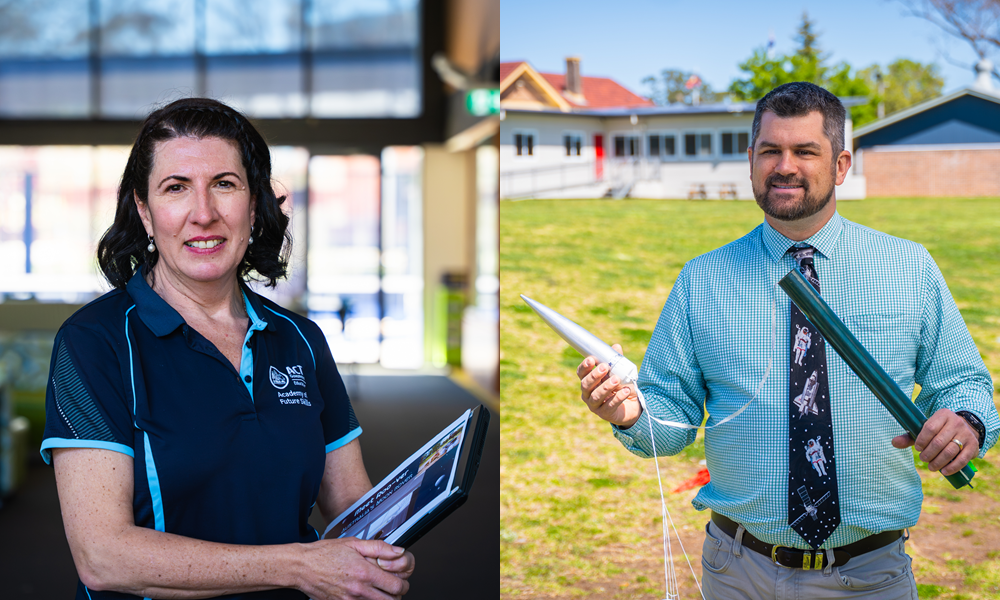
Late last year, the winners of the 2025 Prime Minister’s Prizes for Excellence in Science Teaching were announced. Each year, the 2 prizes – one for a primary school educator and one for a secondary school educator – recognise achievements in STEM teaching. For 2025, the winner for primary school teaching is Paula Taylor, Executive Teacher in STEM at the Academy of Future Skills within the ACT Education Directorate. The secondary school educator recognised is Matt Dodds, Biology and Physics Teacher at Glen Innes High School in New South Wales. I sat down with both of them at the beginning of the 2026 school year to hear all about the work they were recognised for. It was such a delight to hear about the teachers that had an impact on them when they were younger, the lesson activities that are a hit in their science classrooms, and how they’re sharing their knowledge with other educators. I’ll bring you their conversations separately – up first, we’ll hear from Paula Taylor. Let’s jump in.
DR: Paula, thanks for joining us on the Teacher podcast. It's great to be able to share a lot about your expertise, and the fantastic work you've been recognised for with this national prize, with our audience. I'd love to firstly, though, hear a little bit more about your role and what it involves exactly, because it's a little more unique to kind of a standard STEM or science classroom teacher role, isn't it?
Paula Taylor: Yes, and that's what makes it exciting. Every day, every situation, every classroom is different. So I am a STEM specialist teacher with the Academy of Future Skills, with the ACT Education Directorate, and I get the opportunity to work across all our ACT public schools on demand. And I get to do bespoke work, trying to meet the teacher where they're at. And I certainly get to work at developing their confidence and capabilities in teaching STEM.
And I do that by working alongside them in preparing those lessons, those units, making sure that there's buy-in and there's full understanding as to how we're going to work together. But it's really to progress the teacher and strengthen them as a STEM educator. And typically I get the joy of doing it in the classroom with them alongside me. So really, although there's young people in the room, technically the teacher is the student. who gets to see how I model that lesson and really engage students, not just to learn the content, but really how I start an inquiry and to get kids really engaged in that inquiry and how that all happens with equipment in the room as well. So all of it is quite demanding and nothing's easy. But when the teachers see how I put that in a very crafty way, they then gain more confidence.
DR: Yeah, you must have such a wealth of experience there with all the things you’ve seen. I'm sure no 2 days are the same doing what you do. How many years have you held that role?
PT: So I've been a classroom teacher for 30 years and I was the original officer who was assigned to work at the Academy when it first opened up 8 years ago. So we are now 8 years in and 6 full-time teachers stronger. And what we now are is a very powerful multidisciplinary team. So you can imagine early days, I could only bring in my subject expertise, but now we are covering all year levels, all STEM subjects, and doing it in such a creative way that we tend to plan now and work together as a team so that teachers get a sense that STEM is not just a one subject, one area in the curriculum at a time thing, it's very multidisciplinary.
DR: And so I'd love to know then, across all those years, kind of the most common areas, I suppose, that you've supported all of these teachers that you've worked with in terms of science education. Can you tell me a little bit more about the professional support that you've most commonly provided to these teachers?
PT: Well, I'd say my trademark is my overuse or perhaps regular use of data loggers. Now, data loggers allow a student to observe a situation or an experiment or explore the world around them with real-time data. So when they say, ‘Oh, I think this material is better than this one’, we know that those terms is very loose and not very scientifically grounded. So I've been using a data logger in the classroom for 30 years, right from the get-go as a new educator.
And what I've noticed is that it is a very engaging and powerful tool. So when students are developing a STEM project, I get them to make sure that it's robust, it's riddled in lots of data so that they can say strongly with mathematical conclusions and mathematical reasoning as to what it is they've discovered and what those numbers tell them. So they become quite numerate and they're thinking scientifically using real valid data. But what I noticed, and what teachers are noticing, is that the lessons rarely end because they're in the middle of collecting data. And we're talking as young as kindergarten students who have a data logger within one of their student-built homes, and they want to see those numbers rise or go down because they want to prove that they've built the best house for their animated character. And so the inquiry is strong, the kids are asking more questions. And with data available to them, they then rethink and reiterate their projects, and they're so data-driven. So that's the kind of reasoning I've been doing in our classrooms; making sure that it's robust and full of data science.
DR: And we have a long history now of interviewing the various recipients of the Prime Minister's Prizes for Excellence in Science Teaching on the podcast. And one question we always like to ask is if they can share a favourite science learning activity they use in the classroom. So I know that example there that you just gave about working with data is fantastic, but I thought I'd give you the opportunity to see if you have one or 2 that you'd like to share with our listeners as well.
PT: Well, I'd say working with primary school teachers, I have to obviously invent the provocation or the hook that's going to get students interested. And a very popular one is our fourth little pig. He's an upcycler. He likes to use materials to build his home. And we always ask that question, what is the best material to use? And we do a lot of material exploration. So never are we allowed to go into the makerspace until we start to think scientifically.
So we deconstruct materials, we get to figure out their properties, and we do that again through some mathematical data loggers and reasoning. And students have to justify as to why they're going to use certain materials. But I tend to give them 3 criteria as to what the home must fulfill. And they go off to do their testing, all hands-on, all minds on, critically thinking, looking at that data, and then when they assemble the home (this is now weeks later) they can proudly and justify why they have assembled it and used those materials. So that's a very popular character, the fourth little pig. He is our data scientist and definitely sustainable.
DR: I love it. And you've also been recognised for really empowering students to think about how they could have a future as a scientist. And I wanted to talk about that as well today, because we know how important doing that is, particularly for our female students. So do you have any words of advice for other teachers who'd be listening to this podcast who are wanting to support their students in this way?
PT: Well, I'd say that I'm very lucky to have started my career as a scientist first. And what I noticed – and not to say that that has to be how every teacher begins – but what I bring with me, my toolkit, is stories that are relevant and current to students.
So because I worked in the medical field, I was able to bring a lot of real-world examples of how we use some of the mathematical ideas, how we use these science concepts. So students really find stories to be enduring, and they connect with stories. So for any teacher, science is a current event. It's ongoing. Australia is a powerhouse and does phenomenal things. I would suggest for teachers to continue to read those short snippets that come out every day. Soon we're going to the moon, which is something we haven't done in 50 years. So those are current events that students latch on to and get engaged with. So if we can make that the provocation every day – a current event.
So my advice, be well read in science, stay abreast of what's going on. Students like to then share back. They become, I suppose, more science literate as they start to connect with science around them. So that's what I think has been my secret is share science because it's a current event and it is an engaging thing to talk about.
DR: Now, Paula, it's clear you've achieved so much in your career already. I'm wondering, though, if you have any goals for the 2026 school year? We're just about to kick off the school year as we're talking today. So what does 2026 look like for you professionally?
PT: Yes, I say that classroom teaching itself wouldn't be enough for me. I always have to have a project going on the other side. So this year I take on the presidency role for the Australian Science Teachers Association. And we are celebrating our 75 years as a professional association supporting science teachers across the nation. So my job is to make sure we go stronger for another 75 years.
But one of the key projects that we do – and we've been doing it for over 40 years – is nurturing students who have a passion for science innovations and investigations. So we have a national science fair where students from all across Australia are working on their own independent research, and they submit it for judging. And this is organised by the Australian Science Teachers [Association]. And what I'd like to see this year is that we transition that now to be a face-to-face fair and really large scale. So in the past, it used to be done as a very small, exclusive group that got selected to go over to the International Science Fair in America. And never was it a large 500-person science fair, which is what I'm aspiring for it to be next year. So we are currently judging the work of 12,000 students, which means it's popular. This is what students do in their spare time to show that they have a strong engagement in science. So we'll see more about the ASTA iCubed Science Fair as we start to move into an in-person event hopefully hosted in Canberra next year.
DR: Well, you've certainly got a busy year ahead of you then. That’s really exciting to hear about. Well, thank you so much, Paula, for joining us today and congratulations again on being named recipient of the Prime Minister's Prizes for Excellence in Science Teaching. What an achievement. It was wonderful to speak with you.
PT: And likewise, I thank you so much for this opportunity.
That was Paula Taylor there, Executive Teacher in STEM at the Academy of Future Skills within the ACT Education Directorate. Let’s hear now from Matt Dodds, Biology and Physics Teacher at Glen Innes High School in New South Wales.
DR: Thank you, Matt, for joining the Teacher podcast today. It's a delight to be able to speak to you and congratulations on being named winner of the Prime Minister's Prizes for Excellence in Science Teaching. I thought to kick us off, it would be great for our listeners to hear a little bit about the school context at Glen Innes High School, the school that you're teaching at currently.
Matt Dodds: Yeah, sure thing. Thank you so much, Dominique, for having me on today. Glen Innes High School is in far northern New South Wales, quite high in elevation, so about over 1,000 metres in elevation up here. And so it does, it does actually snow in winter, which is pretty cool, this far north in New South Wales. So north of Tamworth, about 2 hours north of Tamworth, about 7 or 8 hours’ drive north of Sydney. So this is a public high school that I teach at, and it's got about 450 students from year 7 to year 12. And I've been teaching here for a couple of years now and really enjoy the impact that I have as well as the rest of the science team.
DR: I loved reading that you were recognised as part of this prize for your work in increasing the 10-year average of female students studying physics in your school from 1.1 female students to 9 students in 2025. That's fantastic, and I'd love to hear a little bit about the work and initiatives that you were working on with your colleagues that really allowed this change to come about, and also as well if you have any advice for other teachers on wanting to increase the female participation of STEM in their own school settings.
MD: Yeah, thanks for touching on that, Dominique. To backtrack in my career, when I went to high school, my high school physics teacher was female and she was phenomenal. And she really inspired me in physics. And, you know, I've got a lot of amazing physics heroes, you know, both my science teacher in high school, but also physicists out in the world. And when I arrived to Glen Innes High School and I did a bit of teaching, I noticed that, not just when I first arrived, but for the last 10 years before I arrived, there was, on average one student, one female student in physics.
And it's a subject that is easily accessible. You know, it's a subject that I think for a long time has been male dominated. And if you don't try to change that problem or that issue, it's not going to change. And so I went and spoke to the year 10 cohort. And I said to all of them, not just the girls, but all of them, ‘Look, if you want to do physics, if you like mathematics, you can do it’. Don't pick it if you don't like maths. But especially to the girls, I said, ‘if you think you can't do physics because you're a girl, well, that's not the case’. And I used a few past students, female students that I taught as role models. And I said, this one particular student, Charlotte, she was the school captain and she was smashing physics. And I said, ‘you can chat to me, but also chat to Charlotte about what physics is about and, talking about the subject, how it teaches you how to problem solve’. And so that was really good. And the following year, the uptake in the number of girls choosing physics was considerable. You know, now the girls actually outnumber the boys, which is 3 to 1, which is crazy. And that trend is continuing, which is really good to see. So I've looked at the numbers for this year and they're high again.
I also changed the classroom environment. And what I mean by that is it's really easy to put up posters of Galileo and Newton and Kepler, you know, all these old, dead, white guys that you associate with physics. And then there's an institute in Canada called the Perimeter Institute who did an amazing Females in Physics poster collection. And so I printed out these posters, I put them up in the room, but I don't just put them up in the room, I actually talk to the students about the females in physics, both past ones and current ones as well. And I think that's really helped change the dynamic of how physics is viewed at my school. And so yeah, it's something that I'm very proud of, but I'm looking forward to influencing other schools.
DR: And so something else that you've also been recognised for is mentoring educators through online platforms. I'd love to hear a little bit more about that and what that kind of involves.
MD: I feel like if I could look back on my career, my first 3 years of teaching – as I think every teacher looks back – are the hardest. You know, you're learning classroom management, then you're also trying to work out, you might know the content, but how do you deliver that in an effective way? And so each year I've tried to add more and more practical activities to my repertoire. And one of them is using Hot Wheels cars to teach projectile motion. And so it sounds really simple, but it's actually quite complex. We set up these ramps of Hot Wheels track on the desk. And the Hot Wheels cars launch horizontally off the desk and the students have to do all the calculations to work out where to place a cup to catch the car. And the amount of engagement the students have with that activity is phenomenal. The amount of elation and delight they get when they see that car land in the cup is palpable. It's phenomenal. And so instead of just me doing this in my classroom, I've shared that online and just organised some after school Zooms where teachers can drop in like 3.15 or 3.30 to 4.30. They can ask questions. And then in addition to that, I also share the worksheets. So teachers can take that to their class and run those activities. And that's just one example. And nothing makes me happier than when sometimes I get a Facebook message or a text message or an email of a video of another teacher doing it at their school. And it's just, it's crazy to think, you know, it's something that is being delivered in a classroom in Glen Innes High School can be also delivered anywhere else in the country.
DR: That leads me in brilliantly to my next question. Listeners of our podcast will know we have a long history of interviewing the recipients of the Prime Minister's Prizes for Excellence in Science Teaching. And one question we always like to ask when we have them on the podcast is if they can share a favourite science learning activity that they use in the classroom with our listeners. So that Hot Wheels example was fantastic to hear about. Do you have one or 2 more that you'd like to share with us today?
MD: Oh yes, yeah, definitely. I think one of my educational heroes is Sir Ken Robinson and he's got this great TED Talk called How Schools Kill Creativity. And I think it's a challenge to every teacher to sort of look at how you can teach your subject and your content matter in a creative way.
And so one thing I developed for year 12 physics is a teaching tool assessment task. And so it gets them to reflect back on their knowledge and understanding of the topics that have been taught, specifically sometimes electromagnetism, so how blenders work, how motors work, headphones and so on. And then they have to build a teaching tool. And this has to be a physical object that they can bring to school, and show and demonstrate. And then in addition to that, they have to record a 4-7 minute YouTube video of them using that tool to teach a physics syllabus outcome. And I mentor them through this process and I give them some advice on what's a good idea and a bad idea. And it then reaches a point where it turns into a passion project for them, where it's something that they spend a good deal of time in the holidays working on. And I open up the classroom during the holidays for them to come, to drop in, to get mentored, to work on their project, and them to go off and then complete this task. And as I said, it's something which goes from an assessment task to something that really allows them to demonstrate their flair beyond the classroom.
I had a student this year, Jada, who built a replica, a working replica, of the original Michael Faraday motor, which I'll just briefly describe. It has a wire that dangles down from a pivot point into a little pool. Now, when Michael Faraday made this, the pool of liquid was liquid mercury, which is toxic. I do not recommend anyone to try that. So we talked about that. And then we replaced the mercury with a suitable substance, which was liquid gallium, which melts at room temperature (or just above room temperature). And she made this. And I was blown away and her parents were really impressed. And I just thought, what an exceptional thing for a student to go away, design, build, and then come back and teach the rest of her class, you know, this syllabus outcome using this thing that she built. And so it's something that I've done for a fair few years now, but I just think it does take a lot of work and time. But the reward for the students' understanding and satisfaction is just worth it, yeah.
DR: And Matt, it's clear you've achieved so much in your career already. We are speaking at the start of the 2026 school year, though. So I thought it would be great to hear about if you have any goals for this upcoming school year, then, professionally?
MD: That's, you know, it is definitely the perfect time of you to ask that question. And I've just done my PDP (my professional development plan). And one thing that I really want to do is share the strategies that I've used to increase the number of females in physics at my school with other schools across the state and the country. So I really want to reach out to other schools and present at conferences and highlight the simple approach that I used and the fact that it's really important for people to look at subjects as not for them, but something that they could potentially do if they wanted to do.
And so my wife messaged me when I was driving the car the other day saying, ‘please listen to the ABC radio’. And Katherine Bennell-Pegg, the Australian of the Year, was talking about the importance of STEM subjects and the importance of picking hard subjects. And I just thought that was such a good message for students to hear. And I look forward to playing that to students this year in year 10. So, sharing those strategies with other teachers and connecting teachers with different organisations. There's a great organisation called Superstars of STEM and they highlight women in STEM and the different career paths they've taken. And you can connect with them and they'll either send someone to your school or they'll connect with you via Zoom and have someone present to your students on different pathways into potential careers. And I just think that that's something that, you know, if I'm working on the problem, that's good. But if a lot of teachers around, you know, the state and Australia identify this issue of women in STEM, it's better for the country.
I just want to say, teaching is a hard profession, but connecting with other colleagues, whether it's at your school or throughout the conferences and online, is so important and sharing resources. And one of those things where it's, especially when reflecting back early in my career, I'm very thankful to the mentors I had. So if anyone listening wants to reach out to me, they're more than welcome. Or if they want to reach out to anyone else, like it's one of those things where sharing resources is really nice in this career to help each other. It is a testing career and it's really important that, if you love teaching, definitely stick with it. It's very rewarding.
DR: What a great note to end on. Thank you so much, Matt. Thanks for coming on the Teacher Podcast.
MD: Thank you very much, Dominique. Thanks for having me on today.
That’s all for this episode. Thanks for listening. If you enjoyed the episode, please take a quick moment to hit follow on your podcast app (if you haven’t already) and leave us a review. Both of those things help more people like you to find our podcast and they’re a really big help to our team. We’ll be back with a new episode very soon!
As a primary school teacher, how do you make science ‘a current event’ for students? Do you share relevant news stories with them? Do you encourage students to share stories back with you?
As a secondary school teacher, is there a gender imbalance in student STEM enrolments? Have you invited female STEM students to speak with younger students about the benefits of studying STEM? Have you directly appealed to female students?