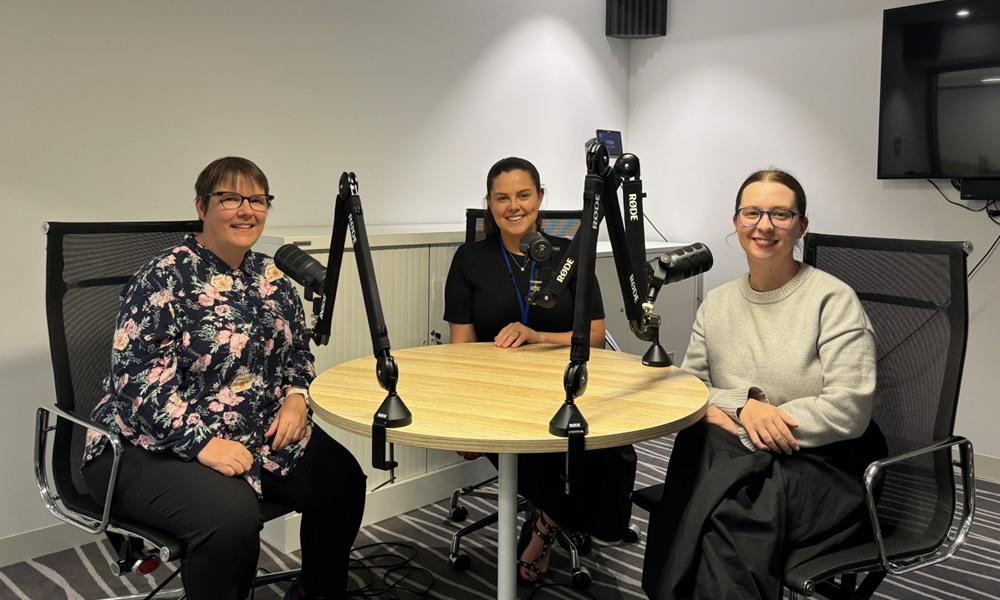
Jo Earp: Hello and thanks for joining us for this special podcast, I'm Jo Earp.
Rebecca Vukovic: I'm Rebecca Vukovic.
Dominique Russell: I'm Dominique Russell.
JE: It's a lovely one today because we've got the full Teacher team here, which is always really nice to do. And it's the end of another year – so 2025 is nearly done, which is amazing to think about. As usual then, with the podcast, we're going to do a special highlights episode. We're going to take a look back at some of our favourites. We've each picked out 3 episodes, and we'll have a chat about those. But we'll also have a bit of a chat about just how we put the podcast together and some other bits and pieces. If you are new to it, we've got a bunch of different series for everybody really. So, we've got School Improvement, we've got The Research Files, Global Education, we've got School Assembly…
RV: And Teacher Staffroom as well. So that's our one where we do our monthly round-up of some of our highlights. We've done some incredible things this year and we have really high hopes for next year as well. We started to experiment with video because we know that's what people want.
In fact, one of the episodes this year, the episode I did with Professor John Munro, we tried to video that as well and we had a bit of an experiment on how that will work and that's definitely something that we hope to bring you in 2026. I'll have a quick chat about my episode with John Munro actually while we're here. So, he's of course a teacher and a psychologist who has taught and researched gifted education and talent development for 4 decades. It's actually the second time that I've sat down and interviewed John in person. He's such a delight. For this episode, he visited our offices here in Melbourne and we had this wonderful discussion about leadership for the provision of gifted education. And this one was for our School Improvement podcast series.
In the episode, we discuss what it takes to develop a vision, putting together an action plan, upskilling teachers, and collaborating with the wider community. It was a really practical episode. John is just, he's so good at breaking down concepts into those clear, actionable steps. He's also got a really great voice. He's one of my favourite people to interview. So, I want to share a clip from the episode. The one that I've chosen, it's John discussing why it's important for schools to collaborate with families, parents and carers, as well as those other stakeholders in the school to really understand gifted students. He says that many students in fact show their giftedness outside of the classroom and it's their families that have that unique understanding of where their strengths lie. So, here's that clip from John.
One context in which students can show high-ability outcomes is in the classroom. The student can also show high level outcomes in a range of other contexts outside of the classroom. Now, we know that many famous scientists, many musicians, many sports people, many artists gained or first thought of what led to them being seen as talented while they were at school. James Watt, playing with his mother's kettle. A lot of students while at school have creative ideas that won't necessarily be seen in the classroom.
Parents and members of the community can see instances of gifted learning and outcomes that are high level, unique possibilities that the students’ teachers will never see – they won't see them in the classroom. Communication with the students’ family and with relevant community members who have interacted with the student is critical for putting together a total gifted learning profile. The information that comes from these sources can impact directly on how teachers go about differentiating and enriching the educational provision. It can lead to the school compiling a more comprehensive understanding of how the child learns.
DR: Yeah, that was a great choice of clip from that conversation Reb, it must have been really challenging to pick just one element of it. John is amazing. Gifted education is also something that comes up in our reader survey that we run every year, consistently. It's been something that people have requested more support on. They want us to do more content on gifted education and that's been the case for years now. So maybe we'll have to get John on for a third episode and unpack a different element.
RV: I'd love that.
JE: Yeah, John's fantastic. I agree. He's got a great voice for podcasts as well. He's so passionate. He's obviously like super knowledgeable as well. But it always strikes me he's so generous with his time and with his expertise. He's always like, ‘yeah, I'm willing to share this’. And I know he does a lot of sharing of his stuff as well through all kinds of different stuff, professional learning activities and so on. So, getting experts like John on the podcast is brilliant for Teacher obviously, and really good for the listeners out there. Another great thing about that one was, as you mentioned, you recorded it in person, which is lovely.
So, another one that we did in person this year is one that I did, and that's my first pick for these highlights. It's episode 63 of our series on School Improvement. So, I recorded this one in October, so fairly recently actually. I went to Sydney to do this one. It's Aspect Schools, which is a not-for-profit and they provide autism specific education programs globally, including schools and satellite classes in New South Wales and South Australia. So, Aspect have been working with Dr Lyn Sharratt since 2023 on something called the Aspect Learning Improvement Collaborative (or ALIC for short). And I went to a learning fair actually in Sydney where they all sort of, all the principals shared their achievements and reflections over the last 3 years. So basically, each school's been focusing on a different area of improvement, something that relates to their context. Really interesting episode this one because there are 5 guests on this one. So, it's one of the longer ones there – I think it's over 40 minutes. The clip I've chosen that I want to play today, it's Principal Joanne Tisdell. She's Principal of Aspect South East Sydney School. And here she is summing up the impact of ALIC in her own school.
What really stands out for me is that individualisation of teaching and learning. We have always been very person-centred in an Aspect school. What we didn't do was articulate the teaching and learning in really granular moments in time, so that we can be very specific about next steps. Next steps to the student via learning intentions and success criteria. Next steps to the parent so that we are sharing success. And, most importantly, for the teacher to have a very clear map within their programming of what they are doing. Where are we heading to? What next assessment are we using to inform instruction? That's been really critical to unpack across the school.
RV: That was a really interesting perspective and I loved actually hearing from all 5 guests because they offered something different. Of course, it was so nice to also hear from Dr Lyn Sharratt and revisit some of the work she's been doing with Learning Walks and Talks. She's incredible, isn't she, Jo?
JE: Yeah, when I went, like I said, I went to the Learning Fair and so she was there and the first thing she said was, ‘oh, say hi to Rebecca’, and she remembered that podcast recording, which is fantastic.
DR: From all those years ago.
RV: Yeah, in 2019, we did a Teacher Talks live podcast event with Dr Lyn Sharratt, where she explored her Learning Walks and Talks in a lot of detail. So, it's nice to know she remembered me.
DR: It's interesting. The thing that stuck out to me from that episode was from a different guest. Again, it was the principal that you had on, Michelle. She spoke about, there was this one line in the episode that really stuck with me, and she said, you know, ‘Shifting our focus on data not being a dirty word’ – so talking about the language there. And it’s ‘data is a celebration of the work that we do. It creates a space where staff feel that the data empowers them in the classroom rather than dragging them down’. I really loved that perspective from her.
And it reminded me a lot of one of my highlights that I chose for this year. It was a conversation that I had with another principal down in Tasmania, Chantel Barnes. She's the principal at Glenora District School in the rural town of Glenora, which is just outside Hobart in Tasmania. And she spoke to us about the work that they're doing as a school around attendance. And of course, attendance is such a crucial thing in a rural setting. It's challenging to get kids to school when they have so far to travel to get to the only school that's available to them. And she's been there for just on 12 months now and the work that they've done is incredible. The name of the episode is ‘Focusing on presence, not absence – flipping the script on attendance’. And so, as that title suggests, a lot of the work that they've done is actually around the language when it comes to attendance, focusing on presence, having a bit of a positive mindset towards it, not focusing on the shame that's around of not being able to come to school for some days.
So, she spoke to us about how a lot of the talk that she's heard over her decades of experience in education is around percentages and talking about the percentiles – you as a student are in the 70th percentile of attendance and what does that mean? The kids themselves don't understand it. Some of the teachers don't understand it. And she said that something clicked with her one year where she went, ‘why aren't we just talking about it in terms of the days that they're actually at school? And if they have 5 from 5 days, that's so much easier to comprehend.’ And so that is what ended up being her 5 from 5 initiative that she's implemented at the school. And she spoke all about that and all the different elements of that initiative.
She also discussed how they track and talk about attendance at all the different levels – so at the student (the individual student level), the family level as well (involving the whole school community here has been really crucial for them), the classroom level and then the whole school level. And so the clip that I wanted to share in this episode today is a really great summary of the different ways they're tracking attendance at those different levels and how they're also presenting the data at the school.
We track our data at 3 different levels, I guess: we track it at the whole school level; we then track it at classroom level; and then kids are tracking it at their own individual level as well. And that means we can kind of see the big picture trends, but we can also zoom in to individual students who might need that extra support. We share the data weekly with staff, families and students, and those attendance goal setting sheets go home to our families each term so that they can see. And that kind of builds the transparency and accountability and also, again, strengthens that language that everyone's on the same page. And like I said before, the data's up on the walls each day, each week, and you know, it's just become – I think that visual data story part is really, really powerful of seeing it and it's done in a really, really safe way.
JE: Yeah, I'm really glad you picked this episode, Dom. It's one of my favourites, too. I agree. I think it's a really easy switch to go from that sort of 70th percentile language, quite formal language, to just clearly explaining what it means. Just like how many days have you been, have you been every day this week? That kind of thing for students and families and for teachers as well. And then also the other thing I loved was Chantel goes on to speak about the impact of that. So, we know that every day counts. And then in this episode, she also speaks about the impact of that on, I think it's literacy, isn't it?
DR: Yes, they had a reading priority at the school.
JE: Yeah, and so the impact on that, which is cool.
RV: And it's interesting too. We've spoken about the fact that we interview people here at the office in person. Dom, you interview Chantel in Tasmania so obviously that happened via Teams. So we interview people from all over. The episode I'll tell you about now, this one was done with Dr Pauline Martinot. She's a medical doctor who specialises in child health and prevention. And she also works as an AI medical and scientific director at DoctorLib based in France.
So, I spoke to her late at night. We had this really, really interesting conversation. And I was just so thrilled to secure this interview with Pauline because she’d just published her groundbreaking study that points to the first year of school as the time and place where a maths gender gap emerges in favour of boys. The reason that this study was so exceptional was really the scale of it. So, it was a 4-year longitudinal assessment of language and mathematical performance of all French first and second graders, and it represented over 2.6 million children.
The finding that everyone seemed to be talking about was that the researchers found that boys and girls exhibited very similar math scores upon school entry, but a maths gender gap in favour of boys became highly significant after just 4 months of schooling and reached an effect size of about 0.20 after one year. So, in this episode, Pauline and I discuss how her colleagues went about conducting the study, some of the key findings, and the impact that this research has had on schools and teachers around the world. I wanted to share a clip now – it's Pauline talking about why the results were so surprising.
The sudden and rapid emergence of gender gaps in math in favour of boys was totally surprising because it doesn't really make sense in a cognitive and evolutionary approach that this change happens so fast. So, really surprising. And second, we notice that when children enter first grade, most of the children, boys and girls, have equal performances in math, except for very like higher income populations where boys already have a small and significant [advantage] in mathematics. And these results were found also in other countries when we did the literature review, we found that in like so many other places, which was really surprising. And second, all types of schools in France, both private and public, were touched equally on the gender gap, no matter which parental occupation children had, the gender gap grew so fast in favour of boys. No matter which school environment or geographical area in France, everyone was concerned with this gender gap. The only modification of the gender gap we found was related to, for example, the first of class in math. When we measured, when we compared classes where a girl was first of class in math was the best student, whereas classes where boys were first of the class in math – in the class where the girl was first in math, all the other girls of the class had a better performance in math compared to classes where the boy was a leader in math. So, the impact of the role model was really one of the points we discovered.
JE: I've got so much to say on this episode. This is just such a brilliant episode. I've got a lot to chip in. Before I do that, though, a reminder that our regular columnist, Professor Martin Westwell, our Teacher columnist, also wrote about this one. Yeah, I talked about sharing expertise earlier with John. And so, this paper was published in Nature, and it made such a splash, didn't it? It was everywhere. It's so interesting. It's a great interview with Pauline. I think it's really well done. Absolute must listen. Of course, one question that when I was re-listening to it, one question to come out of that is why is this happening?
Pauline explains that they weren’t able to measure that in this study because they needed a different type of control trial. But she does talk about a few things that are going on around fake information. So, among children, she was saying like, there's this fake information going around between children themselves that, ‘girls are bad at maths’, or ‘boys are more intelligent than girls’. And then the adults around these types of questions that they ask boys, so there's, so adults tend to ask boys things to do with logic and maths, science and exploration questions. They also set more competitive and challenging games for boys. And the other thing, fascinating, they allow boys to make more mistakes. So, they're really sort of more demanding with girls around not making mistakes. So that could be maybe why that higher anxiety also comes in for girls.
DR: Yeah, this was one episode this year that I immediately sent to all of my friends who are teachers, particularly teachers in the early years. I'm so glad that you were able to get an interview with her. It reminds me why a podcast series like this is so important and impactful because a study on the scale that this was – 2.6 million children – to be able to sit down with the lead researcher and hear in her own words what the study was, what it meant (in an easy to understand, really easily digestible way) is why it's just the perfect form format for a conversation like this. And I think if I had to maybe pick my favourite series of our podcast, of all the series that we do, I hate to pick my favourite, but I think it would be The Research Files.
JE: Research Files, yeah.
DR: I think it would be. Yeah. I really enjoyed our episode earlier this year where we, because of course we ticked over 100 episodes of The Research Files this year and we did a special episode for that occasion where we picked out our favourites of the series and that was probably the most challenging choice for me because I just have so many. I, of course, included an episode of The Research Files in my picks for 2025 and it was a somewhat recent episode that I did. Again, recorded it in person because the researcher was from Monash University, a local university for us here in Melbourne. It was with Ebony Melzak, who is a provisional psychologist and she's also a PhD candidate. And this episode was all about the research that she's done into factors that contribute to fostering a sense of belonging for early career teachers in schools. Really important topic.
She spoke to us all about how she conducted a scoping review of these factors. And I think off the top of my head, they found 41 different factors, so a huge range. But then they decided, well, that's a bit much for people to digest. They did a thematic analysis and 4 main themes emerged. So those 4 themes were things like teacher collaboration, relationships with colleagues, supporting early career teachers through their early career journey, and then also getting early career teachers involved in school decision making. She also, as part of the research, conducted a range of interviews with early career teachers because she'd spoken about the fact that context is key for all of them. They all have different experiences. So that was really interesting to hear about too.
We speak a lot about teacher retention at the magazine and I'm sure a lot of our listeners are aware of the factors that support retention for beginner teachers. And this conversation really, it touches on those factors that people may be already aware about, but it also offers a lot of practical research informed advice down to really small things like having… I remember Ebony in the conversation, she mentioned that having consistent locations for shared materials like a glue stick is actually really important to foster that sense of belonging for an early career teacher. And then another part of the conversation as well was about the importance of mentorship and induction, which we know is really important. I mean, the most recent TALIS results that came out, mentoring and induction were a key part of those results too. What I want to come back to though is the finding on involvement in decision making. I think part of the episode in a clip that I'll play just now is really practical and I think it's something that people can take away and think about in their own school context. And Ebony just puts it brilliantly. So, let's listen to that clip now.
Yeah, this one was interesting because it wasn't something I was expecting coming into it. It's not any one type of decision-making. Again, it can be very, very specific to the school and to the early career teacher. But I think it's just about having the opportunity to get involved if they want to. Not all early career teachers will want to, and that's OK as well, but I think early career teachers described not having that opportunity and feeling shunned to the side and not even being invited to contribute their ideas. So, recognising instead that early career teachers are an asset to the school. They have those fresh, innovative ideas, and allowing them to get involved in decisions around what's the best modification we can give the student? Or, you know, we need to develop a new curriculum, can we invite an early career teacher to that brainstorming meeting so that they can give some ideas? It doesn't have to always be decision making. It can be events as well. So, if the early career teacher wants to do lunch duty or sports day, you know, this is extra work, but it's actually really validating for early career teachers to go, ‘Oh, I was actually asked’, you know, ‘the school wants me’ and ‘the school thinks I'm an important member of the team’.
JE: Yeah, another great clip. These episodes are great because there's always lots of those, like you said, Dom, lots of practical tips that come out of them for listeners. And yeah, often what we'll do, obviously we have an idea, a rough idea of where the conversation is going to go. So, we'll speak to the interviewee or interviewees beforehand and, obviously there's a bit of prep that goes into that, into the podcast recordings. But then sometimes I find it's those little incidental conversations or asides or, a particular answer will lead you down a bit of a rabbit hole and you end up having this chat about something else you didn't even think about.
And yeah, and you get those extra little tips. I agree. I think there's this section where Ebony talks about those little things. Like you say, so consistent locations, where to find materials. And she's saying, yeah, like early career teachers shouldn't be stressing about those small things. So instead of like, spending your time hunting down where something is, you should be spending your time on the really important things. She also talks about genuine check-ins from leaders which I loved. So not just something that you say, ‘oh how are you going?’ But, actually, actioning any concerns or really listening to what the teacher's saying. So yeah, I love this episode too.
RV: There was so much for everyone to get out of it. Ebony was really good at, she actually spoke about a lot of those key themes that people have said they want more support on from our reader survey, those things like teacher collaboration, relationships with colleagues, and of course that mentoring and induction that you spoke about earlier, Dom. She really was just so fantastic. And speaking of fantastic, the person I want to talk about now is Brett Dascombe from Wavell State High School in Brisbane. I did a podcast special episode with him because he was named a top 10 finalist for the Global Teacher Prize this year. So, if you're unfamiliar with the Global Teacher Prize, it's presented each year to an outstanding teacher from around the world. They win $1,000,000 in prize money and I think that's what makes it so unique.
Brett is a senior geography teacher with 23 years of experience doing really some incredible work in his school. He introduces his students to those real-world, project-based learning experiences by embedding things like geospatial technologies, he also uses drones and remote sensing data, and he embeds them in his geography curriculum. He's also one of those teachers who's really keen to share his expertise with the wider community. So, he participates in things like professional learning and training with other schools.
Brett was just one of those people who was meant to be a teacher. You know those people that you meet and you're like, you're doing exactly what you should be doing. He's passionate about the profession. He was enthusiastic, obviously an expert in his subject, but also that really curious, all-round great guy. We did the interview almost a year ago now, but there are still some things that he said that have stuck with me. In particular, I remember talking about how he engages students in those project-based, real-world learning experiences, like the time they visited Cylinder Beach in Queensland and discovered that the E. coli levels were probably 400 times the amount that should be there. He was explaining that by having students participate in these kind of real-world learning experience, issues with behaviour or student engagement are almost non-existent in his classroom. So, here's a clip of him talking about this and some of the other strategies that he uses to engage his students.
Behaviour problems aren't really a reality in my classroom, … I'm not a believer of the ‘don't smile until Easter philosophy’, mine's like, they're already talking about me, so I started up by saying, ‘look, no homework and no high stakes exams in my first term’. And that just, ‘oh, OK’, the change-up. So, I'm always looking to change my classroom practice as well and improve my classroom practice. I read over the holidays, I was reading some Ron Ritchhart and some Yong Zhao, and I'm now getting them to call me ‘Brett’. First time I've ever done that, and they think it's hilarious. They're having a great time with it. But you know, I call them by their first name. So why? And it just creates that connection to the students as well.
DR: I had the biggest grin on my face listening to that clip. He sounds like such a joy to interview. There was another part of that conversation as well, like you spoke about his work with students and student engagement and everything. And then he also, part of that conversation that I really liked was talking about his work with other colleagues and also really highlighting and respecting the different perspectives that his colleagues bring. And there was one element of the conversation where he spoke about nominating a colleague of his for another teaching award. And part of what he said was around how it's really important that young teachers see that there's a different way of doing things in the classroom and it's not wrong, it's not right, it's just what fits with you and your teaching style and how you do things. And I thought that was another great quote from him.
JE: Yeah, also the integration of technology. So, we sometimes hear from teachers about, yeah, I want to use technology in my classroom, but I'm not quite sure how to go about it. And Brett talks in the episode about empowering the students. And he was saying that they do the unboxing and the setting up for the new tech. And he said, ‘oh, you know, if I did it, it'd take me absolutely ages, but they do it pretty quickly’. And he says, ‘so they're the experts in my classroom and it's wonderful to see, you see their personalities in your work’, which I thought was really cool as well. So yeah, great tip from Brett. So yeah, so really sharing that expertise through the podcast, the teacher expertise is something that we love to do.
I'm going to move on to a School Improvement episode then where we did just that – we shared that expertise from teachers. So, this is episode 59 of the School Improvement series and I did this one in June. So, this is another one that I did in person, which is always great. It's at Fairhills High School in Melbourne, and it's about careers and pathways education. Interesting thing about this one, which we also do often with podcasts, is it came out of an OECD report about the state of global teenage career preparation. So we'd already done an article on this report, on the OECD report, and we thought, it would be really good to try and find an example of somebody doing it really well in Australia – careers and pathways education. And it was actually a recommendation from a colleague here at ACER.
So, Fairhills are doing some great work in this area. I spoke to Bill Exton, who's the Assistant Principal of the Senior School and Liz Rundle, Careers and Pathways Manager. So, loads and loads of interesting stuff in this one as well. Lots of different programs that are happening at the school; there's different types of resources they've got on offer and support. We're going to hear from Liz Rundle now responding to a question from me about the OECD report. So in that report, Andreas Schleicher, who's obviously Director of Education and Skills for the OECD and is a Teacher columnist, he talks about how there's a mismatch between and what students want and the pathways that they're choosing. So, this is Liz speaking about that.
One of the real strengths I think of the school is the fact that every pathway is valued equally. And when we have those conversations, those individual conversations with students – you know 9,10 and 11 and 12 then obviously when they're transitioning into the community – it's about what's going to best suit you in terms of your learning style, in terms of your end goals, and what are going to be the steps that you need to take to get there. … So, they don't know what they don't know, and it is about trying to make sure that they realise that picking the right education pathway is going to make them more successful.
DR: Yeah, that was a great episode. And like you say, Jo, it was really, it's got such impact when we can take a global report, a huge report from the OECD, and be able to get that on the ground perspective of what it looks like for one school here in Australia, to be able to understand the topic a bit more and get to know what the on-the-ground experiences of schools here is like.
It actually leads quite nicely into one of my other picks because that was a similar kind of setup for this podcast that I want to share is that you, Jo, did an article with a senior lecturer and researcher in Indigenous Knowledges at Charles Darwin University. Her name's Dr Tracy Woodroffe. You spoke with her about her research into getting more First Nations teachers into schools and I remember you telling me about the interview that you did with her for the article and how amazing Tracy was and how much information and knowledge she had to share. So we thought we need to get her on the podcast and talk about this in much greater depth.
So that's what we did. It was another episode of The Research Files. And like I say, Tracy spoke to us about her research project, which was all about understanding the perspectives of students and also the perspectives of First Nations teachers in the Northern Territory about what would make them consider a career in teaching. And so, to do this research, she surveyed both Aboriginal students and also teachers, like I say, to gather their insights and inform some recommendations for what could work for getting more Aboriginal students to consider a career in teaching. And particularly in the context of the Northern Territory where this research was conducted, it's crucial to have Aboriginal teachers in the classroom because Tracy had told us in the episode that roughly 40% of all students in the Northern Territory are Aboriginal. So, the research really aimed to get to the crux of why they would want to go into teaching or why they wouldn't.
And what I found really fascinating from the conversation – and something that I wanted to highlight in this episode today – was actually the teacher perspective. She said that some of the teachers in the survey told her that they were talking about the positive message that they try to give to students about being a teacher and that that's great, but that it's also important to discuss the challenges that Aboriginal people might face in the education system and the path to becoming a teacher. Because if you're giving them this information, it can empower the students and better prepare them and better help them understand what a career in teaching would look like.
And alongside that, I also found it fascinating when she shared that from the student surveys, they had, a lot of them had mentioned that they wanted to be a teacher, they were interested in it, but they were really worried at the same time about, for example, teaching students who had poor behaviour in the classroom. And so, she said there's a real opportunity there to kind of more thoughtfully and proactively share information with students about what the path to becoming a teacher looks like. If you do go to university to study to become a teacher, they will support you with behaviour management skills. When you're on your pracs as part of the course, you will meet teachers who will support you with this element of teaching and that again helps to empower them. So, the clip that I wanted to share with you here is telling you a little bit more about the student perspectives, because that is obviously a really important part of the conversation too. And I think of course, Tracy puts it best herself, so let's hear from her.
So, it was really, really important to get the student perspective because past projects haven't really focused on that. So that's an innovation in our project, to actually understand student voice and student perspective about their aspirations to do with teaching. So, out of the students we surveyed, one third said they wanted to be teachers, which is fantastic. And they had so many positive things to say about why, but mostly it was because they've had a great experience at school. They've been encouraged by fantastic teachers, or they've been enthused about particular aspects of the curriculum. You know, there was this fantastic comment about biology and marine biology and how a teacher had really enthused this student to the degree where they so much wanted to go on and be able to understand about this particular topic. And, you know, some other students said they'd already begun because they were doing VET in School subjects that could connect them with education and they could go through into a teaching pathway, which was wonderful because we don't know enough about that. That actual data isn't collected by universities. So, it's interesting to see how students have already started thinking about how they want to continue their culture. They want to follow in the footsteps of their Elders. Lots of fantastic positive comments.
JE: Yeah, I've found that a really interesting point about that innovation of getting the students' perspective. Because I just thought, of course, with that voice in there, it presents such a rich set of findings that then you can take those, it can inform those professional conversations and policy makers, those reflections that you've got, conversations among teachers themselves. And, without that student perspective of what's going on, what they're thinking, you're kind of just guessing really, aren't you? So, yeah, great interview, Dom, lovely episode. And yeah, just listening back to Tracy there, you're right, she puts it best herself. And again, it's a bit like Brett, isn't it? And all the people that we've highlighted and all the people that we interview, it's why it’s such a fantastic format because actually hearing from somebody is so good, to hear it in their own words. There's always something that you take out of that that's a little bit special. So, it was nice to go back and listen to that again, prepping for this highlights chat.
I'm going to finish off the episode then with somebody who also encapsulates that, I loved speaking to him. It's actually over the course of 12 months. So, this is for our School Assembly series, which is the one where we follow a leader of a new school and we talk about, we catch up each month and we talk about those different things that go into leading a new school. Series 3 is with Dan McShea. He's Foundation Principal of Notre Dame P-12 College in Bells Creek, which is on Queensland's Sunshine Coast. Of course, we've had series one and 2 as well, so I loved catching up with all the School Assembly leaders. So, a reminder, we had Dr Ray Boyd and Rachel Lehr from Series 1 over at Dayton Primary in WA and Jo Camozzato at Bemin Secondary in Victoria. It's a great set of podcasts if you're just on that leadership journey to being a principal or in fact if you're about to embark on that same task of starting a new school. So, here's Dan McShea then, Series 3 principal. It's the final episode. Here he is with some advice for other leaders about to start that process of building a new school.
If you’d like to come and have a chat, come and visit us. We’d love to see you or hear from you. But build a strong community from the start. Get to know your parents and your community. Have some fun with it. Try the one-percenters, the different ideas. Recruit hard. Recruit hard, and if you don’t see exactly what you want, re-advertise and I would say recruit for potential, recruit for energy and enthusiasm and collaboration and adaptability. Be prepared for the challenges, you’re going to have them. If it was easy, everyone would do it, I guess. But stay flexible in your approach and have the confidence that it’ll all work out. And, yeah, look, don’t underestimate the importance of really clear communication and collaboration with your staff.
RV: It's such an incredible series, Jo, so well done for putting that one together. I think that's it from us. So, thank you to those listening and for you, Jo and Dom, for sharing your picks. I've so enjoyed catching up on the highlights. It's been an incredible year. As always, the transcript for this episode will be in the usual place over at our website, teachermagazine.com. But from the team here at Teacher, we hope that you, the listeners, have a wonderful, restful, well-deserved holiday break. We can't wait to do it all again next year in 2026.
JE: Yeah, have a good break everybody. Thank you for your support this year.
DR: Thanks for listening.
Do you have a favourite podcast episode for 2025? We’d love to hear from you. Comment below your favourite episode or tell us how you’ve used the podcast to improve your practice in the classroom.