Hello, Teacher editor Jo Earp here and I'll be your host. But before we get into this episode, a reminder to take a quick moment to hit the follow button on your podcast app and make sure you stay up to date with the latest content. And please leave a review – it helps people like you to find the podcast and it's a big support for the Teacher team.
Hello and welcome to this podcast exclusive from Teacher magazine, the resource for K-12 educators published by ACER, the Australian Council for Educational Research. I'm Jo Earp and as we head into December, I've got a real festive treat for you. My guest for this special episode is Dr Kristina Kallas, Minister of Education and Research for Estonia. Nestled in Northern Europe with Finland to the north, Sweden just across to the west and then bordering Latvia to the south and Russia to the east, it's a country of just over a million people but it's a real education leader. We're going to be talking about the foundations for that impressive performance and the elements that are setting teachers and students up for success. Estonia is known for really being ahead of the curve, if you like, in terms of integrating technology (and developing student skills in this area, of course). So, we'll be chatting about that and the next big challenge – AI in education. Estonia's national AI Leap program was launched in August, and it'll spring into action in January. This is such an interesting discussion. I hope you enjoy it as much as I did!
Jo Earp: Dr Kristina Kallas, welcome to Teacher magazine. I'm really looking forward to hearing more about what's happening in Estonian education, and your take on AI in particular; I think it's something that all countries, all education systems, are grappling with. Before we go into that though, we talk a lot at Teacher about the positive impact of teachers – that they can have on society, on students' lives. I'm interested in the impact that maybe a teacher, or teachers, had on you when you were growing up, going through that school period.
Kristina Kallas: Oh, thank you first for having me on this podcast. It's a very big honour to talk about my country. Every opportunity I have, I take up this opportunity. Regarding my own experience with my teachers, it's a little bit of a story of positive emotions and not so good emotions because I grew up actually in the Soviet Union. I was 15 when the Soviet Union collapsed, but by that time I was already graduating primary school and lower secondary, I was going to upper secondary. And during the Soviet time we had an education system where there were things that were allowed to be said and things that were not allowed to be said. So, there was no free thinking, there was no dialogue, there was no discussion with teachers about things. You had to memorise things and just repeat what you have memorised, and if you made a mistake, you were punished. And if you dared to venture out of what is allowed, you could be punished quite severely. So, it was a full control society. And in this society, in this kind of schooling, you had teachers who were following just a communist ideological doctrine and really being very ideological. But then you had teachers who, despite that it might have cost them their job and despite that there could be very severe consequences, they still did debate, discussion, they encouraged us to think differently, they encouraged us to actually question lots of things that were there in a society. And I remember those teachers.
And one of those teachers was my teacher of Literature. So, she was also a teacher who taught my father – I went to the same school as my father did – and she used Literature to debate really certain aspects of the communist society that otherwise would not be allowed to [be talked] about at all. She didn't bring us prohibited literature. Because, in the Soviet Union you had a list of literature that you were not allowed to read – I know from your look that sounds crazy, but we had a list of prohibited books, and that's not what she did. But she used books that were not prohibited, and we were reading them, and then the debate she provoked in the classroom was very much kind of questioning everything that was actually in that literature, that you learn to question this. And I remember her. She will be celebrating her 90th birthday, actually, next summer. And I'm now in a team of journalists cooperating, we are preparing, publishing a book about her life because she was really remarkable, she is a very remarkable person.
So, in this sense, I know from firsthand the difference between the teacher who just, how to say, who just follows the instructions and does not add much into your personal growth, or even sometimes inhibits that personal growth, and the teacher who forces and pushes you to think and go into the much more heavier cognitive capacity to analyse, to debate, to systematise information in your head, and to question things that you are provided, and don't take those things for granted automatically.
JE: Yeah, that's a great story. As I mentioned in the intro then, you're Minister of Education and Research of Estonia. You've been in that role since 2023. I know you mentioned there you love the opportunity to talk about your country and what's happening there. And you've been speaking to the community today – we're actually in Brunswick recording this at Estonia House, so you might hear a little bit of the trams in the background. As I say, Estonia is a small country, the population is very spread out, isn't it? Can you give listeners an idea, a sort of brief overview of the context in terms of number of schools, students and teachers. I know the vast majority are municipal public schools as well, are they?
KK: Yes, so we are the country of 1.3 million. Out of this, 300,000 are actually Russians, ethnic Russians, which is our minority. So, Estonian speakers are 1 million and 300,000 are Russian speakers. The biggest city, our capital, Tallinn, has only 450,000 residents – so we are very tiny, very tiny! We have 510 schools across the country. Some of them are very, very small because we have 1,500 islands and out of those 1,500 islands, 15 islands are populated, inhabited, and we have schools on those islands. And in some of the schools, you might have one or 2 students attending.
So, Estonian schools are public schools. They are run by the municipalities, which is local governments. About 6% of our upper secondary schools are actually state-run schools, they are run by the Ministry, by my Ministry. And then we have around 11% of the schools that are private schools. But private schools in Estonia are dominantly, actually, religious congregation schools run by free, dominant confessions that we have in Estonia, which is the most dominant being Lutheran, Protestant, then we have Catholic, and then we have Orthodox schools. And then we have one Jewish school, private school. We have one private Finnish school for the minority Finnish speaking population. And then we have some international schools that operate in English.
JE: So, I was thinking, I think most teachers and school leaders out there that are listening to this, I think when we say Estonia education they'll be thinking of a few things. So, digital technology, definitely, I think that comes up, but also that great performance in PISA, (which is the Programme for International Student Assessment). Now, that's a measure of student achievement at 15 years of age. That just doesn't happen, that they get to 15 and ‘hey, they're doing well at 15’. There are clearly great foundations there, and that always goes back to early years education. Tell me a little bit about what that looks like in Estonia.
KK: Yes, I have been asked in the international arena so many times, ‘so, what is it specific about your education system that your 15-year-olds are performing so well in PISA?’ And I always have to tell them that's not only about the education system. So, if you only focus on the years that they are in school and what you do with them in school, then you are missing a big part of Estonia's success story. Estonian kids go to school very late compared to Australia, or many other countries in the world. They start compulsory schooling at the age of 7, so by the age of 15 when they are all sitting globally doing the PISA tests, by that age of 15, Estonian kids have been 2 years less in school than Australian kids, however, they are performing very well. So, it's not about the school only, it's so much what you do with them before they actually come to the compulsory schooling.
So, in Estonia, early childhood education is something that we are extremely proud of because we think that that's what is the foundation of our PISA success – early childhood education. Children go to kindergarten in Estonia at the age of one-and-a-half. They have a full day, kindergarten is a full day, it's 5 days a week, from Monday to Friday, from 7.30 in the morning till 6 in the evening. It's a full day program. They are all educational institutions – they are part of the education system, they have curricula, they have teachers. The teachers who work in kindergarten they have to have a bachelor degree in pedagogy.
And so, this is where we work with kids. And the focus of our preschool curricula in education is to develop the children's social-emotional skills and self-regulating skills, basically social regulation, capacity to focus, the skills to work in teams, the ability to manage your day on your own. I think that's something that has always sparked very big interest, especially in the Anglo-Saxon world, because that's so normal in the Nordics, in Scandinavia, and in Estonia, that by the age of 6 or 7, the child has to be capable of managing his or her day completely fully on his or her alone. So, from the morning till the evening, the kid has to be capable of handling. So that's something that we focus on in kindergarten quite a lot, to make kids ready for actually the academic learning. So, the academic learning does not start very early, it starts at the age of 7. But before that, the pedagogical focus is on the social, emotional and self-regulatory skills in our curriculum.
JE: And I think that's something maybe that's not fully appreciated. I think sometimes people maybe underestimate that early years kind of equity piece that you have in Estonia of getting off to a strong start. And like you say, they don't start formal schooling until 7, but it's not like there's nothing happening there. And they are expert teachers there. So, I think that's really setting them up for success. You gave a public lecture here in Melbourne at RMIT earlier this week. And one of the comments that you made there (and you've just mentioned there), is, you know, it's a high performer in PISA, 1st in growth mindset, 1st in Europe in creative thinking, leading Europe right up there with Singapore, Korea in the core domains. But yes, indeed, 15-year-olds will usually have been at school one or 2 years less. So, it really is that strong start. I think there's something like 96% attendance for early childhood, so there's huge buy-in there. At the other end of the school age range there, there have been some recent reforms as well, I understand. Compulsory education is now until 18 in Estonia?
KK: Yes, this is one of the reforms we did in the past 2 years, we have been pushing through in education. We used to have compulsory education until the age of 16. So, when they graduate lower secondary, lower secondary was the last level that they had to go through and then they could just quit the education system. And what we have seen in Estonia, the biggest challenge for us was that approximately 10% of the boys, they quit lower secondary and they never progressed any further, so they stayed with a lower secondary education. Some of them did odd jobs, and the labour market situation throughout life has been, for them, very vulnerable, precarious jobs. But, when you are age 40 or 50, your retraining capacity is already limited because your basic education remained only on the level of lower secondary. And then, as a result, what we saw in Estonia was a big gender inequality in education in favour of girls. So, women were getting more higher and higher education levels. So, when you reached the Masters programs at the universities, you would have 70% girls and 30% boys. And the boys were just dropping out every next step in education.
And so, we saw this really as a problem. We’ve got lower life expectancy in men. We have lower expectancy of healthy living, life expectancy in men, high cost for the public health care system and social system of men. So, this gender problem was really significant. And also, you have higher crime rates among men and things like that. So, what we decided was that we need to not so much deal with crime or health issues at the age of 40 and 50, because that's dealing with the consequences. So, we looked at where the problem actually starts, and the problem starts at school and the way that boys are dropping out of the school.
And so, we made a decision that the minimum education level that we are requiring from this year onwards is either vocational certificates or upper secondary. So, everybody has to continue after the age of 16, either to vocational training or they have to continue to upper secondary until they are 18. In Estonia, upper secondary usually goes until they're 19. But by the law, if somebody is already an adult at the age of 18, we can't make it compulsory any longer. But we, of course, hope that they will continue until the end of the upper secondary. So, this is a story of extending the compulsory schooling age. Our neighbours, Finland, did it 5 years ago for exactly the same reasons; they also had the problem with boys dropping out of the education system. And this has been successful in Finland – so, we have seen the uptake of education by boys because basically the education system has to adjust and accommodate to train them longer. And so, from this year, everybody who is in the 9th grade in Estonia this academic year has to continue. They finish 9th grade in the end of May, next year, and then in September, when the new school year starts, they have to continue [to either the] vocational or upper secondary strand.
JE: It’ll be interesting to see, like you say, the impact of that. Of course, it's a very difficult and complex job being a teacher, as we know. I did a podcast series with Professor Geoff Masters on his study into world-class learning systems and Estonia was one of 5 jurisdictions that he looked at with that. And one of the things that he highlighted was supporting students who are falling behind but recognising that really early on. Tell me a bit about that approach to differentiation of teaching instruction in the classroom and very much integration instead of segregation, separation.
KK: Yes. So, we have this equity-based system, and we very much hold on to this, that everybody has to have an equal opportunity in the education system. But that means that we have to pay extremely special attention to children that: a) are coming from maybe weaker socioeconomic background and have less resources at home that would help them; b) immigrant children who have less resources in general, language resources, cultural resources; and then we have to pay special attention to children with maybe cognitive and learning difficulties, especially at the younger age, because the sooner you pay attention to those difficulties the better the skill development it is for children.
So that, and in those 3 areas that I just mentioned, kindergarten or the early childhood is fundamental – you need to get those kids into early childhood education. And in the early childhood education, we have, our teachers are trained to pay attention to socioeconomic backgrounds, to cultural, linguistic aspects, and to the learning and cognitive challenges that children have. Kindergartens have specialists. Every kindergarten has to provide what we call a ‘social pedagogue’, a special support service person, and the psychologists who all look at the developmental cognitive issues, linguistic issues of the children and help and work with teachers in the class, how to work with those specific children in order to level them up by the schooling.
So, what I'm trying to say is that by the time everybody reaches the school and starts academic learning, this big work with kids is done already in kindergarten so that they are more or less levelled up by the age of 7. And once they start academic learning, they have much more equal footing on that. Because children come from very, very different homes and very different life experiences, and if you don't have a prior academic institution or learning institutions working with them, and they just for the first time start learning at school, the kids with strong socioeconomic background, the kids from local historical communities, not immigrants, they are fast forwarding in year 1 in school very fast and the other kids are really struggling. And the gap, the academic gap, already starts widening in year 1. And that will continue throughout the whole schooling. And that's why it's very essential to prepare kids for schooling equally before they actually start academic learning.
And then once they start academic learning, we don't differentiate between the kids that are progressing very well and kids that are not progressing so well. They all study in the same class, in the same group. We don't differentiate them until they are 16. So, from the age of 7 to 16 they all study together, no matter how smart somebody looks like or performs and how difficult it is to somebody else to do the math. Because we believe that if you put a very smart kid in math, who is progressing very fast in math, and the kid who is not progressing that fast in math, if you teach them together there is a mutual learning that is happening in the classroom. So, our teachers are encouraged to not differentiate, not to segregate fast learning kids into a separate group and segregate the other kids into another group but teach them together.
Yes, there is one kind of maybe I would say not so positive outcome of this. We have debated that in the Estonian system quite a lot. It is that very, very talented children get too little attention in our education system because teachers are paying a lot of attention in levelling up. So, levelling up is something that teachers have to work very hard on, and that's the main goal that they need to achieve. So, if you look, for example, at Estonia's PISA results. You know, there are 6 levels in PISA, from level 2 to level 6. If you start doing your math test in PISA, you know, you do level 2, and then when you finish level 2, you go to level 3, and that's, you go up to level 6. Level 6 is the extremely talented, very, very smart kids in math and level 2 are the ones that are basic level. So, Estonian success in PISA does not mean that we have extremely high number of kids doing level 6. No, we don't. If we look at compared to us to Singapore, or even Netherlands, or even Australia, we have much less kids proportionally in level 6 – but we have very few kids below level 2 (so, those kids who don't make it to the basic level). And in some of the countries, for example, in Europe, they have lots of kids performing in level 6, but 30% of the kids not reaching level 2; so 30% of the kids failing completely, and most of those kids are immigrant background or with learning difficulties. An Estonian education system is levelling them up, which means that most kids in our PISA cluster around level 4 and 5, some of them in level 3, but 4/5 is the biggest cluster of the results.
So, our education system is, we have even a saying in Estonian, in our Estonian language, that ‘we are proud to be average’. It sounds, I know to the English, maybe that sounds weird to you. How can you be proud to be average? But this is what we really take pride in, that our goal is that everybody, absolutely everybody has to reach this average level. And some talented kids indeed might not get enough attention in our education system because of that.
JE: There's so much to talk about and I do want to make sure we talk about technology next and AI. Estonia is really seen as a leader (and an early adopter) in terms of tech in schools. At the lecture, I was interested to hear that it's not just about preparing for the future workforce, but actually it was kind of like out of necessity. It's kind of a non-negotiable because all the government services are online, which I found fascinating. The Tiger Leap transformation that you had, the digital transformation, that was in 1997, and you were saying, you know, in the lecture – so, you had this kind of like strong, happy, resilient system, saw everybody through COVID and then bam, 2022, here comes AI. I was really interested in the point that you made about fear – that the fear isn't about AI itself, it's about not doing anything, not acting.
KK: Yes, what is driving us to integrate AI into the learning process in schools, it's fear. We are afraid that by doing nothing, our kids use AI the way in the learning that they will replace their own learning with AI learning. They will do what we call cognitive offloading of cognitive development. And that we might see this generation now, who has AI in their pockets, in their phones, that this generation will be de-skilling. There will be much lower cognitive capacity in memory, in understanding, in knowledge, in generating texts, in comprehending complex problems, that there will be much less capacity to do that because they will delegate this to AI. And that is the fear that is driving us to do something in the education system so that this risk would not happen.
So, we gathered together developmental psychologists, actually neuroscientists, the ones that are working with the human brain, techno experts, the people who work with technologies, and education specialists, the ones that deal with educational didactics, methodology, teaching in general. And we have an AI Council, which consists of those scientists and some of the tech company leaders. And this AI Council developed a strategy, an AI strategy for schools, and the focus of that strategy is enhancing actually cognitive growth of our next generation – so, the learning and teaching in schools by integrating AI into the process so that it forces kids and students to think deeper, to be problem solvers, to have much more complex analytical thinking skills, to develop understanding of big systems, dismantling the information into pieces and then collecting it together again and understanding what depends on what and why is this information bit here and where should be the other information bit…
So, these are the skills that we want to focus on in school, and we are now experimenting by bringing AI into that kind of lessons to force us to do this. Not to make us do less in thinking, but to make us to think more, deeper, more complex. We don't know how that will come out because we are starting with the students in January. But we have a true fear that if we don't do anything, it's actually going to be worse. So that's why.
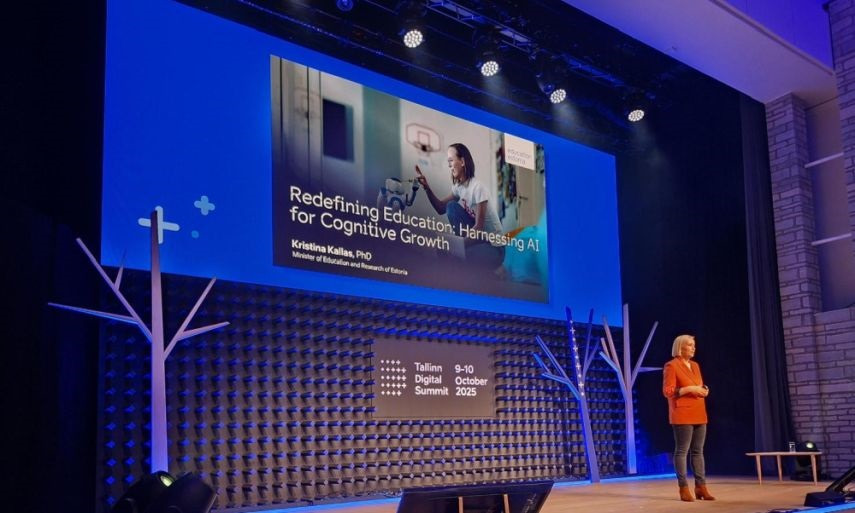
JE: Yeah. So far from that, AI being the risk to cognitive offload, you're actually taking the view that not to do anything, that's the big risk to cognitive offload and actually changing that teacher practice, working with AI to focus on those Higher Order Thinking Skills – so if you think about that Bloom's taxonomy, if you're out there listening and you can see that pyramid, those Higher Order Thinking Skills of creating, evaluating and analysing. You're working with OpenAI and Google on that I think, so it's like a public-private partnership model. There was a Q&A at the lecture, and you were asked something along the lines of, you know, you've developed this version of ChatGPT (which you called a Socratic version), and somebody said, well, ‘aren't you worried that the kids are still using the normal version?’ And you said, well, of course we can't control everything, but we're afraid to sit and wait. You said, ‘students are using it anyway, and they're not using it for the purposes of deep thinking’ which I thought was a great point!
KK: Yes, I have seen it, how my own kids are using it, and I have seen how myself I have been using it. I have been using it for the cognitive offloading, but I have been also using it for deeper thinking. I bring an example maybe to our listeners. As a Minister, I have to do a lot of public speaking, a lot of speeches – sometimes it's 5, 6 speeches per week, sometimes it's 3 speeches per day – and each of those speech occasions are different. So, I have been using AI to provoke me in thinking what kind of messages I want to get across to the audience that I need to speak to. So, I describe the audience, I describe the environment, I describe the purpose of my speech, and then I ask AI to produce the speech. Quite often AI is producing still very general text. And then I need to think, okay, that's still too broad and too general. I need to get more details in some of the aspects. And then I have to think myself that in the whole framework that AI is proposing to me, what I need to take out of this framework as a focus or critical points that I need to elaborate further in my speech. And then with an AI, together, we are elaborating some of the aspects of that speech into more critical, deeper elements. So that's how I've been using and working with AI.
And I had one funny occasion with the Socratic AI, the ChatGPT that we're using in schools, or will be using in schools, because it's master prompted not to please you automatically and give you all the answers, it's master prompted by returning to you with questions, you know, forcing you again, more and more questions, you have to put more and more questions in return. So, it's like a Socratic dialogue between AI and a student. And, at some point, I had 2 inaugurations of 2 rectors of the university on the same day and it was 10pm in the evening the previous day and I had no speeches and I said, okay, I have to start writing speeches. So, I went to this ChatGPT and tell him that please write me a speech to the inauguration of that and that university rector as if you were the Minister of Education of Estonia. And then he replied to me saying that I'm not going to write to you this speech because I'm not the Minister of Education of Estonia! So, would you like me to help you to get some ideas for that speech? I said, okay, yes, please give me some ideas for that speech. He said, what is it that you want to talk to about? What are the critical aspects of Estonian higher education or that university that you want to talk to about? So that's how we went into dialogue with an AI. And it really just, it basically helped me to think and prepare my thoughts for the speech. You don't have to do it alone, but you use another sort of another brain to pick your brain so that you could go ahead and, okay, that's actually a good idea to put that into speech. And then from that, I could elaborate that. So that was very helpful. And it forced me to do deeper thinking for that speech.
JE: Did you say, ‘I am the Minister of Education and I'm asking you to!’ No… So, yeah, the important thing to say is that teachers, you're preparing teachers really in advance for this. It's not just throwing them in at the deep end. Again, we know that with technology, it's what you do with it. So, you could have a fancy new whiteboard, if you're just using it the same as a blackboard well, you know, why are we using the technology? But … so the teachers have been through a lot of training here. And, as you say, that will be introduced next year, won't it? So, you're really setting them up for success with it too, aren't you?
KK: Yes. So, the first thing we did in this AI Leap program was to train teachers. Starting from August, teachers have been part of the teacher training program. They do it regularly. They had the first 2 days of online lectures on AI. What is AI? How does it impact human learning? How does it impact different aspects of environment, ethical questions, biases? So, they went through the fundamentals of AI, and then now they are in these teaching and learning communities across Estonia. Usually these communities are in the, if the school is big enough, all the teachers in the school form this learning community. In some of the smaller schools, they form the learning community in the local municipality of all the schools together.
So, now until January, teachers are just doing basically either weekly or bi-weekly learning community exercises with an AI. And then in January, we sort of do the mid-term review of how the teachers have been using AI so far. And then from January, I think the kids, the students, will receive the licenses. We did also extensive training of the school principals, actually. Not only the teachers, but the school principals. And yeah, that's how we are progressing.
I think in every aspect of education, you have to first focus on teacher competencies. If you provide teachers with competencies, you provide the basic person, the most professional person there to teach the kid with a competency. So basically, I would say that it's not that we trust AI, we trust our teachers. That's the thing, you have to trust your teachers.
JE: That's a great message. Now, your title is Minister for Education and Research – so I love that prominence of research in there too, which is great! I know that you'll be continuing to monitor this as you go along, like you say, with the neuroscientists and the researchers. And it's the beginning of that journey. It's been fascinating to talk to you today. The message from you to other nations while you've been here in Melbourne has been, ‘we don't have all the answers (you said that again today), we invite the world to come and learn with us’. We'd love to share more of that journey that you're on in Estonia in Teacher as you progress. So, that would be fantastic. I was wondering, a final comment from you to wrap up today. What's your message to teachers and school leaders listening as we're heading into 2026?
KK: I think my main message is that if we don't tackle the question of AI in education, we really are risking to become obsolete education systems for the 21st century. Because AI is out there, it is entering every aspect of our life. It is a big challenge to humankind in general, not only education. So, we have to integrate this into education systems. But education systems are resilient in instances where they maintain something that has always been strong and important and don't break that. And human interaction and teacher-pupil relationships is the strongest part of the education system – so this has to be maintained.
I don't believe in AI-led, technology-led education. I don't believe in this. I believe in teacher-led education systems. But if we don't trust our teachers that they can lead this education together with an AI, then I think there's something wrong with our education systems. We have to trust the teachers. But in order to trust the teachers, the teachers need competencies, and they feel that they need competencies. So, the task of education policy makers, I think, is 2 things. Give money. And the second thing, to give and build the opportunities for the teachers to grow professionally and to have the training, to have the competence framework, to allow them to make the decisions, whether they use it in the classroom, how they use it in a classroom. I think the autonomy of the teacher as a professional is fundamental in the education system. So, just trust your teachers and give them training.
That's all for this special episode. What an amazing way to wrap up Teacher magazine's podcast interviews for the year. I really, really enjoyed that one. My thanks again to the Minister of Education and Research for Estonia, Dr Kristina Kallas, and thanks to you for listening. If you enjoyed this one, take a moment to leave a rating and a review and share it through your own networks. We've got one more episode to go for the year when I'll be joined by my wonderful Teacher magazine colleagues, Rebecca Vukovic and Dominique Russell, to look back at the podcast highlights for 2025. Hit the follow button on your podcast app to make sure you don't miss out on that one!