‘In classrooms, silence is often interpreted as lack of ability or confidence. But in many cases, it reflects a lack of safe, structured opportunities to participate.’ Manisha Pundir is an educator at a senior secondary residential school – VidyaGyan School in Sitapur, North India – where English is the medium of instruction but not students’ first language, as they come from diverse, rural educational backgrounds. In today’s reader submission, she explores 5 structured classroom routines that have helped build student confidence to participate in classroom discussions.
In my grade 6 classroom, discussions often follow a familiar pattern: a few confident students raise their hands and speak readily, while many others remain silent, avoid eye contact, or look down, hoping not to be called upon.
For several students, English is still unfamiliar territory. Many come from rural educational contexts where opportunities to practise spoken English have been limited, and speaking aloud feels like a risk rather than an opportunity.
Over time, I have realised that asking students to ‘speak more’ is not the solution. What they need is structured opportunities to participate in ways that feel safe and manageable. Research on dialogic teaching suggests that structured participation can significantly improve student confidence, especially for language learners (Alexander, 2008).
Instead of treating speaking as an occasional activity, I have been introducing small, repeatable routines into my classroom. I have come to think of them as rituals of voice.
Since implementing these routines, I have begun to notice subtle changes. Students who had previously avoided speaking started contributing at least once during structured activities. Discussions became more balanced, and participation no longer depended on the same few voices.
Here are the 5 routines that helped hesitant students in my class begin to find their voice.
1. Fishbowl discussions: Observation as rehearsal
Many reluctant speakers struggle not only with language but with understanding how discussions work. To make the process visible, I began using a Fishbowl discussion model.
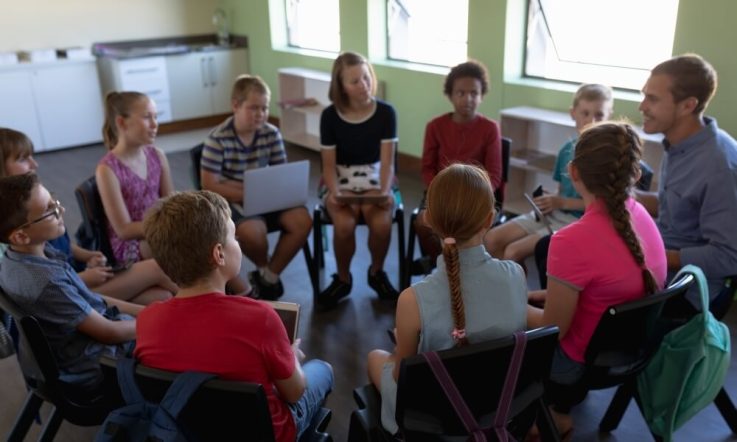
To do this, students form 2 circles: an inner discussion group and an outer observation group. The inner circle discusses a question while the outer circle observes using a simple checklist: looking for turn-taking, listening, and building on others’ ideas. After several minutes, the groups switch roles.
I share the discussion prompt a day in advance, so students have time to prepare. Watching a conversation unfold allows hesitant students to mentally rehearse participation before speaking themselves.
By the time roles rotate, many feel more ready to contribute. Observation becomes a bridge between silence and participation.
2. JAM sessions: Choosing presence over perfection
Every few weeks we hold informal speaking rounds inspired by JAM (Just-a-Minute) sessions, where students speak briefly on a random topic.
To reduce pressure, I begin by modelling the activity myself – pausing, losing my train of thought, and laughing about it. This signals that imperfect speaking is normal.
Students draw topics and speak for a short time. If someone gets stuck, classmates can offer prompts – a strategy we call the ‘Popcorn pivot’.
Instead of judging fluency, the class focuses on helping the speaker continue. A visible timer keeps the activity structured and low-pressure.
Students begin to understand that speaking is not about perfect sentences, but about staying present.
3. The Tuesday threshold: A low-stakes entry into speech
One of the simplest routines has been one of the most effective. Every Tuesday, students encounter a short storytelling prompt at the classroom door. Before entering, each student contributes one spoken line to an evolving story.
By the time the last student enters, the class has created a complete (and often amusing) narrative, spoken aloud as a continuous chain. I briefly retell or note down the full story so students can hear how their individual contributions build into a shared narrative.
Because each contribution is brief and collective, the pressure remains low. Over time, students begin entering the classroom expecting their voice to be part of the learning environment.
4. Resilience shields: Connecting voice and identity
Before students feel comfortable speaking in a new language, they need to feel seen as individuals.
In this activity, students design ‘Resilience shields’ representing their strengths, coping strategies, and sources of support. They then explain elements of their shields in pairs or small groups, using sentence starters if needed.
These conversations allow students to speak about something familiar – their own experiences. As a result, speaking becomes an act of expression rather than evaluation. I’ve found that when students feel recognised, their willingness to participate increases.
5. Building a spoken-English ecosystem
We also introduced a daily English-speaking window during specific classroom periods.
To make this collaborative, students take turns as ‘Language champions’, noticing and encouraging peers who make an effort to speak.
At the end of the week, brief reflections help students identify what supported their participation and where they struggled. The aim is not enforcement, but creating a shared culture where effort is visible and valued.
What does this mean for educators?
In classrooms, silence is often interpreted as lack of ability or confidence. But in many cases, it reflects a lack of safe, structured opportunities to participate.
What made these routines effective was not the activities themselves, but their consistency. They turned speaking into a predictable part of classroom life rather than an occasional demand.
When participation becomes routine, more students begin to see themselves as capable contributors.
I’ve found that confidence in speaking does not emerge spontaneously – it is built through repeated, low-risk opportunities to participate.
When classrooms are structured to make participation safe and predictable, speaking shifts from performance to belonging. And when students begin to feel that their voices matter, silence gradually gives way to conversation.
Think about your own classroom. Whose voices are you hearing most often and which students are hesitant to participate? What structures or routines might be unintentionally reinforcing this pattern?
Do you offer opportunities for students to speak about what they know best – their experiences, strengths and identities? How could you design low-stakes activities that connect voice, belonging and learning more intentionally?