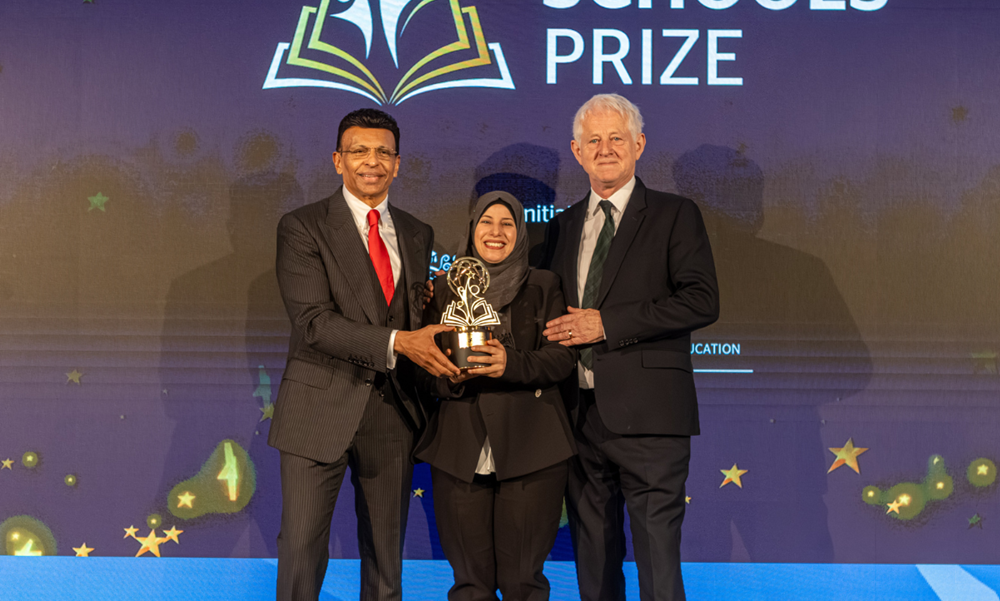
The winner of the inaugural Global Schools Prize has just been announced. Lebanon’s The Alsama Project – an education organisation supporting displaced Syrian and Palestinian teenagers to remain engaged in education – has taken home the US $500,000 in prize money to scale its impact globally.
The Global Schools Prize is an initiative of the Varkey Foundation that aims to recognise and celebrate the world’s most innovative and impactful schools that are reimagining education for the future.
The prize is organised into 10 categories, and this year almost 3,000 nominations from 113 countries were received. Prior to being announced winner at the Education World Forum in London, The Alsama Project was named a top 10 finalist and winner of the category Overcoming Adversity. Each category winner is awarded US $50,000. The other 9 category winners were:
- AI Transformation: IIS Ettore Majorana, Italy
- Arts, Culture, and Creativity: Freedom International Schools, Kenya
- Character and Values: Escuela de Talentos Guanajuato Azteca, Mexico
- Global Citizenship and Peacebuilding: LEAD 359, USA
- Health and Wellbeing: IES Carmen de Burgos Seguí, Spain
- SEND and Inclusive Education: Suubi Community Primary & Secondary Schools, Uganda
- STEM Education: Neeson Cripps Academy, Cambodia
- Sustainability: Institución Educativa Comercial de Envigado, Colombia
- Teacher Development: Reach Academy Feltham, UK
About The Alsama Project
The Alsama Project has been recognised for developing an accelerated education model specifically designed for teenagers whose learning has been disrupted by war, displacement and poverty.
It was founded in 2020 initially to support 40 teenagers in Beirut’s Shatila Refugee Camp. Six years on, the organisation now supports more than 1,100 displaced adolescents by operating 4 education centres in both Beirut and Syria. The project is one of Lebanon’s only education providers to continue teaching uninterrupted during recent conflicts thanks to teachers providing SIM cards to students so they can move immediately to online learning.
Most staff members (72%) are refugees, and most senior leaders have refugee backgrounds. With approximately 90% of their students unable to read, write or perform basic numeracy skills, the curriculum focuses on supporting students to attain these skills within 6 months – through real-life activities such as reading road signs or planning a weekly grocery budget – and be prepared for tertiary education within 6 years. The project’s first cohort will graduate in July, and students have already secured scholarships to the University of Cambridge, the University of Leicester, and Arizona State University.
Each education centre is staffed with full-time psychologists, and weekly awareness classes cover students’ rights, healthy relationships, gender equality, and personal safety. The organisation also works closely with families and communities to help prevent early marriage, child labour, or abuse.
Cricket is a cornerstone of the project’s education model. It operates over 20 cricket hubs where boys and girls train together under their cricket coach – half of which are female. Older students can also take up roles as junior cricket coaches, providing them with safe income opportunities.
The Alsama Project plans to use the prize money to open a second education centre in Homs, Syria. Classes will include Arabic, English, maths, science, IT, financial literacy, professionalism, and rights-based awareness sessions, as well as yoga and cricket.
Australia’s Top 50 finalist, Larrakeyah Primary School
Here in Australia, Larrakeyah Primary School in Darwin, Northern Territory, was named as a top 50 finalist, and top 5 finalist for the AI Transformation category.
The school has been recognised for transforming education through IntelliLearn – a custom-built AI writing platform that provides students with curriculum-aligned and scaffolded feedback, designed by Larrakeyah Primary School educators.
IntelliLearn also has voice-to-text features which are particularly beneficial for the school’s many students with a language background other than English.
The implementation of the writing platform has seen an increase in students meeting or exceeding literacy benchmarks, with the school reporting 92% of students in year 5 and 100% of students in year 6 achieving these benchmarks. Further, 86% of students with a language background other than English have achieved at or above expected writing levels.
After being named in the top 50, Larrakeyah Primary School schools was welcomed into the Global Schools Network, gaining access to partnerships, professional development, and global collaboration opportunities with other leading institutions.