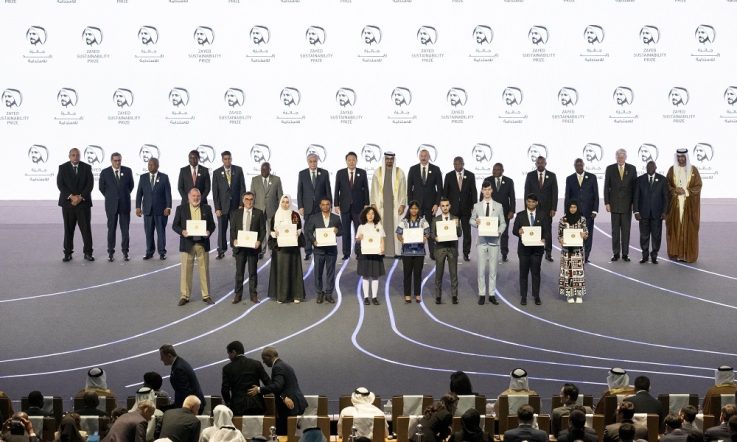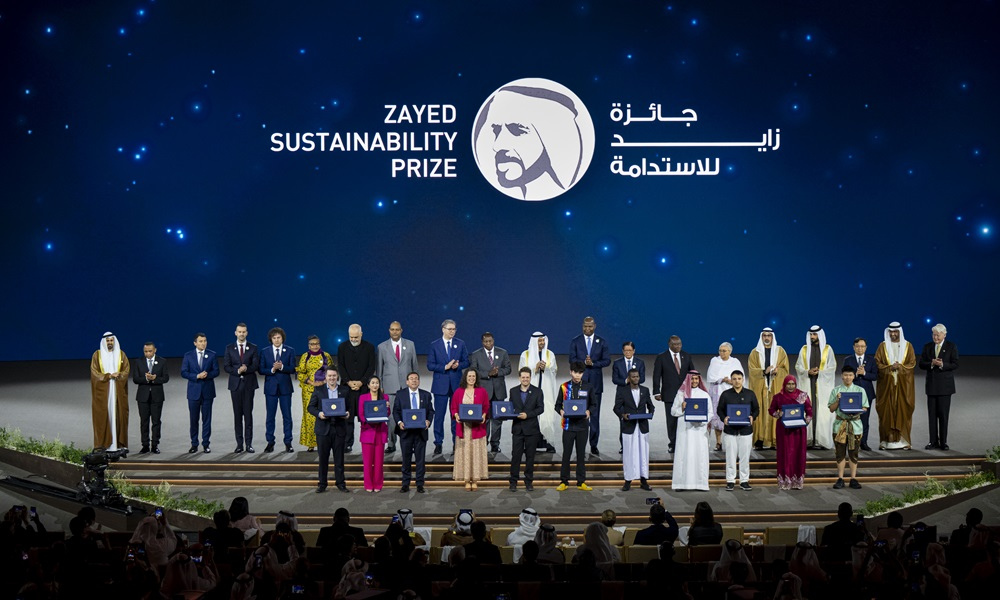
The Zayed Sustainability Prize is a global award that recognises and rewards small and medium enterprises, nonprofit organisations and high schools who are delivering practical, scalable solutions to some of the world’s most pressing sustainability challenges. Last week, the Prize announced the cohort of 2026 winners in a ceremony held during Abu Dhabi Sustainability Week. The ceremony was attended by Heads of State, ministers, and business leaders, as well as His Highness Sheikh Mohamed bin Zayed, President of the UAE, and our very own Deputy Editor, Rebecca Vukovic, who is on the Selection Committee for the Zayed Sustainability Prize in the Global High Schools category.
The Global High Schools category awards 6 high schools from 6 world regions US$150,000 to transform their plan into a scalable project that will deliver impact, innovation and inspiration to their school and local community. Schools must propose projects to be implemented within 12-24 months of receiving the Prize, with tangible outcomes in the areas of sustainable health, food, energy and water. In today’s article, we learn more about 2026 winning projects in the Global High Schools category.
The Americas – Mamawi Atosketan Native School, Canada
In a school of around 250 students located in central Alberta, Canada, students are working to establish a year-round modular hydroponic farm to help to address food insecurity in Northern Alberta's Indigenous communities. The farm will produce over 2,600 pounds of vegetables annually which will form part of a for-credit agriculture programme integrating Indigenous values and sustainability science. The system will also use approximately 70% less water than conventional farming methods, saving an estimated 70,000 litres annually.
Driven by students and supported by Elders and teachers, the farm will become a place for learning, healing and connection. Students will take responsibility for every stage of the project, from growing and monitoring crops to distributing fresh produce within the community.
Sub-Saharan Africa – Kyanja High School, Uganda
Kyanja High School, a private school in Uganda with 431 students, proposes the design and build of a circular farming system that integrates duck shelters and fishponds to produce fish and eggs.
Designed around zero-waste principles, the system will house ducks in raised shelters above the ponds, allowing their waste to naturally fertilise the water and stimulate plankton growth, removing the need for synthetic fish feed. The approach will generate 2 sustainable sources of protein, while giving students hands-on experience in agroecology, aquaculture and sustainable farming.
Over a 2-year period, the project is expected to yield more than 3,000 kilograms of catfish and 27,000 duck eggs, significantly improving students’ access to affordable, nutritious food. The inspiration for this project came directly from students’ lived experience of food insecurity at their school – with around 70% of students eating just one meal a day, they were motivated to create a practical, sustainable solution to support their community.
Middle East and North Africa – Al Rajaa School For The Deaf, Jordan
The project from Al Rajaa School for the Deaf, a private school in Jordan with 147 students, integrates water management, smart agriculture and recycling. The initiative includes plans to install a rainwater harvesting and greywater treatment system, establish a recycling unit and set up 3 hydroponic growing systems. Students will also create a community e-market to showcase and sell surplus produce grown at the school.
The project is expected to cut the school’s water use by at least 60% through rainwater collection and greywater reuse, while meeting around 80% of the irrigation needs for the hydroponic systems. These systems are projected to produce about 300 kilograms of vegetables each month.
Through this work, the school seeks to empower hearing impaired students to become environmental leaders, while fostering a culture of sustainability and tolerance in both the school and the wider community.
Europe and Central Asia – Bodrum Anatolian High School, Turkey
The winning project from Bodrum Anatolian High School, a public school in Turkey with 565 students, aims to implement an AI-powered wildfire prevention system. The system provides round-the-clock autonomous wildfire monitoring and rapid response.
Using drones fitted with thermal cameras and environmental sensors, the system identifies early fire risks by analysing factors such as temperature, humidity, wind speed and thermal data. When a potential threat is detected, the AI platform deploys intervention drones that release BORTEX capsules to suppress the fire.
The capsules contain boron (a naturally occurring mineral) and when released, they create an oxygen-blocking barrier that helps halt the spread of flames. Powered by solar-charged stations, the system is entirely renewable, with students responsible for every stage of the project – from coding and engineering to real-world testing.
South Asia – Faafu Atoll Education Center, Maldives
Faafu Atoll Education Center, a public school in the Maldives serving 570 students, is working to transform its campus into a living sustainability hub. The project brings together solar and wind energy, expanded rainwater harvesting, clean water systems, hydroponic food production and bamboo-based innovation.
Through the installation of 60 kW of solar power and 40 kW of wind energy, the school aims to meet all of its own electricity needs, while also supplying excess power to the nearby Faafu Atoll Hospital.
Students are at the centre of the project, leading its design and delivery through dedicated teams. For example, the Energy Team will support the installation of renewable systems and track performance using real-time dashboards. The Water Team will expand rainwater storage to 80,000 litres and manage solar-powered UV purification and groundwater filtration systems. The Hydroponics and Tree Team will oversee year-round vegetable growing and the planting of more than 320 trees.
The Bamboo Innovation and Compost Team will convert organic waste into compost and create eco-friendly products from bamboo, while the Digital and Data Team develops AI-powered monitoring tools. Community engagement will be led by the Media and Advocacy Team, which will produce documentary films and lead outreach activities.
East Asia and Pacific – Ruamrudee International School, Thailand
At Ruamrudee International School in Thailand, students are addressing the environmental impact of rice farming by introducing Alternate Wetting and Drying (AWD), a water-saving method that significantly reduces methane emissions. To support farmers, they developed RiceSense, a low-cost sensor that monitors water levels and GPS data, helping farmers meet carbon credit requirements.
Over 3 years, the project is expected to cut methane emissions by up to 40% and save more than 750 cubic metres of water per growing cycle, while improving farmer incomes through access to carbon markets.
Inspired by a student’s own experience growing rice with his family, the initiative combines technology and traditional knowledge to make rice farming more sustainable and appealing to the next generation.
Visit the Zayed Sustainability Prize website for more information on the prize and details on how to apply for the next submission cycle.