Young people are navigating a financial landscape that looks very different to the one their teachers grew up in. Buy-now pay-later services, pocket money apps, online scams, gambling advertising and cryptocurrency are part of some students’ everyday lives.
In response, schools are increasingly being called on to help students make sense of these issues. In South Australia, a professional learning partnership is supporting teachers to take up that challenge.
Changemakers in Financial Education – a collaboration between Deakin University’s Research for Educational Impact (REDI) and the South Australian Department for Education – was designed to build teachers’ knowledge, confidence and classroom practice as financial educators.
The 45-hour blended program has supported primary and secondary teachers from more than 60 schools to embed authentic, curriculum-linked financial learning across year levels.
Deakin academic leads Dr Carly Sawatzki and Associate Professor Jill Brown – and several coaches – worked alongside teachers to design cross-curricular lessons that connect mathematics, humanities and wellbeing.
An evaluation of the initiative (Sawatzki et al, 2026) shows that 98% of teachers said the Changemakers course strengthened their classroom teaching, and 90% said it helped build their own financial literacy.
‘So far, more than 3,000 students have benefitted via their teachers’ applied projects. When teachers learn and grow as financial educators, their current and future students can only benefit,’ Dr Sawatzki says.
Financial literacy at Marryatville High School
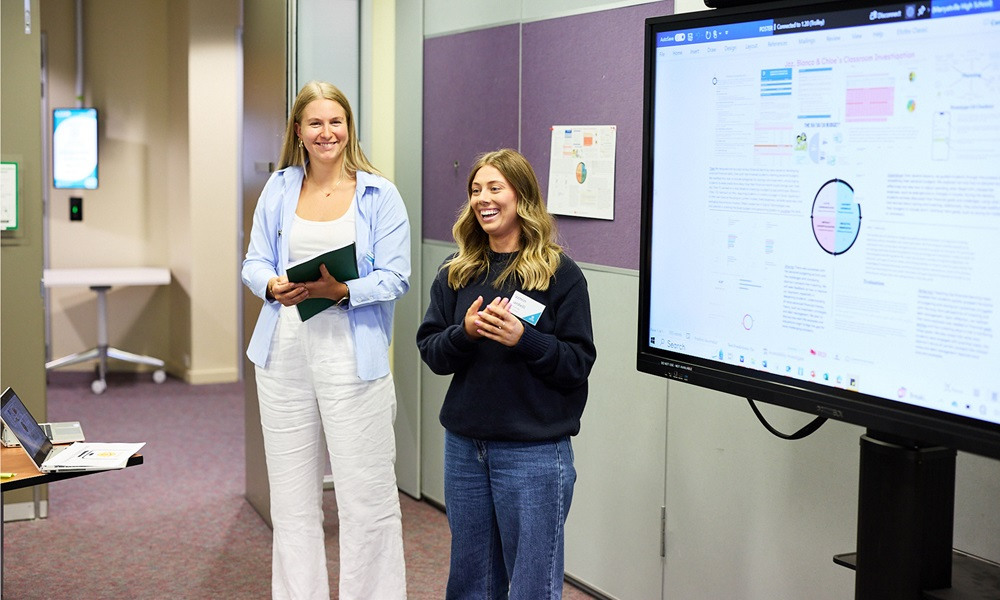
For mathematics teachers Jazmin Nardelli and Bianca Drum at Marryatville High School, the program complemented and strengthened work they were already doing through their popular financial literacy electives.
The year 9 course, which Nardelli teaches, is called Money Matters: Financial Literacy and runs over a semester.
‘It starts with how to write a resume, how to get a job, how to write a cover letter, what to look for, and then we go into types of incomes (earned incomes, passive incomes, government incomes), and we look at where they come from,’ Nardelli tells Teacher.
From there, students learn about the different types of compound interest and simple interest – essentially, how to make your money make more money. They also learn about debt and credit cards.
‘And then we go into the nitty gritty of taxation and superannuation and long-life planning and goals. And then we finish up looking at what sort of careers they could go into in the finance field if they were interested in any of the content they've been learning over the year,’ Nardelli explains.
The year 10 elective, which Drum teaches, is called Money Matters: Investing and Futures. As students don’t need to have done the year 9 course beforehand, the first few weeks consists of a bridging topic on budgeting and money. From there, they learn about income and salaries – where your money goes, how much you earn over your lifetime and what managing that salary looks like in 30-40 years’ time.
‘The main hook lesson is we start off with a $100,000 salary and we look at how much goes to the government for tax and the Medicare levy and how much is our take home money,’ Drum shares. ‘And then from our take home money, we look at how much goes towards our needs – like rent and food, etcetera. And then how much do we actually have left?
‘They realise that from $100,000 salary (which is around average) you really don't have much money left. Then we compare if you save that money your whole life, how much would you have by retirement? Or if you invested it, how much would you have by retirement? That's when they realise, “if I just make a few like smart financial decisions when I'm young, like it's actually not that hard when time is on your side”.’
The students also learn all about investing – in the share market, property and even collectables like toys and artwork. They explore Exchange Traded Funds (ETFs) and they play the ASX Sharemarket Game.
A financial literacy lens
Nardelli says they jumped at the opportunity to take part in the Changemakers program. ‘We thought it'd be awesome to connect with other like-minded people in the space and have a look at what the academic research is in this area and see if we can upskill ourselves or share ideas,’ she says.
The course comprised a 2-day intensive hosted in Adelaide and a series of 4 webinars. Teachers were matched with a Deakin coach and a learning team of 6-7 colleagues. Coaching focused on the completion of an applied project. The program culminated in a professional learning showcase in Adelaide, at which the teachers’ applied projects were shared and celebrated.
Both Drum and Nardelli agree that the content they learned in the course has been beneficial for their financial literacy electives, but they have also been able to apply concepts and some specific activities to their general mathematics courses as well.
Nardelli says that when teaching her year 8s fractions, decimals and percentages, she applied a financial literacy lens. She even used a specific activity she learned in the Changemakers course on a student test.
‘It was about a burger, and it broke down each element of the burger, and it spoke about inflation and how that had increased the entire price of the burger. I used that as a big broken-down test question,’ Nardelli says.
Similarly, Drum used an activity that she learned about through Changemakers with her years 7s. ‘I adapted a task that I'd done in the past and just made it a lot better and richer,’ she shares.
‘In year 7 maths, they learn decimals and percentages. For this task, kids start their own company, and they choose 7 to 10 items that they sell. [They] do research on cost price and then sell price. They decide how much they'd mark it up and their profit and then their volume sold, volume profit.’
A wellbeing-focused approach
Nardelli says that she takes a supportive, wellbeing-focused approach to teaching financial literacy, that makes money feel safe, relatable, and easy to talk about.
‘I do like to break down the barriers, and I do like to be very transparent, and I preach that money should not be a taboo topic and it should be something that we can speak about at any age and it's something you should be curious about,’ she says.
‘For example, when it comes down to types of income, we don't just talk about earned income, and we don't just talk about passive income and shares.
‘We also talk about income from government transfer payments, and we talk about JobSeeker and we talk about why people might find themselves in situations where they might need to be on JobSeeker. So, it's really looking from an empathetic point of view, rather than just looking at money from a capitalist perspective.’
Drum, who also teaches psychology at the school, says that her class takes a similar approach to Nardelli’s.
‘Financial literacy education is vital, and I see every day how transformative it is for young people. In my financial literacy elective, I take a wellbeing-focused approach to make learning about money feel safe, practical and empowering. One of the most rewarding parts is seeing students shift from confusion or anxiety to genuine confidence.’
References
Sawatzki, C., Brown, J., Davidson, A., Driscoll, K., Rajendran, N., & Ridsdale, K. (2026). Changemakers in Financial Education: 2024 – 2025 Course Evaluation. Deakin University. https://redi.deakin.edu.au/wp-content/uploads/sites/3/2026/03/Changemakers_Evaluation_01032026.pdf
How well do your current teaching and learning programs reflect the real financial experiences your students are navigating, such as online spending, debt, scams or investing? Where could you apply a financial literacy lens to existing curriculum content to make learning more authentic and relevant?
How confident do you feel in your own financial literacy knowledge, and what professional learning or partnerships could help you strengthen this area?