Media and Artificial Intelligence Literacy (MAIL) has been announced as the innovative domain for PISA 2029. The OECD has already released the first draft framework, offering an early understanding of how media literacy and AI literacy intersect and link to other curriculum areas, the key concepts and big ideas, and how to nurture the related competences.
The Programme for International Student Assessment – better known to educators around the world as PISA – measures 15-year-olds’ ability to use and apply their reading, mathematics and science knowledge and skills to meet real-life challenges and participate fully in society. Alongside the core subjects, since 2012 the assessment has included an ‘innovative domain’ targeting key interdisciplinary skills.
Creative Problem Solving, Collaborative Problem Solving, Global Competence, Creative Thinking and Learning in the Digital World have featured as the PISA innovative domain assessments across the past 5 testing cycles. In 2029, Media and Artificial Intelligence Literacy (MAIL) will be added to the list.
The OECD has appointed the Australian Council for Educational Research (ACER) to lead the development and implementation of the PISA 2029 across more than 90 countries and economies. This 10th cycle will focus on reading as the major domain, while the MAIL innovative domain is a first-of-its-kind international assessment.
'Measuring how well students can apply learning to the real world has always been at the heart of PISA,’ ACER CEO Lisa Rodgers says. ‘The 2029 innovative domain will be the first study of its kind to assess how equipped the next generation is to co-exist with AI and think critically about what they see online.’
ACER’s Dr Goran Lazendic, International Survey Director for PISA 2029, adds, ‘What makes the new PISA MAIL assessment so important is that it looks at how young people actually make sense of information in an AI‑shaped world, not just what they know.
‘They are learning and developing in environments where meaning is shaped by algorithms. MAIL will focus on whether students can notice and question that shaping.
‘It will place students in realistic digital situations and, for the first time, allow us to see how education systems are preparing young people to exercise judgment in digital environments. Where answers are uncertain and where meaning, influence, and responsibility extend beyond the reach of AI alone.’
Navigating an evolving digital world
The 63-page preliminary draft framework for the MAIL assessment explains this innovative domain will measure how well students ‘engage effectively, ethically and responsibly with digital content, media platforms, and AI systems,’ (OECD, 2026). It adds these competences are vital in making well-informed decisions and taking responsible actions; they’ll also empower your students to ‘safeguard their privacy and promote their wellbeing’.
MAIL combines both media and AI literacy, and the framework offers a shared language and set of ideas for how they intersect. ‘At the core of media literacy lies the critical thinking skills needed for engaging with, understanding, assessing, and filtering the images, words, and sounds encountered through books, newspapers, magazines, radio, television, video games, the Internet and social media.
‘… AI literacy represents the technical knowledge, durable skills and future-ready attitudes required to thrive in a world influenced by AI systems. It enables learners to engage, create with, manage and shape AI, while critically evaluating its benefits, risks and ethical implications.’
Key concepts and big ideas
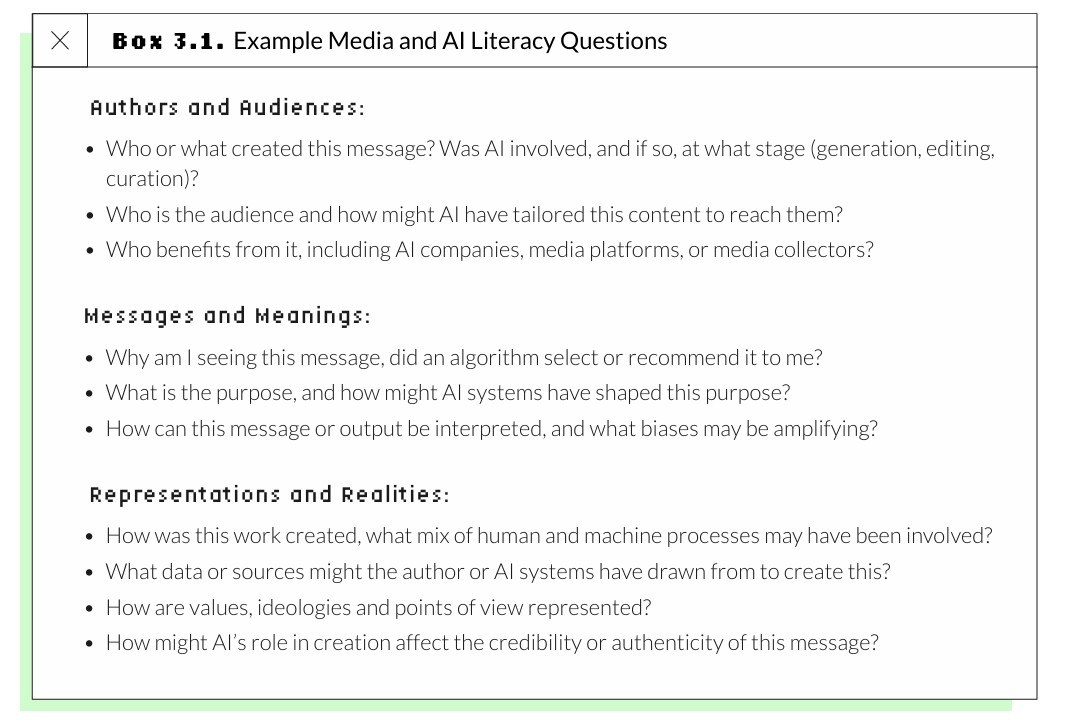
The framework digs into 3 interconnected dimensions: authors and audiences, messages and meanings, and representations and realities.
Authors and audiences: Thinking about authors and audiences requires students consider ‘not just what is said or shown, but also for whom and why’. This means moving beyond the author of a message or shaping of an AI system to think about the contexts and structures that influence them, such as politics and business. Audiences also respond and react in different ways, depending on their own context and experiences. ‘… an assessment of Media and AI Literacy should invite students to reflect on the complex social, cultural, historical and technological processes that influence authors and audiences.’
Messages and meanings: Understanding of this area requires students to critically interpret messages (whether they’re produced by humans or AI) and understand the strategies and choices used to create them; that messages are more than just ‘vehicles for entertainment, but they are also powerful instruments of influence’. To this end, it notes ‘… an assessment of Media and AI Literacy should include realistic reflections on the underlying decisions about what has been included, highlighted and omitted from media messages.’
Representations and realities: In this dimension, students need to recognise that messages are selective (and sometimes entirely fabricated) ‘curated, edited and often strategically crafted representations’ of the world. ‘… an assessment of Media and AI Literacy should include realistic ways in which individuals question the reality presented to them, scrutinise who is shaping these narratives, and understand how certain groups or perspectives may be privileged or marginalised.’
The framework suggests a set of ‘big ideas’ for each of the dimensions, and shares example questions (OECD, 2026 Box 3.1).
Links to other curriculum areas
For teachers, the draft framework positions Media and AI literacy as a ‘cross-domain topic’ relevant to all subjects. ‘[It] requires strong foundational knowledge and skills. It is not possible to expect that students can exercise critical thinking, creative expression, ethical judgement, social responsibility, or citizenship engagement if they are not fluent readers, have solid scientific and mathematics foundations, have in-depth knowledge of scientific critical thinking, and have had exposure to a diverse set of knowledge, key ideas and practices in the social sciences and the humanities …’
There are examples of how MAIL links to other competencies and ‘connecting activities’ in 8 subject areas: Reading, Mathematics, Science, History, Geography, Foreign Languages, the Arts and Computer Science. Here’s a selection – the full list is in Table 3.1 of the framework.
Reading: Reflect on how media platforms and AI systems personalise news feeds in ways that may affect people’s interpretation of current events.
Mathematics: Examine how algorithms target advertisements based on user data.
Science: Discuss the ethical implications of AI in scientific research by examining media coverage of AI breakthroughs and controversies
The Arts: Examine the copyright issues concerning human-machine collaboration and reflect on cultural understandings of the nature of creativity and originality.
History: Debate the impact of deepfakes and other AI-generated content on the authenticity of historical evidence in digital and traditional media
It also discusses Media and AI literacy connections to social and emotional competencies, again giving examples of connecting activities, this time in 5 areas: Self-awareness, self-management, social awareness, relationship skills, and responsible decision-making.
And there are draft student expectation progressions for 5 competencies (Reflect and Act Ethically and Responsibly; Access and Use; Analyse and Evaluate; Participate and Collaborate; Create), which it notes will be revised after the PISA pilot study and field trial.
Stay tuned for more from Teacher: The results of PISA 2025 – featuring Science as the major domain and Learning in the Digital World the innovative domain – are due to be released on 8 September 2026.
References and related reading
OECD. (n.d.). Innovation in PISA: Frequently Asked Questions (FAQs). https://www.oecd.org/content/dam/oecd/en/about/projects/edu/pisa-rdi-programme/Frequently-Asked-Questions.pdf
OECD. (2025). Empowering learners for the age of AI: An AI literacy framework for primary and secondary education (Review draft). https://ailiteracyframework.org/
OECD. (2026). Navigating an Evolving Digital World: First draft of the PISA 2029 Media and Artificial Intelligence Literacy (MAIL) Assessment Framework. https://www.oecd.org/en/about/projects/pisa-2029-media-and-artificial-intelligence-literacy.html
Thinking about your own planning, which aspects of Media and AI Literacy are already included in your subject area, even if they are not specifically named as this?
When students are engaging with media, or digital tools, how often do you encourage them to ask: Who created this? Who for? And why? Are they thinking about not just what’s being said, but what’s being highlighted and what might have been left out?