The Trends in International Mathematics and Science Study (TIMSS) is conducted every 4 years and explores how well year 4 and 8 students have mastered the factual and procedural knowledge taught in school mathematics and science classes. It also includes a questionnaire for teachers from participating schools, and one topic is their professional development needs.
The latest (2023) data show that improving students’ critical thinking and problem‑solving skills is the most desired professional learning topic for both year 4 and year 8 teachers in Australia. In today’s expert Q&A Renee Ladner, Education Consultant at the Mathematical Association of Victoria (MAV), discusses the topic and explores why integrating technology into the mathematics curriculum is another area of need for educators.
You work with many schools across the state. In your experience, what are the current most common professional learning areas of need for mathematics teachers? Why do you think this is the case, and how are you supporting educators in these areas?
Working with schools across Victoria, 3 professional learning priorities are emerging consistently for mathematics teachers.
The first is a renewed focus on explicit teaching in mathematics, particularly following recent system‑level directives across government and Catholic sectors. Teachers and leaders are seeking clarity about what explicit teaching looks like in practice, while still valuing rich tasks, investigations, games and mathematical modelling. Schools are keen to strike a balance between clarity and structure, and opportunities for deep thinking, ensuring that no single pedagogical approach is overused.
A second significant area of need is clarity and sequencing of content. Many schools are strengthening their planning processes through collaborative work in level or learning area teams. This often involves identifying key understandings within topics, using formative assessment to surface common misconceptions, and intentionally sequencing learning to build conceptual understanding over time.
A third priority is mathematical wellbeing, for both students and teachers. This work is closely connected to clarity of instruction and confidence with content. When teachers feel well supported and clear about what they are teaching and why, students are more likely to engage positively with mathematics.
These priorities align closely with findings from the TIMSS teacher data, where explicit teaching, problem solving and sequencing featured strongly.
The latest TIMSS data show that improving students’ critical thinking and problem‑solving skills is the most desired professional learning topic for year 4 and year 8 teachers in Australia. What are some of the challenges for practitioners in this area?
In our experience, the most significant challenge for teachers in developing students’ critical thinking and problem‑solving skills is time. High‑quality problem‑solving requires teachers to engage deeply with tasks before they are used in the classroom – exploring possible solution paths, anticipating misconceptions, and planning purposeful questions and responses.
Critical thinking and problem-solving are not linear processes. They demand thoughtful planning and a willingness to allow students to experience uncertainty, test ideas and revise their thinking. Without adequate planning time, this can be difficult to sustain consistently in classrooms.
What are some practical strategies teachers in primary and secondary settings can use to support students’ critical thinking and problem‑solving skills?
Planning is central. When teachers work through tasks themselves during planning, they are better positioned to anticipate how students might respond and how instruction can be adjusted in the moment. This allows teachers to plan intentional questions that prompt deeper thinking.
Embedding questions such as: How do you know? Does it always work? Can you convince us? into lesson planning helps ensure that time is protected for students to justify reasoning, challenge ideas and build on one another’s thinking. When these prompts are planned explicitly, they are more likely to occur naturally during lessons.
Classroom strategies such as think-pair-share, turn and talk, and the use of mini whiteboards support all students to engage actively. Mini whiteboards, in particular, provide low‑risk opportunities for students to estimate, sketch diagrams, trial mental strategies and explain their thinking.
Creating opportunities for productive struggle is a powerful way to deepen students’ mathematical thinking. When this becomes part of classroom culture from the beginning of the year, students learn that doing mathematics involves grappling with ideas, making errors, asking questions and refining thinking over time. Warshauer (2015) defines productive struggle as an intellectual effort to make sense of mathematics, involving challenges within a student’s reasonable capability, and leading to deeper understanding when supported towards resolution. The teacher’s role is critical in ensuring that struggle remains productive rather than frustrating. With clear structures, intentional scaffolding and well‑timed questioning, students can maintain confidence while developing independence and a stronger sense of themselves as capable problem solvers.
Explicitly teaching problem‑solving strategies gives students a shared language and a growing ‘toolbox’ they can draw on across a variety of contexts. Many schools introduce these strategies at the start of the school year, revisiting familiar ones while gradually introducing new approaches.
Over time, students learn that different problems call for different strategies and become more adept at selecting efficient approaches and explaining their reasoning.
Strategies commonly taught include:
- acting it out
- guess and check
- making a list
- drawing a diagram
- looking for patterns
- thinking logically
- working backwards or simplifying
- creating a mathematical model
(Reys et al., 2022)
Developing a clear scope and sequence for these strategies supports consistency across year levels and builds expectations for increasingly sophisticated reasoning and communication. Here’s an example we use at MAV to support schools in planning:
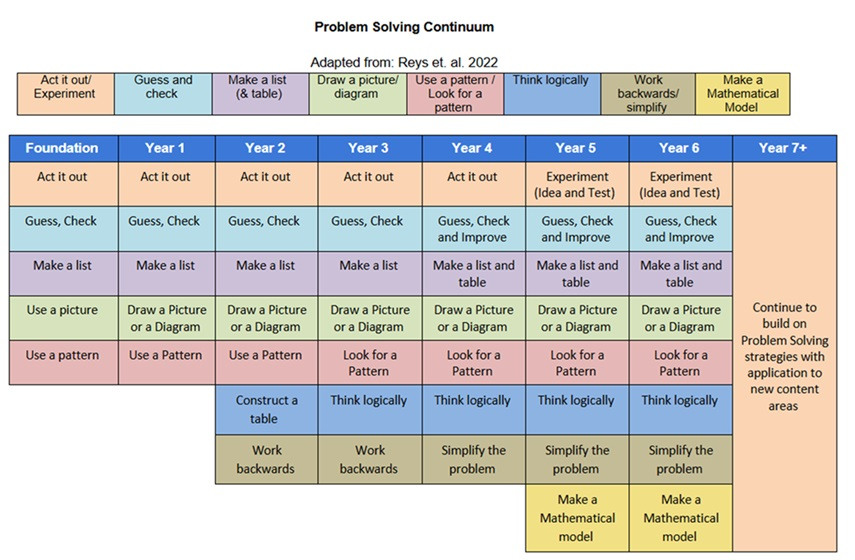
Example of a MAV scope and sequence used to support schools in planning.
In the TIMSS survey, a majority of teachers in year 4 (78%) and year 8 (61%) were also wanting PD related to integrating technology into the mathematics curriculum. What are some of the challenges for practitioners in this area? Can you give some practical tips for Teacher readers working in primary and secondary settings?
While many digital tools are available, teachers often report uncertainty about which technologies genuinely enhance learning. The challenge is not access, but knowing how and when technology adds value, rather than increasing cognitive load or distracting from mathematical thinking. Computational thinking is embedded within the revised Mathematics Curriculum 2.0, emphasising logical analysis, solution design and representation. Professional learning in this space increasingly focuses on supporting teachers to respond to these expectations with confidence.
Technology is most powerful when it supports students to explore, represent and communicate mathematical ideas more deeply.
Key principles include:
- minimising cognitive load through coherent and well‑sequenced learning resources
- using technology to enhance, not replace, mathematical thinking
- supporting conceptual understanding through multiple representations
- using worked examples and scaffolds strategically
(Adapted from Department of Education, 2023)
When used intentionally, technology can strengthen conceptual understanding and support students to engage more deeply with mathematical ideas.
Across all of the areas that we’ve discussed, a common message emerges. Effective mathematics teaching is strengthened through thoughtful planning, shared understanding and sustained professional learning. Teachers are navigating increasingly complex demands with care and professionalism, and collaborative support makes a meaningful difference. By focusing on clarity, purposeful pedagogy and student wellbeing, mathematics teachers continue to create learning environments where all students can engage, persist and succeed.
References
Department of Education. (2023, July 24). A Best Practice Guide: Teaching maths with digital tools. (File Ref. D23/2214188). Department of Education. https://www.education.gov.au/australian-curriculum/resources/best-practice-guide-teaching-maths-digital-tools
Reys, R., Rogers, A., Bragg, L., Cooke, A., Fanshawe, M., & Gronow, M. (2022). Helping children learn mathematics, 4th ed. John Wiley & Sons. https://research.usq.edu.au/item/q7201/helping-children-learn-mathematics-4th-ed
Warshauer, H. K. (2015). Productive struggle in middle school mathematics classrooms. Journal of Mathematics Teacher Education, 18, 375–400. https://eric.ed.gov/?id=EJ1067302
During your planning time, do you work through tasks yourself or with colleagues in order to better anticipate how students might respond and how instruction can be adjusted in the moment?