Thanks for listening to this podcast from Teacher magazine, the free digital resource for K-12 educators published by ACER, the Australian Council for Educational Research. I’m Rebecca Vukovic.
Hello and welcome to today’s podcast special from Teacher. I’m excited to share this one with you. Today, you’re going to hear my chat with Kayla Borg, a STEM Specialist Teacher at St Mary’s Primary School in Whittlesea, Victoria.
I travelled out to the school to sit down with Kayla to hear all about how she went about co‑designing a podcast lesson for her year 5 and 6 students in partnership with the eSmart team at the Alannah & Madeline Foundation. It all began 2 years ago when Kayla recognised a gap in how her curriculum connected online safety learning with the wider school community, so reached out to the eSmart team for support. That initial conversation has since evolved into a co‑designed podcasting lesson that gives students the skills to become journalists and podcasters.
Over several months, Kayla worked with advisors at eSmart to design a hands‑on learning experience that explores everything from media ethics to scriptwriting, interviewing, and digital wellbeing. The resources reinforce the 4 online safety risk areas – Content, Contact, Conduct, and Compulsion – and also include a lesson plan to guide teachers wanting to create a podcast with their own students. They are available on the eSmart website, and I’ll be sure to link to them in the transcript of this episode.
When it came to recording their own podcast, the students at St Mary’s researched topics that were relevant to them – like managing screen time, practising online kindness, and spotting trustworthy content. They then went about interviewing their teachers around the school (you’ll hear a short clip of this a little later). And for the students involved, it all culminated in a trip to a podcasting studio in Melbourne CBD, where a group of 10 students recorded interviews with each other, as well as experts in media literacy and digital wellbeing.
In this episode, Kayla reflects on how the project came together, what her students learned along the way, and why real‑world, student‑led digital learning like this can have such a powerful ripple effect across the entire school community. Okay, let’s jump in.
Rebecca Vukovic: Kayla Borg, thanks for joining me today on the Teacher magazine podcast. It's so lovely to be here at your school, St Mary's Primary School in Whittlesea, Victoria, to record today. Can you start off by telling me a little bit about your school and its context?
Kayla Borg: Yeah, so I teach at St Mary's in Whittlesea. We're a semi-regional school with about 250 students. We're very lucky, we're kind of where the city meets the country. So, we're incredibly lucky to have 8 acres of land, giving our students lots of room to play and explore. We have a lot of families that come from farming around the area and also the suburbs.
RV: Fantastic. And so, what was your motivation for running a podcast lesson in the first place? Can you take me back to when you first had the idea?
KB: So as the STEM teacher, digital safety is an important part of my curriculum. We had lots of lessons where I was teaching kids about e-safety and what to do and what not to do. But then I was looking at the eSmart guidelines around connecting to the wider school community, and I really felt like there was a gap in my teaching within that. So, we had a lot of resources at our school for making podcasts and I thought it might be a really accessible way for our students and parents and community to come together on the podcast.
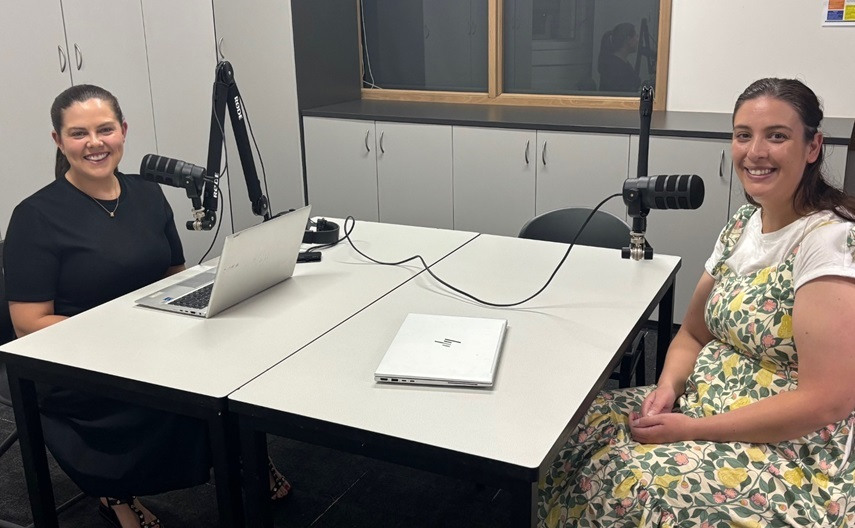
Rebecca Vukovic and Kayla Borg recording this episode of the Teacher magazine podcast.
RV: Fantastic. And of course, that's exactly what I want to talk to you about now is that co-designing of the podcast lesson with eSmart Schools. And for anyone unfamiliar with eSmart Schools, it's an initiative developed by the Alannah & Madeline Foundation to help schools manage cyber risks, bullying, and cyber bullying by providing a framework for responsible technology use. Kayla, how did this partnership come together? And also, what did this co-design look like in practice?
KB: I started by reaching out to my eSmart advisor, who was Craig at the time, for some expert feedback on how I could maybe pull off this idea of the podcast. He then connected me with Erin, who was leading the charge in their new digital safety curriculum. It was perfect timing. So, Erin and Craig invited me to do something really innovative where we could co-design a podcasting lesson with the students at my school.
So, I think what made the project really successful was the partnership with the eSmart team. So, from day one Erin was ensuring that the content was personalised to my school's specific needs. It was really that conversation of ‘what do our students need in our context’ and it really felt like that was personalised. So, we really identified what their current challenges were and built that into the curriculum of the lesson. I was even invited into a professional radio station with the eSmart team just to navigate the technical side of creating a podcast and to navigate those sort of complex media laws as well. So, it was really good just for even upskilling myself as a teacher.
RV: I do want to ask you a little bit about that podcasting experience, but before I do, I understand that the lesson reinforced the 4 online safety risk areas, and they are Content, Contact, Conduct, and Compulsion. For listeners who perhaps aren't familiar with those terms, can you briefly explain what they are and how they related to this project specifically?
KB: Yeah, so the 4 Cs refer to Content, which is the information that students access online. Then we have Contact, which is around who they talk to online or who they communicate with. We then have Conduct, which is how they might be treating others online. And the last one being Compulsion, which is around the time that they spend on activities online.
So, to get things started with our podcast, we had Peta and Mitch from the eSmart team come into the school to run a session with our students. They helped the students to understand the 4 Cs and then we brainstormed topics that they felt were relevant. So, the students were really interested in things like the use of social media algorithms, the screen time and the apps that they're using every day.
It was incredible to see them group themselves based on these themes. So, by the end of day 1, they weren't just the students, but they were journalists – they were writing scripts, they were interviewing teachers and navigating the ethics of media law to prepare for their recordings the next day.
RV: I love hearing that: the students were journalists. It's so nice to hear that. And of course, I said that I'd ask you now about the trip to the free podcasting studio. So, I understand that you and a group of students headed there. It was in the city, and you recorded your very own podcast. Can you tell me a little bit about that experience?
KB: Yes, I think this is definitely a highlight for the students of the experience. So, we went to VicHealth. They had the podcasting booth set up. We had our experts there to work with. And my students knew exactly what they were going to do, they were so ready. They went in, they had their questions ready for their interviews. We spent the day planning, creating targeted questions so when they sat down across from these professionals, they weren't just kids asking questions they were informed creators leading a really high-level discussion on digital wellbeing.
RV: And how did the students make decisions around, you know, like the themes of the podcast or the guests or the editing? Did they work together as a group, or did you split up tasks amongst them? I'd love to hear about how it all worked on a more practical level.
KB: Yeah, so there were quite a few layers to it. We spent a lot of time on that first day planning out the different segments of the podcast and how it would look. The students were able to choose themes that really appealed to them and that they were interested in. I think that student voice and agency was a really important part of the process.
So, they separated into smaller groups where they researched and investigated topics that were relevant to them. And they then had the opportunity to go and interview their teachers around the school about those topics. And then eSmart very kindly had a panel of experts and professionals and the students knew who they were going to be; and I think that really helped because they could target their questions to those experts.
RV: Yeah, fantastic. And I mean, listening to the episode myself, it was so, it was a perfect example of that real world learning experience. And I'd love to include a clip now of the students doing their podcast. I think it'd be really helpful for listeners to just hear a bit of an example of what it sounds like. So, I'll play that clip now.
Student: What sort of apps did you use when you were our age?
Teacher: There were no apps when I was your age. I only had MSN and that was on a computer, so not a laptop. Like a computer needs to be plugged into the wall. Yeah, and that's about it.
Student: What was MSN like?
Teacher: MSN was like direct messaging.
Student: Oh, yeah. Yeah. Miss Sharp, what apps did you use when you were little? Or our age?
Teacher: When I was your age? Well, there wasn't as much social media when I was your age. We used, I can't even remember what it was called – it was something where you could chat to your friends. But we didn't have any Snapchat or TikTok or anything like that. I think Facebook came out when I was in year 7 and I got that.
Teacher: Oh, so when I was younger, there actually wasn't an app. We didn't have apps. We had just the internet and we had a thing called Messenger where we could speak with other people through messaging. We also had MySpace, which is similar to Facebook, but my parents had to approve the friends that I had on there.
Student: What sort of apps did you use when you were our age?
Teacher: You are hysterical. Your age. Not only can I just remember your age, but we did not have computers [when] I was your age. So, we actually only got, I'm happy to explain it. The first computer I ever saw was one of my friends ... and they had it in a whole room. So, their one computer was in a whole office room – so it took up the whole room, but it was something that was able to make all these googly, goggly noises. that were very loud and that finally he was able to make contact with somebody else not in the room.
RV: And, so far, you've published 2 episodes. What have the students learned from this experience and what has the impact of this project been on their engagement at school?
KB: I think creating the podcast really helped to develop our students' abilities to understand how to research and question effectively. Not only that, but it really developed their ability to critically and creatively think about their own use of the internet, which I hope really does impact their future when they spend time online.
We were even able to share this podcast with our whole school community to demonstrate that our students are really knowledgeable in this area now, which was great. It's a resource that we can use as a school to help educate students. And I think the younger students really love when they can hear this information coming from their peers or their older classmates. I think that's been a really special experience.
RV: And Kayla, we know that school-community partnerships are so important and they expose children to those real-world learning experiences, as I just mentioned. What have been some of the benefits of collaborating with eSmart to do this work?
KB: Well, for me, the biggest goal was to provide a platform for these e-safety conversations to happen between school, and home with their families. And I still remember when we sent the recordings home the first time and I received a message from one of the parents of one of the boys that was a part of the podcast. And they sat down as a family together to listen, and she was so proud of him. But more importantly, I felt like it really supported meaningful conversation around e-safety for families and that it was so accessible and just connected really well with our school and the community. It's been something that we've been able to share with all of the families within our school community.
eSmart are such a supportive and well-resourced group. I've had other experiences where they've run parent, student and staff workshops. and they're always so positively supportive in any way possible. I'm so thankful for the experience of collaborating and truly feel like their work is important. I think the difficulties that young children are facing more than ever with technology, that it's really important that we find ways to send this message to them and to give them the support and skills they need to navigate their online time safely.
RV: Yeah, it's really important work that we're talking about here. And of course, a lot of this took place in the last couple of years. But what have you got planned for the podcast for this year? Is it something that students are interested in continuing with in 2026?
KB: These podcasts were actually used as the foundation of our new year 5 project in STEM. And I think it sparked a realisation in them that they can be the experts. They aren't just being told to be safe – they're researching, they're interviewing our school staff and choosing topics that they know that younger children in the school might need to hear. It's given them a real sense of purpose as digital leaders within our school community.
RV: Fantastic. Well, Kayla Borg, thank you so much for sharing your story and your insights with Teacher magazine.
KB: Thank you so much for having me.
That's all for this episode. Thanks very much for listening. If you enjoyed this one, please take a quick moment to hit follow on your podcast app and leave us a review. Both of those things help more people like you to find our podcast and they're a really big support for the Teacher team. We'll be back with a new episode very soon.
Teacher magazine is published by the Australian Council for Educational Research.
The lesson plans that Kayla Borg co-designed with the eSmart team are available on the Alannah & Madeline website and linked below:
- Speak Up About Content Risks: Create a Podcast or Fact Sheet | eSmart Academy
- Speak Up About Contact Risks: Create a Podcast or Fact Sheet | eSmart Academy
- Speak Up About Conduct Risks: Create a Podcast or Fact Sheet | eSmart Academy
- Speak Up About Compulsion Risks: Create a Podcast or Fact Sheet | eSmart Academy
To listen to the full podcast episodes produced by the year 5 and 6 students at St Mary’s Primary School, visit the links below.
What opportunities do your students have to collaborate with others to co-design their lessons? How could this strengthen connections between classroom learning, families and the wider community?
Check out the lesson plans linked in this article. Could you try a simple podcasting lesson with the students in your class? Could you give students more responsibility for researching, questioning or presenting information as part of that lesson?