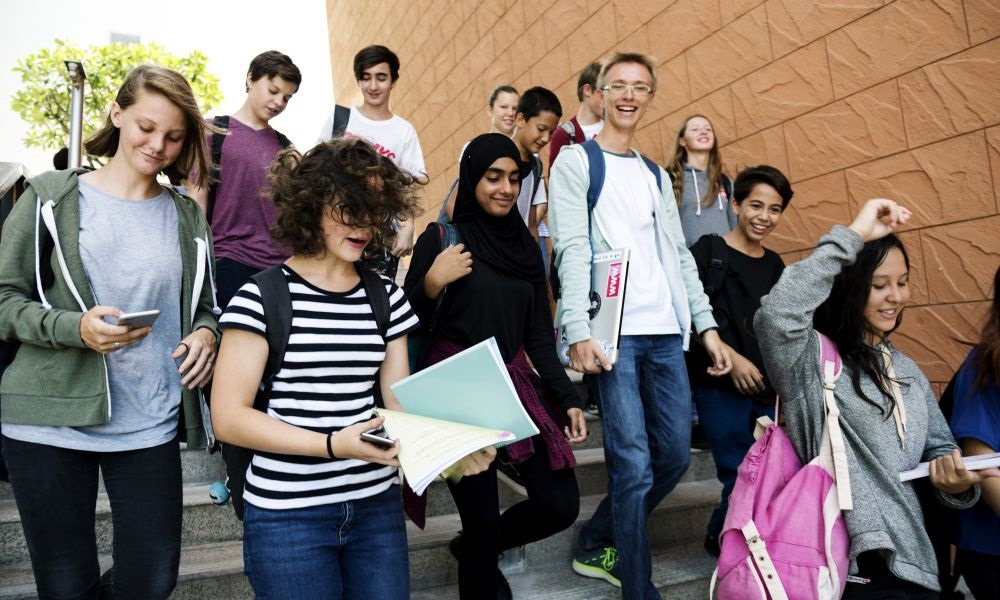
Thinking back to your own school years, it’s likely there were key friends you relied on for support. But it’s not just close friends who make a difference. New research from South Australia suggests that, when it comes to building resilience among adolescents, being part of larger peer groups is just as important.
The study led by Dr Sarah Halliday analysed the responses of more than 21,000 government school students in years 9 to 12. Dr Halliday and Bastian Miliotis, from Adelaide University, share the findings in the journal Youth & Society. They note although resilience is a key contributor to mental health, peer processes supporting development of these skills is under-explored in education research.
Commenting on the importance of the topic Dr Halliday, a Lecturer and Researcher in the School of Psychology, says, ‘It’s estimated 50% of mental disorders develop before age 18, so it's critical to determine and understand any protective factors which can be fostered to facilitate wellbeing. Resilience in adolescence is also valuable for the transition to well-adjusted adulthood and helping to avoid longer-term mental distress.’
Capturing student voice
The researchers analysed data from the Wellbeing and Engagement Collection (WEC) – an annual survey by the South Australian Department for Education that focuses on emotional wellbeing, engagement with school, readiness for learning and students’ health and wellbeing outside school. More than 100,000 students took part in the 2025 survey. This study looked at responses from 21,059 participants in grades 9-12 (students aged 15-18).
Students were asked to respond on a 5-point scale (from strongly disagree to strongly agree) to 6 statements related to resilience: I have a hard time making it through stressful events; I tend to bounce back quickly after hard times; it is hard for me to snap back when something bad happens; I tend to take a long time to get over setbacks in my life; I usually come through difficult times with little trouble; and, it does not take me long to recover from a stressful event.
There were also 3 statements relating to peer belonging: I feel part of a group of friends that do things together; I feel that I usually fit in with other kids around me; and, when I am with other kids my age, I feel I belong. And a further 3 on friendship intimacy: I have a friend I can tell everything to; I have at least one really good friend I can talk to when something is bothering me; and, there is somebody my age who really understands me.
The self-report nature of WEC meant researchers were able to gain crucial insights students’ own views and experiences, rather than a teacher or parent view of what might be happening.
‘The WEC is an amazing resource for researchers, allowing us to better understand the perspectives and experiences of students in South Australia,’ Dr Halliday tells Teacher. ‘In research, it can be really challenging obtaining ethics approval to work with children under the age of 18, so this dataset allows us to conduct research which focuses on student experiences, directly benefiting those who need it.’
Key study findings and takeaways
The study found that peer belonging was ‘a stronger predictor of resilience than friendship intimacy for students’, across grades 9-12, even when personal differences that could also influence resilience and friendship were accounted for.
‘In line with previous research, findings suggest there may be benefits of belonging to a peer group for developing resilience during these formative years; however, in contrast with previous work, friendship intimacy (i.e. the perceived quality of support from a close friend) had a negligible effect on resilience,’ the researchers write in their journal paper.
Commenting on the findings, Dr Halliday says, ‘This could be because in a group you have more people role modelling behaviours and skills, so you're exposed to more resilient behaviours than you would be with one close friend.’
‘Within this age group too, students have likely been part of established friendship groups for at least a couple of years.’ Students in Australia enter high school at grade 7. ‘Having a support network with a shared history and deeper trust can foster a sense of belonging, helping to bounce back from adversity with greater resilience.’
The researchers note those students who reported high scores on peer belonging may be gaining being part of a larger group and having close friends. ‘This finding supports the idea that as adolescents age, friendships become more intimate and peer networks expand, and there are benefits to experiencing both for resilience.’
Although the student data suggest schools should prioritise fostering diverse peer group opportunities, close friendships are still an important piece of the puzzle.
‘Absolutely,’ Dr Halliday tells Teacher. ‘A key takeaway from this study is that friends play an important role in developing resilience during adolescence.
‘While there are unique benefits to peer group membership (like there being more opportunities to see resilient behaviours modelled by peers), close and intimate friendships can also provide the support that one needs to cope with a challenging situation.’
What schools can do to support students
The researcher says students may be better supported to develop their resilience by encouraging larger, more inclusive peer networks, that include intimate friendships like best friends.
On supporting and encouraging inclusive peer cultures at a whole school-level, the journal paper shares group projects and extracurricular activities as examples of the kind of structured opportunities that allow students to connect with diverse groups of peers and that ‘may help with creating environments of belonging where students feel broadly accepted among others with shared interests’.
The researcher add it may be useful to encourage primary students who are about to transition to high school to make peer group connections, so they can establish support networks.
Opportunities for further research
Dr Halliday tells Teacher adolescence is such an important time developmentally. ‘So, exploring how we can best support them by offering opportunities for prevention and early intervention is one of my main research goals.
‘This particular paper has focused on resilience, but I am also interested in the impact of bullying and cyberbullying, how social media impacts adolescent wellbeing, and the role of school environments in fostering wellbeing and mental health.’
She adds there’s also scope to apply the current research questions to an earlier adolescent age group in the future.
References
Halliday, S., & Miliotis, S. (2026). Understanding Peer Dynamics and Resilience in Adolescence: Insights From a Population-Based Australian Study. Youth & Society, 0(0). https://doi.org/10.1177/0044118X261479751
What evidence do you have that students feel connected and accepted at school? When you consider student wellbeing and resilience, how much attention do you give to peer belonging?
What opportunities are there in your own school for students to develop a sense of connection and belonging beyond their close friendship group? Which students might be missing out of these larger peer group connections?