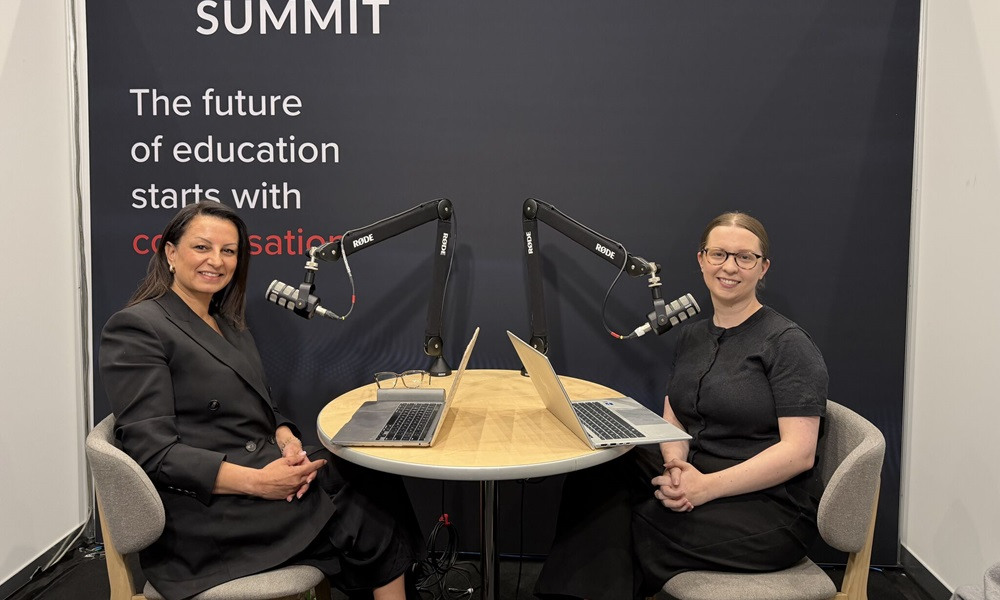
Thanks for tuning in to this podcast from Teacher Magazine, the resource for K-12 educators published by ACER, the Australian Council for Educational Research. I'm Dominique Beach.
We are here at the National Education Summit in Melbourne to record this special podcast episode live. I am delighted to have Professor Miriam Tanti sitting across from me today. Miriam has just presented at the AI in the Classroom conference at the summit where she spoke all about the rationale behind a brand-new guide released by her and her colleagues called The Science of Learning and Generative AI. In our conversation today, we are going to dissect the guide a little bit. We're going to talk all about the intersection of the science of learning and generative AI. I am so excited to get started.
Dominique Beech: So welcome, Miriam. Before we get into our topic for today's chat, I'd love if you could tell our listeners a little bit about yourself, your role at La Trobe University, and also a bit about your career in education so far.
Professor Miriam Tanti: Thanks, Dominique, and thank you for having me here today. It really is a privilege, and it was a privilege to present this morning also to all of the educators that made the time to come. So, I want to thank them too – a bit of a shout out.
So, my career, so yes, as you said, I currently work at La Trobe University where I am the Deputy Dean of the School of Education. La Trobe University, for those of you that don't know, is the only true Victorian university because we have 5 campuses across all of Victoria that span sort of the regions but also the Metro Melbourne. But we've also expanded into New South Wales. So, I'm actually Sydney based, but obviously work across both Victoria and New South Wales in my role. I'm also very newly one of the co-directors of the AI Institute of the university; so we have a very clear strategy around AI first principles university-wide. And I'm again very fortunate and privileged to be in that leadership role too that looks at strategy more broadly across education.
But I often like to remind people or let people know that I started as a teacher, as a high school teacher. And I've been teaching for a very long time. And I would say that is my number one first vocation job was being a teacher. I used to teach computing studies in secondary schools, and in the early 2000s I actually found myself as Head of Computing of quite a large independent boys school. And I love to share these, some of the stories and some of the memories and some of the key challenges that I dealt with when I was Head of Computing Studies – sort of seems worlds apart from what we're dealing with right now. … we had computer rooms, so they were laboratories filled with computers. And each computer had a mouse and a keyboard, but the mouse had a mouse ball in it. And the boys used to love to take the mouse balls out, bounce them around. They used to take the keys out and replace the keys in the keyboard to spell out really questionable words. And they were really, some of the big challenges of, that I was dealing with at the time. And it's a really far cry from the challenges that we're dealing with today in terms of GenAI. But I say challenges, but I also mean opportunities, because I think it presents a really big opportunity as well.
And then just the other big sort of significant moment for me and what's led me down a career into academia is I was also in schools in 2008 when Kevin Rudd sort of famously, stood up in front of everybody with a laptop in his hand announcing the Digital Education Revolution. And, he stood there with the laptop saying that every single student was going to get one and it really was going to transform education. But I was in schools at the time on the ground and I was thinking, ‘it isn't going to be as simple as handing every single student a laptop’. There was no professional learning for teachers, no real assessment of school infrastructure, limited planning about how it was going to fit into teaching and learning and how it was going to change, potentially, teaching and learning. So, it was the opposite of everything I understood, you know, the effective integration of technology and education to me. And it was that experience that actually ultimately led me to pursue the PhD.
And the PhD is really interesting, sort of a real pivotal moment for me because it was what I developed, and my research was a slow pedagogical approach to technology-rich education. So, I really played on those metaphors of fast food versus slow food; so fast school versus slow school. You know, and I was advocating for this more deliberate, reflective, human-centered use of technology. And, you know, I wanted to make it about time and honouring time, connection between people, purpose and what are the conditions that really allow students to learn. … and whilst I wrote it back in 20 (I think I finished it in 2014) – still so relevant to today. And so, and I really was quite deliberate in the subtitle of that, which was the vision for the long now. Because yes, we need to learn from our past, but our current present has a responsibility for not just the present, but the future. It's this continuous understanding and conception of time. And that still drives me, my philosophy, all of my work today. And I probably should revisit that actually!
DB: So, as I said at the start, you've released this new guide for secondary school teachers called The Science of Learning and Generative AI (Tanti, et al., 2026). As the name suggests, the guide brings those 2 things together and looks at the intersection of those 2 things. I'm sure this is something that teachers are thinking a lot about on their own, in the classroom, talking about it in the staffroom. So, the fact that you've produced this guide, which is really practical for secondary teachers, is really exciting. Before we get into what's actually contained in the guide, what was the rationale for actually producing it in the first place?
MT: So just for those that are listening, so The Science of Learning and Generative AI Guide is freely available for everybody to download. So, you just search Science of Learning, Gen AI Guide, hopefully there's a link or a link that's available, and then the guide will come up. It's free to download and we would love everybody to share it.
And the rationale – I mean, after I worked in schools, I worked with pre-service teachers, I worked with systems and schools and teachers. That's predominantly much of my work today. And so, in that work, on the ground working with teachers in schools, they were asking us for evidence-informed practice. Well, what does this actually look like for me in my classrooms? Because there's a lot of information on material around frameworks, position statements, policy documents, really sort of broad, global, responsible, ethical use of AI – which are all extremely, extremely important. But there wasn't actually anything on what does this actually look like for me in my classroom? What does the evidence tell me works?
And so, we wanted to produce a guide that wasn't just focused on technology. This isn't about how to prompt and how to create an agent. This is about what we already know about the Science of Learning and what effective teaching and learning looks like. So, we use that as our foundation and where can we use GenAI to amplify that or to support learning so that we ensure that cognition – the things that we know that are important for learning, to make learning stick – remains at the heart of all of that teacher teaching practice.
And so, whilst the guide is theoretical, I'm not going to say it's not, we do go into the theory of Science of Learning, but we've also created these 4 really rich classroom vignettes. They sort of take teachers through step by step: This is what it looks like in a year 10 science class when you're teaching greenhouse gases, when you're using a chatbot for the very first time. So, and we walk teachers through that particular process. This is what it looks like, you know, for a year 10 Commerce teacher who wants to teach or use agents as a way to really apply strict guardrails or use it as a way to undertake retrieval practice. So, the guide is theoretical, yes, but it is very much about connecting that theory with practice for teachers.
DB: Yeah, it's not a surprise necessarily to hear that teachers are really craving that evidence-based information to support them on the ground in their classrooms. I'd love to ask you though, because you've worked so closely with secondary schools and secondary school teachers – in general when it comes to the topic of generative AI, what are they telling you? What are they concerned about? What are they excited about? Where do they need more support?
MT: So, what's been really interesting is we are working right now [nationally] with systems and schools because we are all grappling with the same questions. You know, what does evidence informed practice, meaningful integration, look like? And so, we've worked a lot with teachers, in particular secondary school teachers, in trying to understand: What are you currently doing right now with GenAI?
And we were fortunate enough to work quite closely with an education system that had deployed [Microsoft] Copilot to all of their teachers. And we were able to undertake an evaluation of that deployment. And so, we were looking at not just usage, but we were looking at, well, what is the impact of that use on teaching and learning? And what we discovered was that a lot of the teachers that were using Gen AI were using it in what was really quite thoughtful and pragmatic ways. So, the usage wasn't the problem. There was quite high levels and sustained levels of usage. But what we were finding was that the usage was focused on productivity and efficiencies: How am I going to use this for administrative purposes to help me craft that email, to help me collate those documents, to help me differentiate my lessons? But what we saw less of was the confidence, knowledge and understanding of: Well, how do I bring this into my classroom? What is the evidence telling me that will make this effective in classrooms?
And so, we were seeing a lot of that. And then just on that, interestingly, with that same study, we actually also spoke to students. And what we found was – and these students also had access to Gen AI tools as well – and what we found that these students (and we were talking year 8 through to year 12, so, quite a broad range of students and across multiple schools) they were all using Gen AI in some way, shape or form. They weren't necessarily using the system-sanctioned GenAI, but they were genuinely trying to use it for learning. So, they spoke to us about how they pop their notes in to create a podcast so that they can listen on their way to school. They talked about creating flashcards to help them revise for exams. They spoke about using AI as a way to explain concepts that they didn't quite understand in class. And then we also then asked them, ‘Well, how did you learn how to use these tools?’ And all of them were self-taught. So, it was predominantly by experimentation and trial and error. So, we've got teachers in schools using it, but not necessarily bringing it in to teach students, but we know students are using it as well; and so, it was just trying to bridge that gap.
DB: And so, to bring us back to the guide, at the very beginning of the guide, you present a framework that positions the GenAI challenge for teachers. To give our listeners a bit of an idea of what that framework kind of looks like, there's an inner circle that's split into four quadrants, and then there's an outer circle. If we work from the outside down into the middle, the outside circle really looks at where learning begins. So, you signpost attention, working memory, long-term memory, all of those key kind of cognitive load theory concepts. Can you tell me a little bit about, thinking about where learning begins, can you tell me a little bit about the impact that GenAI can have on how students learn? How can it support learning, but then also how can it undermine that learning?
MT: So, if I just start with that outer ring – and I really do appreciate that you've looked at the framework like that because it is really critical and it does underpin the entire structure of the guide. And the outer ring is the familiar part for teachers, as you've just described – attention, working memory, long-term memory. These are what we call the architecture of learning as cognitive science understands it. So, they're the knowns of teachers. And so just in a nutshell – and I'll get to the undermining and the impacts of GenAI on cognition – but essentially, for those of you that might be new or for listeners that might be new to that, everything in the classroom is competing for a student's attention. And so, attention really acts as the filter, and it pulls forward whatever it sees is the most relevant at that time. And I would like to think that teachers have designed well-planned lessons, so we've got really coherent instructional design in place; so, they're focusing in on the new information that the teacher is presenting. Whatever then gets through that attention filter goes into working memory. And that's where the thinking happens. But working memory is quite tiny and limited and it's only a temporary space. And so whatever sits in there for too long and is not processed is really quickly quite forgotten.
And so, to really remember something, a student has to actually do something with the information that is in their working memory. So, they have to connect it to what they already know. They have to rehearse it, apply it, use it, answer a question, undertake an assessment task, etc. So, it's that real ‘doing’ action. And that's what moves it from working memory and into long-term memory. And so, every time working memory connects to long-term memory, what happens is that new information [grafts] onto, the structure we call a schema, which is sort of like that branch-like structure. And so, the whole point and our purpose is to really expand that structure and deepen that schema so that we can free working memory to tackle the harder bits of the problem, to come up with and interrogate complex parts of arguments, to think really critically or interrogate quite rigorously. And so, you can see how teaching and learning and instructional design is a really important part of that particular process.
So those moments where you’re sort of made to recite something, answer questions, remember it, they are really critical to moving things from working memory to long-term memory and what we call that schema building process.
So, what happens when GenAI becomes part of that process? If we don't intentionally build GenAI into that particular process, into instructional design – not necessarily task design, but looking at the full continuum of learning – the risk is that students are going to outsource those cognitive processes to GenAI. Because we know that it really, I mean, GenAI can produce a really fluent, comprehensive answer to the question in 2 seconds flat and so the temptation to offload is really quite high.
And when we use – I just want to add one point because I did use the term cognitive offloading, but there's a really great piece of work, who my colleagues Jason Lodge and Leslie Loble worked on, all about cognitive offloading (Lodge & Loble, 2026). And they actually describe, there are benefits to cognitive offloading, but there's also detrimental cognitive offloading.
And so, in the example that I just provided there, when they're completely cognitively bypassing learning, that's detrimental offloading. So, we know that it is there that it can remove the need for students to do that cognitive work. And that's the work that's the desirable difficulty. That's the work that makes learning stick. So, we need them to do that particular work. And then the other danger is the actual opposite – it can make students feel like they've actually understood the concept. So, it produces this really fluid answer. They read it and they go, ‘Okay, yeah, I know this’. But because their working memory is not actually processing anything, they haven't actually remembered it, so there's no durability of knowledge. And so, it becomes what we call this illusion of mastery – which is equally as dangerous because there's no schema building, no long-term memory, but there's that sense of confidence that, you know, I really actually do know it.
So, we've got the 2 sort of real things that we need to be able to plan for and the real sort of implications of GenAI use. So, what the guide does is we provide advice on how to scaffold against that detrimental offloading so that we can hold fast to those cognitive, really important cognitive processes that build schema.
DB: And so, let's look at the inner circle of the framework then. I mentioned earlier there's 4 quadrants in that inner circle. Those 4 areas, 4 quadrants signpost 4 areas where GenAI and the science of learning intersect. Can you tell listeners what those 4 areas are? And I'm also curious about, why are these the 4 key areas? How did you determine that these are the 4 key areas?
MT: Yeah, thanks Dominique. So, what we've always said is that whilst the technology is new, cognitive architecture, and the evidence that we know informs it, isn't new. And so those 4 key focus areas are actually not new.
And so, we've looked at, at the level of learning we don't need to design a completely new pedagogy. We're not making this really big leap into this unknown, sort of, frontier. Let's use what we already know about cognitive science and the Science of Learning that works, that the evidence tells us works. And so, you know, students still learn by building knowledge, connecting new ideas to what they already know, practising retrieving information from memory and then receiving feedback. And so, the 4 areas essentially came out of asking exactly that. Where might AI impact those processes most? And so they're the 4 places that we wanted to start with where we felt that GenAI could genuinely improve, or help, a student; but obviously equally the 4 places where GenAI might actually also impede the learning and the cognitive processes.
So, as you said, at the point of attention and cognitive load, we've got memory and knowledge, the transfer of that knowledge, and then those 3 areas are all underpinned by – even though there's 4 areas, there's actually 3 with the fourth, which underpins all of them – and I don't think educators will be surprised by this one, Metacognition and self-regulation. Because none of the others are going to happen reliably without a student having the knowledge, skills, ability to notice their own thinking and then to act and be responsive to that.
DB: Yeah, that's what I, it's also no surprise that that's the area that I wanted to hear a bit more about, that metacognition and self-regulation. Can you give me a little bit more detail on how this area does intersect with the others, perhaps an example?
MT: Yeah, sure. So, we drew – and you'll see in the guide if you have a look at the framework, and that framework's on page 7 for those of you that are following along – whilst metacognition is in the inner circle, it's actually a dashed border rather than a solid one because it's the thread that holds them all together. So, it's an awareness, the metacognition part is an awareness of their own thinking and then the self-regulation is whether or not they act on it. So, the others are not going to happen without it.
And a student can be given a really well-designed task with a load well managed, but if they don't recognise that they've stopped understanding or that there's been a misunderstanding and they don't do anything about it, or if they don't retrieve knowledge from memory, then they're unlikely to build those really important levels of cognition.
And so, the other reason we've sort of really called this out is because the research around GenAI – so the early research that we're seeing come out of GenAI – will tell you that students with limited knowledge in this particular domain are the students who tend to have more weaker metacognitive habits to begin with. So, they are more likely to engage in that detrimental cognitive offloading. They're the ones that are most likely to go to ChatGPT and just produce this really fluent answer and then submit it as their own. And so, we wanted to make sure that we really called it out.
And just on that piece of research – this may be of interest – there was research done earlier this year by an academic named Fan and his colleagues (Fan et al., 2024), and they gave students (117 university students) the same writing task, but they gave them all different kinds of help. So, one group used ChatGPT, one worked with a human expert, one used a writing analytics tool, and one didn't have any support at all. And they looked at how motivated the students were afterwards (so, after they had used the tools or the supports). And, interestingly, the ChatGPT group had the best essays. I know. So, they had the biggest improvements from any group – but when they took that technology away, they weren't able to transfer that knowledge into other settings.
And, I mean, interestingly, I'd love to see them follow up that with the durability of that particular knowledge too, but what the process data showed – so they actually looked at what processes students engaged in with ChatGPT – was the students actually handed over the monitoring and the evaluation part. So that meant that they didn't actually notice when things might not have been working or determine, ‘What should I fix next?’ because they've completely offloaded those processes to ChatGPT. And so, they titled, they called it, or they labelled it, metacognitive laziness. And so, that's why we need to make sure that metacognition self-regulation is something that we call out, we work with our students about, and that's why it sort of underpins rather than sits sort of beside the other 3 focus areas.
DB: Yeah, that's a really important reminder. I was lucky enough to attend your session this morning at the National Education Summit. And as you mentioned earlier in our conversation, the guide includes 4 classroom vignettes. And you spoke a little bit about that in your session today. What I really loved is you shared an example of how one teacher was using (or not using) Gen AI when introducing a brand-new concept for students in the classroom. I'd love if you could talk to our listeners a little bit about an example like this. Could you provide us an example of how you can, as a teacher, use Gen AI intentionally and appropriately during a lesson?
MT: Absolutely. And so, and this is why the guide's really important because we start with the Science of Learning. And so, you know, the example that I used in the presentation was a year 10 science class and it was a teacher who was teaching greenhouse gases. And the science, the content, curriculum content, was new on greenhouse gases, but this teacher had also never taught her students how to use ChatGPT as well, or GenAI in this particular instance. And so, because in this class using an AI chatbot for genuine learning was new, and it is a new skill in itself, and like any new skill – like science curriculum content, like mathematical content – any new skill needs to be taught explicitly. And so, the teacher designed the lesson around the explicit teaching of both the science curriculum content, but also GenAI, how to use GenAI.
And so just very briefly is that, you know, they started by activating schema. And that was a no AI. So, what do students already know about what I've already taught them about greenhouse gases? Let's activate this schema so that at least they're ready when I introduce new knowledge that we can connect it really easily to long-term memory. And then the next part of the lesson was, ‘Okay, now I'm the expert here. I'm going to start modelling how to intentionally use GenAI’. So, the teacher is the expert and if we look at students, in terms of their domain knowledge and understanding of how to use a chatbot, are novices. And so, as an expert user we have to model and it's not just about giving a starting prompt, but it's about telling them, ‘Well, this is the starting prompt I'm crafting and why I'm crafting it’, ‘This is the answer that the chatbot has given me. And now what is my follow up question?’ So, it's just working through very methodically how you as an expert use and engage with GenAI as a way to get feedback, as a way to revise work, but never as a way to just get answers through.
And so, within that particular lesson that I sort of described, there were moments of really low-stakes retrieval: ‘Okay, you've now done this, turn to your shoulder partner, tell them what it is that you know’. No AI. So, it's that constant, we're going in and out of the learning environment where GenAI is never the focus, but the learning is always part of the focus. And so that modelling then becomes, as students gain confidence is because what that teacher's done is really planned for cognitive load – so we're removing some of that extraneous load to make sure that students aren't being overloaded with too much information, but also intrinsic load because I know where my students are at. And then as she moves through that cycle, she then gradually releases responsibility so that students can then work, obviously guided by the teacher, but then to independent practise. But we don't have this competing and overwhelming of knowledge where they're having to learn the new, how do I use a chatbot or an agent, but also how do I use or understand curriculum, the curriculum content?
DB: Yeah, that's such a great example. Just finally, Miriam, I know that this is an area, GenAI in general is an area where teachers are desperate for more research and evidence. We know the research is very much still emerging in this space. Considering your work, what are some future opportunities for research? Where do you see the next step being?
MT: So, we are working on 2 really exciting pieces of research. One is – we've heard from a lot of primary teachers, you know, ‘This is a guide for secondary, where's primary?’ We get it. But right now, you know, GenAI is really for 13-plus. Often, it's parental consent for, you know, under 18 years of age. And, in terms of evidence of impact on cognition, we're not quite sure without that evidence that we should be promoting this in primary – and we sort of call that out really up front in the guide.
That said, what we're working on – in the same way that mathematics in particular has an instructional hierarchy, we're working on something very similar to that for AI. And it might not actually include AI tools themselves, but the thinking that's needed to engage with the changing nature of that technology. And that will be a continuum from primary all the way through to high school.
And then the other piece of really exciting work that we have started is we're working with cognitive neuroscientists, because we don't have objective evidence right now. So, we've used the science of ... to underpin our work. But what we're doing is we are working with 14-year-olds, so year 9 students. We've given them a year 9 literacy test, year 9 NAPLAN numeracy test, under 3 different conditions. So, no AI, we want you to complete the task, go for it. Completely detrimental offloading, so we want you to bypass, go straight to ChatGPT, get it to give you the answer. And then this scaffolded intentional use. So, whilst they're doing those 3 tests, we've got EEGs on them and eye-tracking software. So, we are looking at what actually is happening neurologically in the brain; so, we're trying to understand what actually is the impact on both cognition and on attention, too.
And so, it's really early days. We've been out to several schools already. But the results are really promising and we're really hopeful that … and it's sort of affirming the work that we are already doing. And so, we’re looking forward to releasing that data in the next few months. So that'll be really exciting.
DB: Great. I'm really looking forward to that too. We'll have to keep an eye out for that.
MT: Absolutely. We will share that widely, don't worry.
DB: Definitely. Thank you so much, Miriam. I really enjoyed our conversation today. It was great to sit down with you. Thanks for joining us.
MT: Thank you, Dominique. And I'm also open to working with schools, systems … so if any of your listeners are keen, please feel free to reach out. We're always happy to help.
DB: Great. Yeah, we'll leave your details and of course a link to that free guide that we've been talking in depth about today on our website, teachermagazine.com, so everyone can find and access it and know where to find you.
MT: Great.
DB: Thanks, Miriam.
MT: Thank you.
Well, that's all for this episode. Thanks for listening. It was really enjoyable to do a live podcast recording at the National Education Summit with Miriam. So, I hope you enjoyed the conversation as much as I did. Don't forget to visit our website, teachermagazine.com, to access the transcript for this podcast, where we've included a link to the free guide we spoke about today. If you enjoyed this chat, please take a moment to follow our show on your podcast app if you haven't already and leave us a review. Both of those things help more people like you to find our podcast and they're a really big help for our team. We'll be back with a new episode very soon.
Teacher Magazine is published by the Australian Council for Educational Research.
Enquiries about the guide discussed in this podcast can be directed to Professor Miriam Tanti at m.tanti@latrobe.edu.au.
References
Fan, Y., Tang, L., Le, H., Shen, K., Tan, S., Zhao, Y., Shen, Y., Li, X., & Gašević, D. (2024). Beware of metacognitive laziness: Effects of generative artificial intelligence on learning motivation, processes, and performance. British Journal of Educational Technology, 56(2), 489–530. https://doi.org/10.1111/bjet.13544
Lodge, J. M. & Loble, L. (2026, March). Artificial intelligence, cognitive offloading and implications for education. University of Technology Sydney. https://doi.org/10.71741/4pyxmbnjaq.31302475.v2
Tanti, M., Maddox, A., & Phillips, E. (2026). The Science of Learning and Generative AI: A guide for secondary teachers. La Trobe University. https://doi.org/10.26181/32775462
As a secondary school teacher, how could you model the intentional use of a GenAI tool to students? How would this use support learning, rather than undermine it?
How are students currently using GenAI in your context? Have you noticed any examples of an ‘illusion of mastery’?