The student thinking we must not take away

In his latest Teacher column, Professor Martin Westwell, Chief Executive of the South Australian Department for Education, argues explicit instruction, classroom technology and AI raise the same essential question: who is doing the thinking? ‘The aim is not to make learning harder. It is to make sure the hard thinking is happening in the right place.’
Whenever I visit a classroom, I try to look beyond what students are doing. The room might be busy and orderly. Students might be answering questions, creating presentations or enthusiastically competing in a digital quiz. All of this can look like learning.
But I find myself wondering: what are the students actually thinking about?
More than a decade ago, Rob Coe (2013) warned against what he called ‘poor proxies for learning’ and his challenge has stuck with me ever since. Students can be engaged, motivated and producing lots of work without necessarily learning what we intended. His deliberately simple formulation was that learning happens when people have to think hard.
It is not a complete definition of learning, and students have to be thinking about the right thing. But it is a powerful question to bring to 3 current conversations in education about getting the balance right – explicit instruction, classroom technology and artificial intelligence.
All raise the same essential question: who is doing the thinking?
Cognitive load theory (Sweller, 1988) helps explain why thinking hard is not the same as unproductive struggling. Our working memory is limited, particularly when dealing with unfamiliar information. Long-term memory gives us access to organised knowledge that makes increasingly complex thinking possible.
For a novice, being asked to discover an unfamiliar principle can mean spending considerable mental effort searching for an approach, remembering instructions and trying to work out what matters (Kirschner et al., 2006). That effort is real, but it may not help the student understand the intended concept.
This is a compelling case for explicit instruction in the early stages of knowledge and skill acquisition. Clear explanations, carefully chosen examples, modelling and guided practice can remove unnecessary demands so students can concentrate on the thinking that matters.
But we can go too far in the other direction, too.
Imagine a teacher explaining 6 mathematics problems while students carefully copy each step. The explanation may be excellent. Student responses in narrow assessments may be correct. Yet the teacher may be doing all the deciding – which method to use, why it works and how to check the answer. Students can be attentive without thinking deeply. Guidance should reduce unproductive search while creating opportunities for productive thinking.
We can think about classrooms as places where we might be in one of 4 situations (see figure below). We know that the sweet spot for effective learning is low unnecessary load and hard thinking. Getting the mix wrong can lead to confusion, unproductive struggle and passive reception.
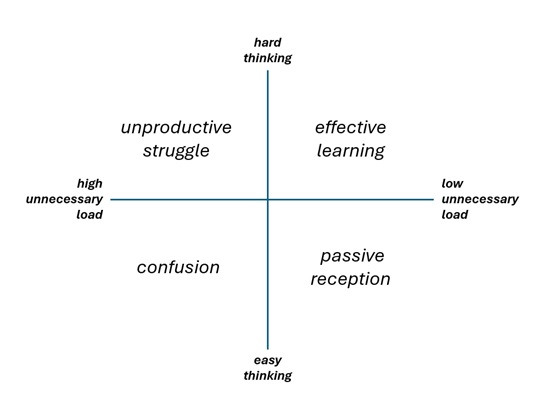
Of course, these are broad tendencies rather than fixed rules. Easy thinking might be valuable when consolidating learning, and hard thinking is only productive when it serves the learning we intend.
Technology raises much the same issue.
Digital activities can be engaging, colourful and enjoyable. Students might spend a lesson making an animation, navigating a game or perfecting the design of a presentation. But what have they had to understand to complete it? Sometimes, the intellectual work is central (low unnecessary load; hard thinking). At other times, most of the effort goes into navigating software, selecting images or earning points (high unnecessary load; easy thinking)
Enjoyment is not the enemy of learning. Nor is technology. A well-designed simulation might make an otherwise inaccessible concept understandable. Immediate feedback provided by an app might help students identify a misconception. But entertainment, activity and polished products are still poor proxies for learning.
UNESCO's (2023) report on technology in education makes a similar point: the value of technology depends on the educational purpose it serves, and digital technology may increase student engagement without necessarily improving learning.
Generative AI makes the question sharper still.
Jason Lodge and Leslie Loble (Lodge & Loble, 2026) have helped bring clarity to the challenge of cognitive offloading and the pitfall of ‘bypassing desirable difficulties’. Bypassing things that don’t need to be difficult can be helpful; we do this all the time. A calculator lets us focus on a larger mathematical problem. A reminder frees us from having to remember an appointment. Offloading can be sensible and powerful.
But education presents a dilemma. What if the thinking we offload is precisely the thinking through which learning would have happened?
If a student asks AI to construct an argument, solve an unfamiliar problem or produce an explanation before they have attempted it, the finished product may be impressive, but the student's understanding may be unchanged (low load; easy thinking). We have made the task easier to complete, but perhaps harder to learn from.
We are seeing examples of how unproductive AI use can lead to low-load, easy-thinking experiences and the negative impact on learning (for example, Bastani et al., 2025; OECD, 2026).
The lesson is not to keep AI out of learning. It is to design its use around learning. AI can pose questions, offer hints, challenge explanations and help students test their reasoning. But we should be able to say which cognitive work the technology is doing, and which work the student must still do.
This matters for student agency as well. Explicit instruction is not supposed to produce dependence on the teacher. Nor should technology produce dependence on a tool. As knowledge grows, guidance should change, and students should take increasing responsibility for their own judgement.
As Lodge and Loble conclude: ‘The challenge of AI is fundamentally pedagogical, not technological. Its effect on learning is determined by the instructional context and the learner’s goals.’
Three questions could guide us, whatever the teaching approach or technology.
What do I want students to learn?
What will they actually have to think about?
And have I removed an unnecessary obstacle to that thinking, or removed the thinking itself?
The aim is not to make learning harder. It is to make sure the hard thinking is happening in the right place.
References
Coe, R. (2013). Improving education: A triumph of hope over experience [Inaugural lecture]. Centre for Evaluation and Monitoring, Durham University. https://5191137.fs1.hubspotusercontent-na1.net/hubfs/5191137/attachments/publications/ImprovingEducation2013.pdf
Bastani, H., Bastani, O., Sungu, A., Ge, H., Kabakcı, Ö., & Mariman, R. (2025). Generative AI without guardrails can harm learning: Evidence from high school mathematics. Proceedings of the National Academy of Sciences, 122(26), https://doi.org/10.1073/pnas.2422633122
Kirschner, P. A., Sweller, J., & Clark, R. E. (2006). Why Minimal Guidance During Instruction Does Not Work: An Analysis of the Failure of Constructivist, Discovery, Problem-Based, Experiential, and Inquiry-Based Teaching. Educational Psychologist, 41(2), 75–86. https://doi.org/10.1207/s15326985ep4102_1
Lodge J. M., & Loble, L. (2026). Artificial intelligence, cognitive offloading and implications for education. University of Technology Sydney. https://doi.org/10.71741/4pyxmbnjaq.31302475.v2
OECD. (2026). PISA 2025 Results (Volume I): Future-Ready Students. PISA, OECD Publishing. https://doi.org/10.1787/73451bc5-en.
Sweller, J. (1988). Cognitive load during problem solving: Effects on learning. Cognitive Science, 12(2), 257–285. https://doi.org/10.1207/s15516709cog1202_4
UNESCO. (2023). Global Education Monitoring Report 2023: Technology in education – A tool on whose terms? UNESCO. https://doi.org/10.54676/UZQV8501