There's room for everyone to SPARKLE – leading with purpose and heart

I have always loved a bit of sparkle. Not necessarily the glittery kind (although I certainly don't mind that either!), but the kind you see in people. That special something that makes someone light up when they talk about their passions, the energy they bring to a room, or the way they make others feel valued, capable, and inspired.
I first started talking about SPARKLE some time ago now, in relation to STEM teaching, something I did for many years; but over time, and as my roles have shifted, I have learned that the SPARKLE equally applies to leadership.
One thing I have learned as I have fumbled my way in various leadership roles, is that leadership isn't about being the brightest person in the room. In fact, I'd argue that some of the best leadership happens when we're not the ones shining at all. It's when we help someone else discover their confidence, recognise their strengths, or find the courage to step forward.
Through my role as Associate Principal at Dayton Primary School in Western Australia, my work as President of the Australian Council for Educational Leaders (ACEL) WA Branch, and my ongoing journey as a doctoral student, I've had plenty of opportunities to reflect on what leadership really looks like. And I've learnt that it isn't always particularly glamorous. Often leadership involves making difficult decisions, navigating uncomfortable conversations, admitting you don't know the answer, or doing the things that nobody else particularly wants to do. Sometimes it's about stepping up and other times, it's about knowing when to step back.
These experiences led me to develop what I've called The Leadership SPARKLE(S) – a collection of 8 interconnected leadership qualities (based on the SPARKLES acrostic acronym) that I believe help us lead with greater authenticity, purpose, and humanity. It's not a new leadership theory, nor is it another checklist for already busy school leaders. Instead, I see it as a compass to help us reflect on how we show up, how we influence others and, most importantly, how we help others shine. Because I genuinely believe that there is room for everyone to sparkle!
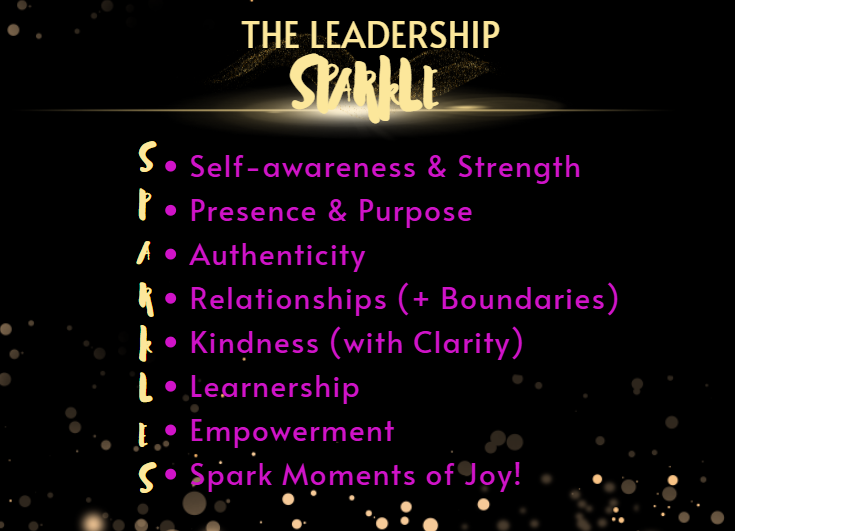
S – Self-awareness and strength: Knowing yourself before leading others
I have learnt that you need to know yourself well before you can lead others well. Leadership has a remarkable way of holding up a mirror; you quickly discover what you're good at, what challenges you and which situations bring out the best (and occasionally the worst) in you. I've always been someone who likes to get things done. I enjoy being involved, solving problems, and making things happen. These can be useful leadership strengths, but I've also learnt that they can become limitations. When you're someone who likes to help, it's easy to take on too much, say ‘yes’ too often or jump in to solve a problem that someone else could work through themselves. Self-awareness requires us to recognise both sides of our strengths.
At Dayton, where we've been building a school culture since opening in 2023, I've learnt the importance of being clear (with myself and others) about what I value and why. Our commitment to belonging, engagement, wellbeing and success provides an anchor for the decisions we make in our school. But more than that, self-awareness requires me to reflect honestly on whether my own actions consistently align with those values, and whether the choices I make show others what I stand for.
One reflection I often return to, was a task Holly Ransom asked us to do in the Epic Leadership Challenge. This is to consider: If you met your future leadership self, what would you hope people remembered about you? I doubt many of us would say we want to be remembered for our efficient emails, perfectly organised meetings, or impressive to-do lists. We'd probably hope to be remembered for how we made people feel, what we stood for and the difference we made. That's a useful place to begin with when reflecting on who we are as a leader.
P – Presence and purpose: The power of showing up
In schools, it's remarkably easy to be busy without being present. There's always another email, another meeting, another issue requiring our attention. School leaders can spend an entire day doing important work and still feel disconnected from the very people they're there to lead.
One of the things I've come to value at Dayton is the significance of everyday interactions. Being visible around the school, visiting classrooms, greeting families, checking in with staff, and noticing the small things that might otherwise go unseen. These moments might seem insignificant, but collectively they help shape culture.
A genuine conversation with a staff member can communicate more care than a beautifully written wellbeing statement. Visiting a classroom and noticing effective teaching can be more powerful than another whole-staff email about instructional expectations.
Presence, however, goes beyond physical visibility to being genuinely attentive. We need to consider: are we listening to understand, or listening while mentally composing our next response? (Something I am still learning!) Are we noticing when someone seems different from their usual self? Are we making time for people, even when the demands of leadership are pulling us in multiple directions?
Purpose matters as well and connects to our self-awareness. If we understand who we are as a leader, our strength and lesser strengths, and we know what we stand for, we can then consider what is our purpose in our current role. What is life asking of us right now? To sparkle as leaders, it helps if we connect the everyday work of schools to something bigger. At Dayton, we regularly return to our shared vision and the kind of school community we're building. When expectations are clear and connected to a collective purpose, they're much easier for people to understand and embrace.
Being present helps people feel seen, and being purposeful helps them understand where we're going; and we need both.
A – Authenticity: Being unapologetically yourself
Authenticity is something I have grappled with over the years. Sometimes we get the message that when we show up as ourselves that it is ‘too much’ or even not enough. That, perhaps, we don’t display the traits typical of a leader. This can lead to temptation in leadership to become the leader we think we're supposed to be. We observe people we admire, absorb ideas about what successful leadership looks like and sometimes begin to believe we need to fit a particular mould. But I have learnt that there's something incredibly powerful about leading as yourself.
I've had the privilege of connecting with educational leaders from across WA and beyond through ACEL. Their contexts, personalities and leadership styles vary enormously. Some are quietly reflective; others are energetic and outspoken. Some lead through compelling vision, others through their remarkable ability to connect with people. What stands out isn't that they all lead in the same way, it's that the most impactful leaders seem to understand who they are and lead from that place.
For me, authenticity means bringing my personality, enthusiasm, and values into my leadership. It also means being prepared to acknowledge mistakes, admit when I'm uncertain and recognise that I don't have all the answers. As educators, we encourage our students to take risks, learn from mistakes, and embrace challenges. Yet, as leaders, we can sometimes feel an expectation to project certainty, even when things are anything but certain. I think our teams benefit from seeing that we're human.
Authenticity doesn't mean sharing every thought or emotion, nor does it excuse unprofessional behaviour, but it means being genuine, consistent, and sufficiently secure to say, ‘I got that wrong’, or ‘I'm still figuring this out’.
After all, why would we expect our teachers to be reflective learners if we're unwilling to model that ourselves?
R – Relationships (with boundaries): Warm and demanding
Relationships sit at the heart of everything we do in education. At Dayton, we've deliberately worked to build a culture where people feel they belong. As a relatively new school, we've had the opportunity, and responsibility, to establish expectations, traditions, and ways of working together from the beginning. One of the leadership principles I keep coming back to is the importance of being warm and demanding.
Sometimes these qualities are presented as opposites. We can be relational or we can have high expectations. We can be supportive or we can hold people accountable. But why should we have to choose? In my experience, strong relationships actually make high expectations possible. When people know that you care about them, believe in their capabilities and genuinely want them to succeed, challenging conversations become more constructive. That doesn't mean they're easy! It means we've established the relational trust that allows us to have them.
However, relationships also need boundaries. I've learnt that being friendly isn't the same as being everyone's friend. Being approachable doesn't mean being available every minute of the day. And being supportive doesn't mean taking responsibility for everyone else's problems.
This has been an important learning curve for me. School leaders can become very good at looking after everyone else while quietly neglecting their own needs. We say yes because we want to help, take on extra tasks because we know we can do them, and sometimes feel guilty when we finally say no. It is important to acknowledge that boundaries aren't a rejection of relationships, they are a significant part of sustaining healthy ones. Indeed, sometimes the most respectful thing we can do is be clear about what we can and cannot offer.
K – Kindness (with clarity): Being kind, not just nice
This is one of my favourite leadership distinctions. There is a difference between being nice and being kind. Being nice often feels good in the moment. It can involve keeping people happy, avoiding conflict, or telling someone what they want to hear. Kindness, however, sometimes requires considerably more courage.
As school leaders, we're regularly faced with situations where the easiest response isn't necessarily the right one. Perhaps a staff member isn't meeting agreed expectations, a difficult conversation needs to occur with a parent, or someone wants an exception to a process that exists for an important reason. It can be tempting to soften the message, postpone the conversation, or avoid the discomfort altogether. But what does that achieve? Usually, it just shifts the discomfort somewhere else or leaves the issue unresolved.
I've become increasingly conscious that clarity is an act of kindness and I love Brené Brown’s (2018) ‘clear is kind’ ethos. When we communicate expectations clearly, provide honest feedback and explain the thinking behind decisions, we give people the opportunity to understand, respond and grow. At Dayton, we regularly talk about consistency and the importance of maintaining high expectations. Yet we also recognise that fairness doesn't always mean treating everyone identically as different circumstances sometimes require different responses.
This is where leadership judgement becomes so important. Being kind means listening carefully, considering the individual and acting with compassion. Being clear means not compromising our values or expectations to avoid discomfort. We can be both clear and kind; and I believe to sparkle as leaders, we must.
L – Learnership: The best leaders remain learners
One of the wonderful things about education is that there's always more to learn. One of the challenging things about education is that there's always more to learn! My doctoral research has reinforced this for me. The more deeply I've explored teachers' experiences and the complexities of classroom practice, the more I've recognised how much there is to question, reconsider and understand. This has influenced the way I think about leadership.
I don't believe leaders need to have all the answers. But I do believe we need to remain curious, open to challenge and willing to change our minds.
Through ACEL, I've had opportunities to engage with educational thinkers, researchers and practitioners who challenge my assumptions and broaden my perspectives. I've also found that some of the most valuable professional learning happens in conversations with colleagues who see things differently.
At Dayton, we've worked to develop a strong culture of professional learning, with a focus on evidence-informed teaching, instructional practices, and collective improvement. An important part of this is recognising that learning applies to everyone, including the leadership team. We can't ask teachers to embrace feedback, refine their practice, and try something new if we're unwilling to do the same.
And learnership isn't simply about attending professional learning or reading another leadership book (although I do love a good book!). It's about what we do with what we learn. Do we question our existing practices? Do we seek different perspectives? Do we create opportunities for others to challenge our thinking? Perhaps most importantly, can we acknowledge that something we once believed strongly may need reconsidering?
Leadership requires conviction, but it also requires intellectual humility and the willingness to embrace learnership in our leadership.
E – Empowerment: Letting go so others can grow
The aspect of SPARKLE that can be particularly challenging for those of us who like getting things done is empowerment. Sometimes it genuinely is easier to do something yourself. You know what needs to happen, you know how you'd like it done, and you know you can probably get it finished quickly. But the real question is, easier for whom? If we're always the ones solving problems, making decisions, and taking responsibility, what opportunities are we creating for others to develop? Empowerment requires us to let go of some control.
At Dayton, as our team has grown from a small foundation staff to a much larger school community, I've increasingly appreciated the importance of developing leadership capacity across the school. There is enormous talent, creativity, and expertise within school teams. Our role as leaders is to recognise it, nurture it and create opportunities for it to flourish.
Sometimes this means encouraging someone to step into a leadership opportunity they're not yet confident about. Sometimes it means providing support without taking over. And sometimes it means allowing people to approach a task differently from how we would have done it and, let’s be honest, that's not always comfortable.
But if we want others to grow, we need to make room for them to do so.
My involvement with ACEL has reinforced this belief as it has highlighted that leadership isn't confined to those with formal titles. Across education, there are extraordinary people influencing others, initiating change, and making a difference without necessarily holding designated leadership positions. Empowerment is about recognising that leadership potential and creating the conditions for it to emerge. We really don't need to be the star of every show: sometimes our greatest contribution is helping someone else take centre stage.
S – Spark moments of joy: Don't forget to have fun!
Finally, SPARKLES concludes with a little reminder that leadership doesn't need to be serious all the time. Yes, the work we do is important. Yes, the responsibilities are significant. And yes, there are days when the challenges feel relentless. But schools are also wonderful places, filled with humour, energy, creativity, and moments of unexpected joy.
At Dayton, we work hard, but we also make space to laugh, celebrate, and enjoy being part of Team Dayton. Sometimes that involves a deliberately silly staff activity, a bit of fun in a professional learning session, or finding ways to recognise the everyday contributions of our colleagues. At other times, it's simply taking a moment to appreciate the amusing, unpredictable things that happen in schools.
Tracey Ezard (2021) spoke about joy bubbles – a term I have embraced joyfully! They're the moments that remind us why we love working in education. It's easy to become so focused on improvement agendas, operational demands and the next thing that needs doing that we forget to celebrate what's already going well. And there's always something worth celebrating, even if it is just some tiny wins. A teacher who has tried something new. A student who has achieved a personal milestone. A colleague who has gone out of their way to support someone else. A team that has navigated a challenging term together.
These moments matter as joy doesn't diminish the seriousness of our work; it helps sustain us through it. As sometimes, a shared laugh is exactly what a team needs.
Finding your leadership constellation
When I think about The Leadership SPARKLE(S), I imagine a constellation. Each star represents something important, but it's the connections between them that create the bigger picture.
You would have noticed the threads tying each aspect together. Self-awareness without authenticity can become self-consciousness. Relationships without boundaries can become unsustainable. Kindness without clarity can leave people confused. High expectations without empowerment can become control. And leadership without joy? Well, that can become pretty exhausting.
These qualities aren't independent, and none of us will demonstrate them perfectly every day. Nor should we expect to as leadership is complex, contextual, and deeply human. It asks us to navigate competing priorities, make decisions in uncertainty and find our way through situations where there isn't always an obvious right answer.
Some days we'll feel confident and purposeful. Other days we'll question our decisions, feel stretched beyond our capacity, or wonder whether we're making the difference we'd hoped.
That's leadership.
Rather than seeing SPARKLE(S) as 8 more things to add to an already overflowing leadership to-do list, I encourage leaders to use it as an opportunity for reflection. Which qualities come most naturally to you? Which ones require more deliberate attention? Where are you shining brightly, and where might you need to recharge? And the most important question of all: Who are you helping to shine?
Because, ultimately, I don't believe great leadership is measured by how brightly we sparkle as individuals. It's reflected in the confidence we build, the opportunities we create, the culture we shape and the people who shine a little brighter because we were part of their journey.
There's room for everyone to sparkle. Our job as leaders is to make sure they get the chance. So, shine with purpose. Lead with heart. And let your leadership SPARKLE!
References
Brown, B. (2018). Dare to lead: Brave work. Tough conversations. Whole hearts. Random House.
Ezard, T. (2021). Ferocious warmth: School leaders who inspire and transform. Tracey Ezard.