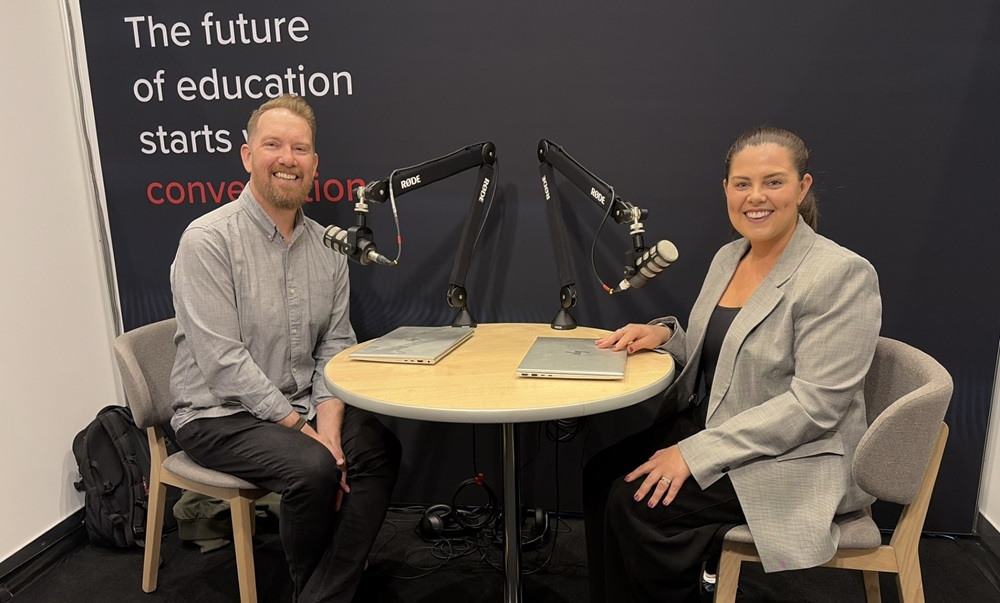
Hello and welcome to this podcast from Teacher magazine, the resource for K-12 educators published by ACER, the Australian Council for Educational Research. I'm Rebecca Vukovic, Teacher’s Deputy Editor.
I have a very special School Improvement episode to share with you today. I’m joined by my guest and colleague Jonathan Heard, a Research Fellow at the Australian Council for Educational Research. This episode is all about developing critical thinking across the curriculum and was actually recorded live at the National Education Summit in Melbourne this month. Jonathan also presented on the topic as part of the Capacity Building School Libraries Conference at the Summit. In the episode today, we’re going to be discussing the importance of having a shared definition on what critical thinking is, the connection between critical thinking and information literacy, and provide some key takeaways for teachers, teacher librarians and school leaders. And I’m also very excited to share that this episode is also available to watch in full on YouTube, so if you prefer to watch your podcasts, we’ve got you covered. Okay let’s jump in.
Rebecca Vukovic: Jonathan Heard, thanks for joining me today.
Jonathan Heard: Thanks, Rebecca.
RV: So critical thinking is one of those terms that's become increasingly prominent in education, like we see it referenced in curriculum documents, capability frameworks and discussions among educators themselves. Yet it can mean different things to different people. Drawing on your research in this area, when you talk about critical thinking, what exactly do you mean and why is it important that educators have that shared understanding of the term?
JH: So there are a thousand different definitions of critical thinking out there and as someone famous once said, ‘they're all just different ways of cutting up the same pie’. And so I guess at ACER we are contributing to the cutting up of that same pie with our own definition and framework. I guess perhaps the difference with the ACER definition of critical thinking is that we are focused primarily on the skills associated with critical thinking – the cognitive skills – which is not to say that critical thinking isn't also comprised of certain values or certain dispositions towards thinking, of course it is, but it's just that we know as an education research organisation that skills are the sorts of things that can be taught. And if skills can be taught, they can be learned. And if they can be learned, they can be measured. And if they can be measured, they can be measured over time.
So we're interested particularly in the aspects of critical thinking that can be measured as an aspect of learning over time. And that primarily comes down to the cognitive skills involved. Those skills related to interrogating information, analysing, interpreting, evaluating – that sort of thing. The other thing that might be slightly different, although not entirely different with the ACER definition of critical thinking, is that we see it as a generalised skill. So it's generalisable in the sense that we believe it's possible to think critically in every subject domain. And that's true even if critical thinking manifests differently in different subject areas. But at some level of abstraction, when students are thinking critically, they are (broadly speaking) doing the same kinds of things no matter what subject they're in.
And so we think it's quite useful for teachers to have a common general framework of critical thinking so that they've got the same language to use to describe critical thinking with their colleagues when it comes down to questions of how they're teaching critical thinking and what aspects of critical thinking they're teaching.
RV: Yeah, fantastic. Because I do want to ask you a little bit about that framework because I know that you are the lead author of the Critical thinking: Skill development framework. 2nd edition, which was published last year. For any listeners who are perhaps unfamiliar with that work, can you tell them a little bit about the framework and how it supports educators to have that really clear definitional model on which to base their understanding of critical thinking?
JH: Yeah, so the Critical Thinking Framework that was published last year is one of 5 essential skills frameworks that we published – the other 4 being creative thinking, collaboration, communication and self-regulation. But they all have much the same structure. They all have a definition, firstly, which is drawn from not only our own research in these areas, these constructs, but the definitions that arise in the research literature more broadly. But then we go that next step further by breaking that skill and that definition of that skill down into its constituent strands and even further again down into the constituent aspects within each strand.
So to take critical thinking as the example, critical thinking in our framework breaks down into 3 strands. There's the strand related to critical thinking as it relates to information, so that's what we call our Knowledge Construction strand. There's critical thinking as it applies to argumentation, which is our Evaluating Reasoning strand. And then there's the critical thinking as it applies to situations, and that's what we call our Decision-making strand. So you can see already that critical thinking, while it can be seen as quite a broad, generic, amorphous concept. Actually, already it's starting to break down into some fairly concrete areas in which we expect students in schools are expected to apply their critical thinking to information, argumentation and situations. And then again, each of those strands break down into constituent aspects. So there are 3 aspects per strand.
And so we think this kind of a framework, or as you've described it, a definitional model, is useful for teachers because it allows them to identify quite readily exactly what aspect of critical thinking am I intending to assess in this particular task, this project, this test, this assignment? And indeed, what aspect of critical thinking do I want to teach in this particular lesson? Because again, as I say, critical thinking is quite a broad and amorphous construct. It can be quite difficult to identify what aspect of critical thinking you're intending to teach if you haven't got a framework that breaks it down. So we feel that our framework is quite useful in the sense that it takes this big construct and it breaks it down essentially into 9 aspects, which we feel gives good coverage of the entire construct. And we think that provides a really useful template for teachers to use to base their assessment and their pedagogy.
RV: Yeah, fantastic. And as I mentioned in my intro here at the National Education Summit, your session forms part of the Capacity Building School Libraries Conference. Many teacher librarians would probably recognise elements of critical thinking in the work that they do around information literacy, inquiry learning and of course research skills. How closely connected are critical thinking and information literacy and where do you see the strongest overlap?
JH: So critical thinking and information literacy are very strongly related and that's not just my opinion. There are several researchers in both fields actually in the critical thinking field and the information literacy field who come to a similar conclusion. There's not complete overlap. So information literacy does and always has traditionally entailed certain skills and knowledge related to locating information, selecting that information, retrieving it, storing it, organising it, citing it, referencing it and so on, which is not really the preserve of critical thinking.
But most information literacy models accept and understand that if students are to be intellectually honest, if you like, in their information literacy tasks, then they are going to need to deal with information in ways that deals sceptically, critically, evaluative with that information rather than just to take any old information on board – to be able to process and sort and evaluate and to be able to discriminate amongst information. So there is a very strong overlap and in fact, information literacy models heavily influence the development of our own critical thinking strand. That's how strong I think the overlap is.
RV: And then building on that, how can teacher librarians use that critical thinking skill development framework to strengthen their practice and also support student learning?
JH: So I think the strand of our Critical Thinking Framework that teacher librarians would find most familiar would be our first strand, the Knowledge Construction strand. This is about critical thinking as it applies to information. And as I mentioned before, each of our strands break down into 3 aspects. So the 3 aspects in our Knowledge Construction strand are identifying gaps in information, sorry, identifying gaps in knowledge rather. So students demonstrate critical thinking when they understand what it is they know, sure, but what it is they don't know and what it is that is important for them to know, what they need to know in order to have a fuller, better, more holistic, truer, more sound or valid understanding of the thing that they're interested in. So identifying knowledge is the first part and that aligns really strongly with information literacy processes that have at the start of them, this locate, sorry, this define element, defining what it is we need to know.
The second aspect in our framework is discriminating amongst information. And this is very familiar to teacher librarians. So the skills that students need to bring to bear when they encounter information to be able to use criteria to say, ‘well, which information is credible?’ ‘What information is relevant to my purpose?’ ‘What information seems reliable versus the information that seems a bit unreliable and why?’ Even criteria around the completeness of the information or the interpretability of the information. Does the student even understand it? These are all criteria that students need to bring to the information they find in order to be able to be very selective and discriminating in what information they will then take away and use.
And then our third aspect is about interpreting and processing that information. So okay, you found these relevant, reliable, credible sources of information and you're drawing the information out from those sources. How are you going to organise that information in such a way that you're starting to develop a valid, interpretation of what that information is saying. So if you're looking at information and data, what sort of patterns are you finding? What connections can you make? And how is that allowing you to develop a valid interpretation of what that information is saying? So those are our 3 aspects of the Knowledge Construction strand and they would be very familiar to teacher librarians as information literacy experts.
RV: Yeah. So let's make this tangible for our listeners now. Can you share an example of a research or inquiry task and explain how a teacher librarian or even perhaps a classroom teacher might deliberately build critical thinking into that learning experience?
JH: Sure, so I have a teaching background – I've not been in the classroom for a while – but back in my day, we used to use a graphic organiser when we started students on an inquiry called a KWL chart. I'm not sure if you're familiar with it, but for those who are not familiar, a KWL chart asks students to identify what it is they know, that's the ‘K’ part, about this particular topic, whatever the topic is, then what it is they want to know, which is the ‘W’ part, and then at the end of the inquiry to be able to identify what it is they learned so that they can actually see the growth in their learning. And this is great as far as it goes.
But for teachers to bring a little bit more critical inquiry into the picture, I would suggest that maybe the ‘W’, what it is I want to know, needs to be swapped out with an ‘N’, so what it is I need to know. Because as soon as you ask students what it is you need to know, you're starting to discount their own biases, their own worldview, their own interests, which might skew what it is, might skew the direction of their inquiry towards the things they're already comfortable with knowing, the things that validate what they already think.
And instead, if you said, ‘I'm less interested in what it is you want to know, I'm more interested in what it is you think you need to know’ in order to have, as I say, that fuller, truer, more valid, more sound, more objectively reasonable understanding of this topic, that changes the direction of the inquiry from one that is just about potentially personal interest to something that is more about objective critical inquiry. So that would be a concrete example of where I think teacher librarians could just start to turn the dials a little bit on established inquiry models and graphic organisers to start to direct them more into critical inquiry.
RV: Yeah, that's a really great example. And of course, it's hard to attend any education conferences nowadays and not talk about artificial intelligence. So I thought I'd ask you about it today. How do you see generative AI changing the critical thinking skills that students need? And also what role can teacher librarians play in supporting those developments?
JH: So to tackle your second question first, I think it's fairly obvious what the role is for teacher librarians. So if teacher librarians are positioned as the information literacy experts in their schools – which they are – gen AI is really radically altering the information landscape. And so it's incumbent, I think, upon teacher librarians to be really assured in their knowledge and understanding of what it is gen AI does when it generates information outputs. How is it programmed? How is it trained? What is it trained on? What are the biases in that training? How is it engineered to produce that information?
It seems to produce it with complete confidence and plausibility. But it can be wrong. It often is wrong. It can hallucinate. It can not be up to date. It can flatter you. It can be a little bit sycophantic. Is that influencing what it is telling you? If you ask it a question and it, for example, detects that you already have a bias because of the nature of the question, is it challenging you or is it flattering you and is it confirming your priors? All of that I think is really important for students to know and therefore it makes it important for teacher librarians to know so that they can pass that knowledge on to students.
Because in my view, if students are aware that there are these ways in which the outputs of an artificial intelligence are not perfect, they're not perfectly objective, they're not perfectly complete, they may be influenced by certain ways they're deliberately engineered or certain ways they're indirectly biased by the corpus of information they've been trained on – I think that would help to give students the confidence to interrogate the outputs of AI a little bit more.
And I'm not sure if you've had this experience, I know I have. When you ask an AI to tell you something that you have even just a modicum of knowledge about and you detect something a little bit fishy in its response and you ask a question that pushes back a little bit, it suddenly starts reversing and crumbling and going, ‘oh yes, great point. You're absolutely right. I didn't take that into account’. And so I think giving students the confidence that they can actually interrogate AI outputs just like any other intelligent output of information, using the same set of critical thinking skills, applying logic and reasoning, trying to identify the assumptions it's making or the motivations for why it's saying certain things. I think that would go a long way to helping students deal more critically with AI, with information in the AI age.
RV: Yeah, I've definitely had that experience with AI myself. Nothing quite like asking AI to tell you a bit about yourself and hearing what it comes back with.
JH: I've never tried that.
RV: That’s always interesting! So I'd like to talk about assessment now, because assessment of critical thinking is often where a teacher encounters the biggest challenges. I mean, it's relatively straightforward to assess whether a student knows a fact or has mastered a procedure, but assessing thinking can feel much less clear-cut. How can educators recognise and assess critical thinking in a meaningful and a reliable way?
JH: I think really here we're just getting back to basic principles of good assessment, right? So the first of these is that you can only assess what a student produces. You can't assess an invisible process that takes place quietly in their own mind. And that's why it is so easy to produce their answers to questions because they always produce their answers to questions. So there's always evidence to mark, to assess.
So the first thing to do would be for teachers and teacher librarians to assist teachers to develop tasks that elicit not simply the answer but also the thinking process the student underwent in order to arrive at that answer, to show they're working if you like. Once the student has shown they're working, once they've shown their thinking, ‘made their thinking visible’ to quote Harvard Project Zero, then the teachers have the substantive objective evidence that is the closest possible proxy for what actually took place up here in their brain. Then they've got evidence that they can bring some sort of assessment rubric to bear. So the first step is to elicit the evidence of the thinking. The second step is to bring a rubric of what good thinking looks like. What does it mean?
So for example, if you asked a student to not only provide an answer, but to justify the reason why they think that's the answer, for example, well, what do you think a good justification sounds like and why? What would a poor justification sound like and why? And what about something in between? What about something where a student is starting to move a little bit away from poor justification, but they haven't quite reached sound or robust justification, what does that look like objectively? Like when you're looking at the student's work, what do they write? What do they say? What are the sorts of, what's the content you expect of a low-, medium- or high-quality justification of an argument? If you have a clear idea of that in your mind, you make it explicit in your rubric and you apply that rubric consistently, then we're starting to get towards the area of more reliable assessment of critical thinking.
RV: Yeah, fantastic. So we've covered a lot of ground in our discussion today, from defining critical thinking through to teaching, assessment and the impact of AI. I'd love to finish with something really practical for our listeners. So if a teacher librarian, a teacher or even a school leader listening to this episode wanted to take one action this week to strengthen critical thinking in their school, what would you recommend?
JH: They could do worse than to reach for a framework that defines critical thinking, breaks it down into 9 tangible aspects in a generalisable way that could be applied across subjects, but enough with the self-promotion. Look, I think what teacher librarians could do that would be really impactful is really just to approach their staff or their heads of faculty and just ask 2 questions. What does critical thinking look like in your subject? And, how can I help you develop that skill in your students?
If they ask those 2 questions of the staff in their school, they would start to develop, if you like, a native understanding of how critical thinking is understood in their school. They could then take that sort of combined generalised understanding of critical thinking, apply it to certain robust frameworks of critical thinking, and then start to develop a profile. Not only as an information literacy expert in their school but also something of a critical thinking expert in their school and afford their teacher colleagues some assistance and some expertise in bringing certain skills and techniques and pedagogies that the teachers may be able to implement in their classrooms or indeed that they might be able to assist the teachers via team teaching in the library space during a research or an inquiry task, to just make sure that the students are engaging a little bit more critically and demonstrating critical thinking in the ways it's manifest in those teachers' subjects. I think if they asked those 2 questions, they would go quite a long way to developing a culture of critical thinking in their school.
RV: Yeah, fantastic. And that's a really practical way to end the conversation. And of course, we will link to the framework in the transcript of this episode over on the Teacher magazine website. But for now, Jonathan Heard, thank you for sharing your insights and your work with Teacher magazine.
JH: My pleasure. Thanks, Rebecca.
That's all for this episode. Thanks for listening. If you loved this episode, please take a quick moment to hit follow on your podcast app and leave us a review. Both of those things help more people like you to find our podcasts and they're a really big support for the Teacher team. We'll be back with a new episode very soon.
References
Heard, J., Scoular, C., Duckworth, D., Ramalingam, D., & Teo, I. (2025). Critical thinking: Skill development framework. 2nd edition. Australian Council for Educational Research. https://doi.org/10.37517/978-1-74286-752-6
As a teacher, how often do you ask students to justify their thinking, reasoning or decision-making, rather than simply provide a correct answer? What opportunities could you create to make their thinking more visible?
As a teacher librarian, how could you work with classroom teachers to develop a shared understanding of critical thinking and make it a more explicit focus of inquiry and research tasks?