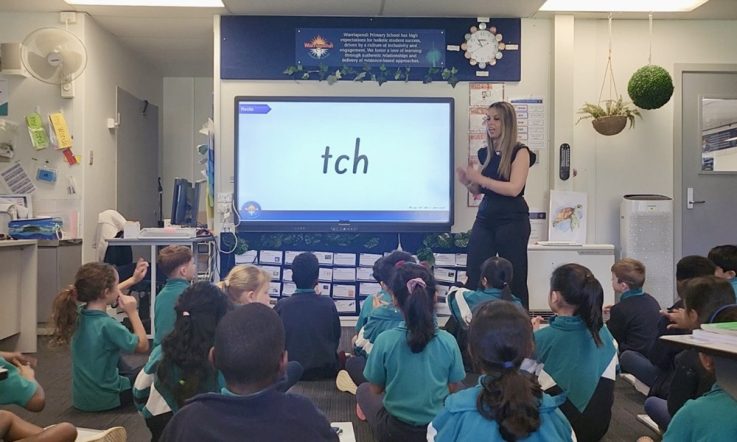
When students are in the early stages of developing skills, knowledge and understanding, or encountering new material and concepts, explicit teaching, and the gradual release of responsibility are crucial for progressing the learning. In today’s article, teacher, instructional coach and researcher Dr Nathaniel Swain discusses the importance of structured approaches, teacher judgement, being responsive to students, and the potential benefits and caveats around shared curriculum materials.
Explicit teaching is an area of fierce debate in education. I’m often asked by teachers what explicit instruction looks like in practice. How can they ensure lessons are engaging for all students? Can they deviate from the lesson plan or materials? Can they still do their own lesson planning?
In this article, I hope to achieve some nuance in the discussion around just how spontaneous the act of teaching is. And how can we walk the line between the extremities of rigidly adhering to a script and flying by the seat of our pants.
My explicit is not your explicit
Those who decry the perils of ‘death by a thousand slides’, or rigid approaches ‘killing the love of learning’ are inevitably stereotyping explicit teaching and referring to the non-examples of effective practice. Essentially, if teachers are trying to teach explicitly in a boring or rigid way, they are doing it wrong. At the very least, explicit teaching must be interactive and must be pitched at the optimal level to meet the needs of all students in the class.
While many students may have different starting points, in any new topic learning can be broken down into manageable components and built back up again in a systematic and coherent manner so all students benefit. Explicit instruction is a system by which we can make great decisions about how to best model and explain new concepts and procedures and allow our students to practice these to proficiency.
To make explicit teaching work, we have to be interactive, and ready to bring the lesson to life for the students that are there in front of us. This adaptability must be based on deep knowledge of our subject matter and what our students already know.
Explicit teaching as a pathway
In the debate on explicit teaching, there are also concerns that this approach reduces the scope of what learning entails and locks students into narrow views of what learning can be. On the contrary, explicit teaching need not be an endpoint, but merely the starting point to students gaining new knowledge, skills and capacities. As Daisy Christodoulou (2023) has previously described, explicitly teaching rich knowledge is not a pendulum swing away from critical thinking and creativity, but rather a pathway from one to the other.
When done well, effective explicit teaching equitably moves students from their starting point (a novice state) into having significant knowledge and skill (an expert state). From here, all modes of discovery, exploration and inquiry are possible and worthwhile.
Being explicit and responsive
Most educators would agree that teachers should be responsive to the students in front of them. Planning to collect and use formative assessment is a powerful component of effective practice.
To achieve responsive teaching, we also need to be willing to adjust our instruction in real-time, based on how students are progressing. Checking for understanding is a key prerequisite and it must be frequent (occurring after each small segment of learning, usually every 3 to 5 minutes of active teaching), equitable (so all students respond), and verified (so the information indicates what students know and can do, and not simply what they self-report). Only after frequently checking for understanding can teachers seek to make responsive changes to the lesson as they work through it.
Planning to teach responsively
The other key characteristics of effective, responsive teaching is having a solid plan from which to work. While I would make the case that you do not always need to create the plan yourself, if teachers are to be meaningfully prepared they must understand the materials inside and out. This means knowing:
- what stage of the curriculum this lesson is seeking to target
- how it relates to all the previous learning in the unit
- all of the learning that is yet to come.
To be meaningfully prepared means that teachers understand the content, and know where their students are up to. They also understand the teaching practices that best align with the research on learning to allow them to make excellent decisions as the lesson unfolds. One cannot be responsive without this meaningful preparation.
So, if a teacher wants to involve all students in the learning, they need to know exactly what each part of the lesson is for, and how they will breathe life into it.
Can we be responsive without knowing the lesson back to front?
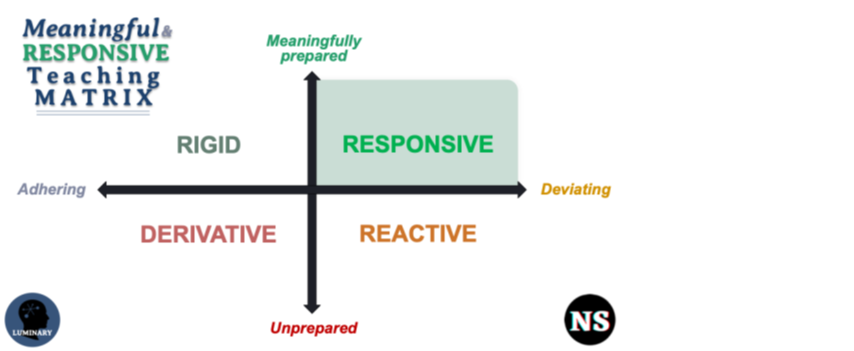
It is tempting to think that teachers can rest on their laurels and feel their way through a given lesson. Some educators have let me in on a workplace joke known as the ‘3-step planning process’, where teachers use the 3 literal steps it takes them to walk from the door to the centre of the classroom to plan out an idea of what they are going to do with a given session. I would argue that if we attempt to be flexible in our delivery without meaningful preparation, we cannot possibly achieve responsive teaching. Instead, we are left with reactive teaching.
In my mind, reactive teaching is what happens when teachers think they can spontaneously come up with the entirety of a lesson; with all of the materials, instructional moves, planned explanations and anticipated misconceptions all on the spot. While experienced teachers may be able to appear to bring a lesson out of nothing, they actually bring significant meaningful preparation from numerous other lessons they have already implemented, indicating they are in fact meaningfully prepared.
Deviating from lesson plans
There are growing collections of resources available to support explicit teaching across many subjects. However, having comprehensive lesson materials should not place teachers into a straitjacket from which they cannot deviate. Even with adequate preparation, if teachers are unwilling to deviate at all from the plan, and instead adhere to the lesson as written, they also do not arrive at responsive teaching. Instead, they find only rigid teaching.
It is my argument that responsive teaching, by its nature, requires deviation and that this is a positive thing, so long as teachers are meaningfully prepared. Having a structure should not make teaching rigid. Rather, such structure should paradoxically give teachers better options for flexibility, as they know where they are trying to go.
To deviate means to stray from the planned path, and teachers can in fact make excellent deviations off the track they had originally envisaged. These can involve opportunities to address misconceptions, explore student interests and questions, as well as skip forward in the lesson sequence if students show signs of early proficiency.
The issue with rigid teaching is that teachers who resolutely adhere to the plan miss an important opportunity: responsive and adaptive teaching allows us to give the lesson that the students need, not just the lesson that was planned. To be excellent educators we need to be planning in advance, but be willing and prepared to deviate from that path to be dynamic and responsive in the moment.
Looking at the lesson beforehand
A final risk is that teachers believe they must follow the plan, or slides, or even a script, but are not meaningfully prepared to teach that lesson. As a result, for a given lesson they will be insufficiently prepared (not ideal) and also unwilling to deviate (not ideal either). As you might guess, we cannot achieve responsive teaching this way. Here, we are only left with a less-than-genuine copy of someone else’s lesson: the result is derivative teaching.
I have made the case that teachers do not always have to plan the lessons themselves and could make use of pre-existing materials, especially when part of meaningful units or sequences. However, as with any supporting classroom resources, teachers must understand how these materials work in great detail (meaningful preparation), and how to adapt and modify such materials to best suit their learners and the stage they are at in the moment (meaningful deviation).
Teachers must be willing to improve their teaching by being responsive to how students are progressing through the lesson, and whether they need additional extension or support. So even if the teacher is gifted a fully written lesson, there is still significant preparation to be done.
Do teachers need to plan every lesson themselves?
If we have the time and inclination, we teachers could, in principle, plan out every lesson from scratch, and could even make them as explicit and responsive as has been described above. But one cost to this is the lack of cohesion with other units taught by other teachers in other classes. And this is a cost that has cumulative effects.
This is because curriculum planning is greater than individual lessons. To provide a cohesive and coherent experience for students, teachers should not work in isolated silos but instead in collaborative teams. If teachers choose to create the lessons from scratch, they must plan in tandem with other curriculum makers so that coherent links and connections between lessons, units and year levels can be made.
So yes, by all means, plan out all your lessons if you have the time and expertise. Remember though, we are not individuals working in private practice, so plan in collaboration and synchrony with your colleagues.
Some final thoughts
All in all, teaching should still be a very creative endeavour; one that involves the process of dynamically guiding our students’ understanding and curiosity in real-time and together building something meaningful and tangible. Spontaneity and deviation from the lesson plan are integral parts of this. However, teachers need a solid and reliable structure from which they can design the best path forward in each moment.
Regardless of where you stand in these live discussions, I hope you can share in my passion and love of teaching opportunities that meet all students’ needs, engage all students’ interests, and support the movement of all students from novice to expert in any subject.
The tools teachers need to be successful are available. Responsive teaching is possible when we are meaningfully prepared and willing to adjust our instruction according to what our students need in real-time. If we can continue to share such successes and challenges of translating the research into the classroom, our collective expertise will no doubt move the entire profession forward.
References
Christodoulou, D. (2023, March 4). Keynote presentation at researchED Ballarat 2023 [Conference presentation]. researchED Ballarat, Ballarat, VIC, Australia.
Swain, N. (2026, August 3). The meaningful and responsive teaching matrix. Dr Swain’s Cognitorium. https://www.nathanielswain.com/cognitoriumblog/meaningful-matrix
In this article, Dr Nathaniel Swain says that effective explicit teaching must be interactive and responsive to the students in front of us. How do you currently adapt your instruction to meet students' needs during a lesson?
How do you decide when it is appropriate to deviate from your planned lesson sequence?
What evidence do you gather during a lesson to determine whether students are ready to move on, need additional support, or would benefit from further challenge?