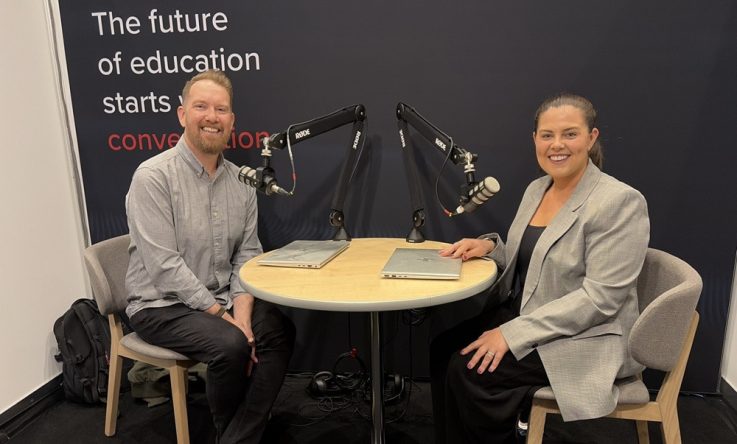
Dr Kay Oddone, Director of Linking Learning Advisory and Adjunct Senior Lecturer in the School of Information and Communication Studies at Charles Sturt University, and Kasey L Garrison, Senior Lecturer and the Associate Head of Research in the School of Information and Communication Studies at Charles Sturt University, published research in the Australian Journal of Education (AJE) that examines when and how information literacy skills are introduced to students. The paper is titled: Planting the Seeds of Information Literacy: An Exploratory Study of When and How Australian Teacher Librarians Introduce Information Literacy Skills to Primary School Students. In this article for Teacher, they draw on that paper and further highlight the need for teachers to have the support of qualified teacher librarians to introduce and build students’ capacity to use information critically and ethically.
The kid playing a game on the tablet at the restaurant, the toddler watching a video in the pram, the children huddled in front of a phone on the train ... we know that young Australians are regularly engaging with technology and complex information environments at home and in school supported by the requirements of the Digital Literacy as a General Capability in the Australian Curriculum (Australian Curriculum, Assessment and Reporting Authority, 2026).
However, there is a gap between the intent of the Australian Curriculum and student outcomes. In 2025, just 50% of year 6 students nationally met or exceeded the proficient standard for ICT literacy (Friedman et al., 2026). In this context, ICT literacy is a measure of students’ ability to use ICT and digital tools appropriately, safely, and effectively across real-world contexts.
There is a need to investigate how and when students are introduced to information literacy in primary school.
Our research explores information literacy through the perspectives of primary school teacher librarians, with particular attention to the changing nature of the information landscape and its ongoing impact on teachers and students.
Teacher librarians, dual qualified professionals in education and librarianship, are specifically trained and well positioned to collaborate with classroom teachers in cultivating students' information literacy skills (Australian Library and Information Association & Australian Coalition for School Libraries, 2024a, 2024b).
Substantial evidence has found that, even when accounting for socio-economic background, the presence of a full-time qualified teacher librarian who leads a well-resourced school library, results in greater academic outcomes, higher literacy levels and improved student wellbeing (Hughes et al., 2025). Yet, there is a nationwide decline in the employment of qualified teacher librarians in schools (Merga & Mat Roni, 2026).
Who was involved in the research?
Our research reveals the need for Australian primary teacher librarians’ expertise to support teachers to introduce and develop students’ capacity to use information critically and ethically, and the importance of systemic support to embed information literacy as core learning across primary education.
We surveyed 91 practicing primary school teacher librarians from across Australia and then interviewed 13 of these professionals to learn more about how teacher librarians work collaboratively with classroom teachers to develop information literacy skills, how they introduce information literacy to their students and at what age they believe information literacy concepts should be developed.
Here are their responses to the question, ‘In what year level do you begin introducing information literacy skills to students?’
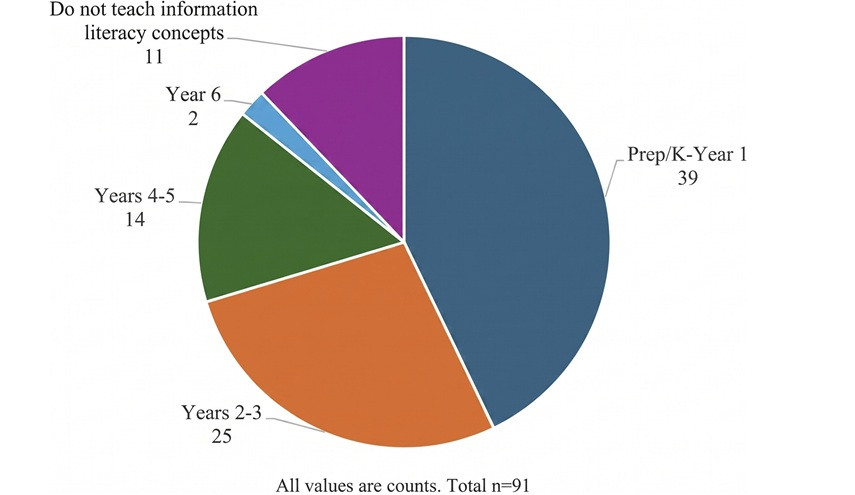
We found that the majority (58%) of teacher librarians supported introducing information literacy capabilities from the earliest years of schooling (years P/K-3), aligning with the presence of these concepts in the Australian Curriculum.
However, there was significant variation in the extent to which teacher librarians were actually involved in implementing these elements of the curriculum.
Teacher librarians reported that the limited hours granted to enact their role, a lack of awareness of their potential contribution as information literacy specialists, and different interpretations of curriculum requirements and program specifications are huge obstacles to their efforts in developing information literacy for their primary school students.
While a few teacher librarians shared the belief that the early years should focus purely on literacy and literature and that younger students did not have the capacity to grasp information literacy skills, others challenged this position. These educators spoke about integrating innovative pedagogical strategies and describing lessons with their young students that involved creating and analysing AI images to teach the concept of intellectual property, differentiating between fiction and non-fiction texts and using the library management system to navigate and locate items in the library.
There was repeated emphasis on the need to build positive habits and ethical awareness around information literacy from the early years to allow time for practice and consolidation. As a Victorian teacher librarian reflected:
…a parent might not let a child across the road on their own till they're ten, but they practice from the minute they're walking and holding their hand, telling them to look left and look right, and you know, the traffic comes from here. So, I feel the same way about information literacy.
A teacher librarian in a private P/K-12 school in New South Wales also described the change that was currently underway in their school.
Up to this point, it was not in my job description to be involved in the information literacy skills of the students. That is starting to change as teachers are wanting more help. I can see that the students desperately need more help in this area, and I am hoping to change the way things work at my school.
Recommendations for systems, teachers and leaders
Regardless of whether primary school students in Australia have limited or extensive access to digital devices at school, they still need to build their information and digital literacy capabilities. Based on the findings of this research, we make the following recommendations:
- School systems should adopt a shared framework such as the Information Fluency Framework as a complement to the Australian Curriculum positioning teacher librarians as expert practitioners across the General Capabilities (Wall, 2019, 2022) and providing for contextualised and consistent teaching of information literacy across all primary school year levels.
- School administration teams should ensure timetables are designed to permit opportunities for collaboration between teachers and teacher librarians, such that this becomes considered standard practice. This will enable the expertise of teacher librarians to be leveraged appropriately, and teachers to feel supported to develop well-resourced, high-quality curriculum that effectively embeds information literacy.
- School leaders and teaching staff should engage with professional learning to build their own recognition and understanding of the pedagogical role and expertise of qualified teacher librarians. This will ensure teachers, school leaders and system staff are empowered to make informed decisions regarding school library staffing and timetabling.
Some final thoughts
Information and digital literacies are core learning for all primary school students. Failing to teach it comprehensively and consistently leaves young learners underprepared for an information environment growing increasingly complex at speed. Our research shows that when teacher librarians are present in schools, they employ a variety of pedagogical strategies to teach information literacy, yet they are constrained by multiple barriers. In our Australian Journal of Education (AJE) paper, we have made recommendations that would go some way addressing this issue.
Furthermore, a mandate to ensure the presence of a qualified teacher librarian –fulfilling their full pedagogical role – in every primary school would guarantee students would have sustained, systematic support in developing the information literacy skills this study identifies as foundational to their learning and future.
AJE special issue on School Libraries
The AJE article Planting the Seeds of Information Literacy: An Exploratory Study of When and How Australian Teacher Librarians Introduce Information Literacy Skills to Primary School Students is available online and open access. It’s also part of the journal’s Special Issue for October on School Libraries. AJE Editor, ACER Senior Research Fellow Kylie Hillman, says ‘The collection also includes 2 articles from the archives, published in 1995 and 1965, offering an opportunity to reflect on how the role of libraries in education has changed – and what remains just as important today.’
References
Australian Curriculum, Assessment and Reporting Authority. (2026). Digital literacy (Version 9). https://www.australiancurriculum.edu.au/curriculum-information/understand-this-general-capability/digital-literacy
Australian Library and Information Association, & Australian Coalition for School Libraries. (2024a). ALIA ACSL statement on school libraries and information literacy. Australian Library and Information Association. https://www.alia.org.au/common/Uploaded%20files/ALIA-Docs/Group-Docs/ALIA%20ACSL%20Statement%20on%20School%20Libraries%20and%20Information%20Literacy.pdf
Australian Library and Information Association, & Australian Coalition for School Libraries. (2024b). ALIA ACSL statement on school library staffing. Australian Library and Information Association. https://acsl.alia.org.au/wp-content/uploads/2025/05/ALIA-ACSL-Statement-on-School-Library-Staffing-1.pdf
Friedman, T., O’Malley, K., Eveleigh, F., & Schulz, W. (2026). National Assessment Program – ICT literacy 2025 [Public Report]. https://research.acer.edu.au/ict_literacy/29
Hughes, H., Allan, C., & Bozorgian, H. (2025). School library contributions to student literacy, learning and well-being: The latest evidence, 2014-2023. In D. Oberg & L. Marquardt (Eds.), School librarians and principals leading together: International perspectives (pp. 191-208). Bloomsbury Publishing.
Merga, M. K., & Mat Roni, S. (2026). School library professionals' perspectives on current and future workforce challenges. Journal of Librarianship and Information Science, 58(1), 300-313. https://doi.org/10.1177/09610006241309104
Oddone, K., & Garrison, K. L. (n.d.). Planting the Seeds of Information Literacy: An Exploratory Study of When and How Australian Teacher Librarians Introduce Information Literacy Skills to Primary School Students. Australian Journal of Education, 0(0). https://doi.org/10.1177/00049441261483749
Wall, J. (2019). Information fluency: A path to explore and innovate? Scan, 38(9), 7-11.
Wall, J. (2022). Information fluency: A framework for teacher librarians as expert practitioners. Access, 36(1), 15-23.
Do you have a teacher librarian in your school? How are you leveraging their expertise?
As a school leader, do you provide regular time and opportunities for teachers and teacher librarians to collaborate?