Monika Ren is a classroom teacher from Maramba Primary School, a government school of around 250 students located in Victoria. In today’s article she shares details of a 2-cycle maths inquiry she ran in her year 1 classroom. Ren explores the gaps she noticed between students knowing place value concepts and being able to apply that knowledge independently in a new context. She also shares how assessment helped her to refine her teaching response.
This inquiry was conducted with a class of 16 year 1 students (aged 6 and 7). I used assessment evidence to identify students’ learning needs, respond through explicit teaching, and provide varied opportunities for students to apply their learning in new contexts. The inquiry developed across 2 cycles, and 2 terms, moving from strengthening foundational number sense and place value understanding, to examining whether students could transfer this knowledge independently.
First cycle – identifying student needs
From pre-assessment and classroom observations, I identified significant gaps in students’ foundational number sense and place value understanding. I found that many students relied heavily on counting strategies and had difficulty recognising relationships within numbers.
Twelve of the 16 students counted all or counted on in addition, while one student used addition facts but couldn’t explain why. Three students could show more than one way to partition a number. One student could explain the relationship between a 2-digit number and the value of its individual digits. No students could use other representations – other than counters (draw circles) – to represent a number.
Initial teaching response
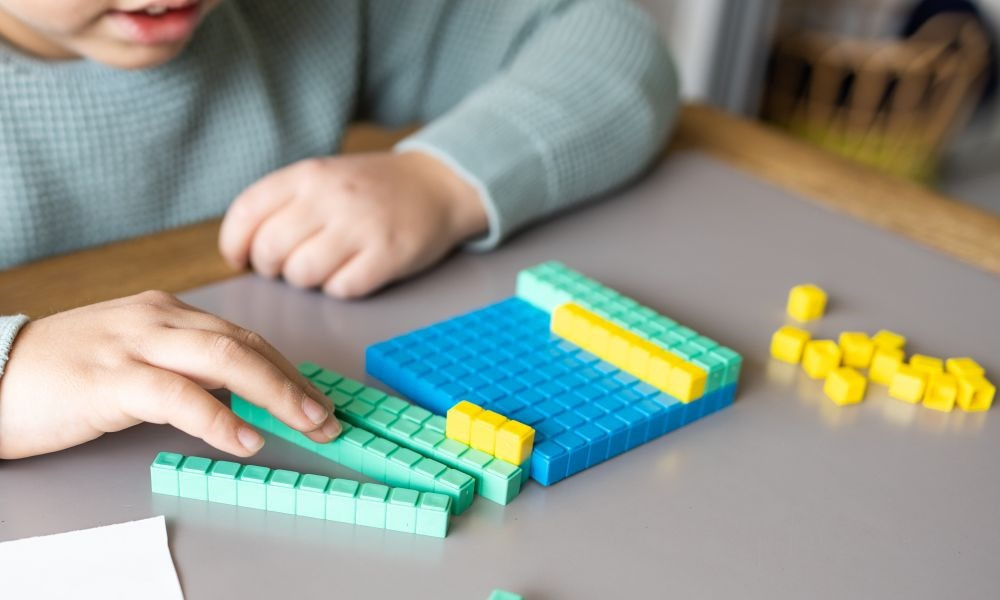
In response to the baseline data I collected, I introduced a Number of the Day routine, in which students explored a different number from 0 to 120 each day. Students recorded the number in a place value chart and partitioned it into 10s and 1s. I structured routine using the Concrete–Representational–Abstract (CRA) approach, where students progress through 3 stages: from using physical materials such as blocks and counters; to visual representations such as drawing dots or tally marks; to abstract concepts using traditional maths symbols and digits. Through this method, students explored the Number of the Day through multiple representations, including 10 frames, MAB (multibase) blocks, place value charts, number lines, and expanded form.
Students also investigated number relationships by finding +1/-1, +10/-10 and +100/-100, calculating the sum of the digits, and skipping counting by 2s, 5s and 10s from the given number.
Together, these tasks developed broader number knowledge while strengthening students’ understanding of the relationship between digits, their place and their value. I found that repeated practice with a different number each day provided cumulative opportunities to make these connections, while scaffolding was gradually reduced as students became more independent.
Monitoring improvement
The routine produced clear improvement in students’ foundational number and place value understanding. They became increasingly confident in representing numbers using MAB, interpreting 10s and 1s, ordering numbers and explaining number structure.
By Term 2, 14 of the 16 students could explain the difference between a digit and a number and relate the value of a digit to its position within a number, represent numbers in expanded form and calculate the sum of the digits. In addition, 11 students could confidently skip counting by 2s, 5s and 10s from whichever number we were focusing on for that day. These results demonstrated stronger connections between digits, place value, number structure and number patterns.
However, this progress raised a new question for me: Could students apply this knowledge flexibly beyond the familiar Number of the Day routine?
Second cycle – identifying student needs
My classroom observations also showed that, although most students could confidently skip-count by 10s from a given number, they did not consistently apply this understanding when calculating. When asked to solve 47 + 10, 8 students counted on using their fingers, 3 used the120-charts, and 3 drew circles on their mini whiteboards to count on. I could see that they saw the pattern in skip-counting but could not transfer the understanding into calculation.
My focus shifted from demonstrating place value knowledge to transferring it. I asked myself: Can students independently recognise when and how to apply place value knowledge in a new context?
Refined teaching response
Rather than assuming students needed more practise with place value, I adopted a targeted diagnostic assessment to identify where their understanding was secure and where transfer began to break down.
The assessment presented related number concepts across different representations and contexts. Students were asked to:
- represent and rename numbers
- compare and order numbers
- identify +1/-1, +10/-10
- locate the same number on number lines with different scales. For example, students were asked to locate 10 on number lines from 0–20, 0–50 and 0–100, requiring them to reason about magnitude rather than rely on a familiar position
- addition and subtraction tasks that could be solved using existing place value knowledge
- use questions such as ‘What do you already know that could help you?’, ‘What changes?’, ‘What stays the same?’ and ‘Why?’ to make the mathematical relationship visible.
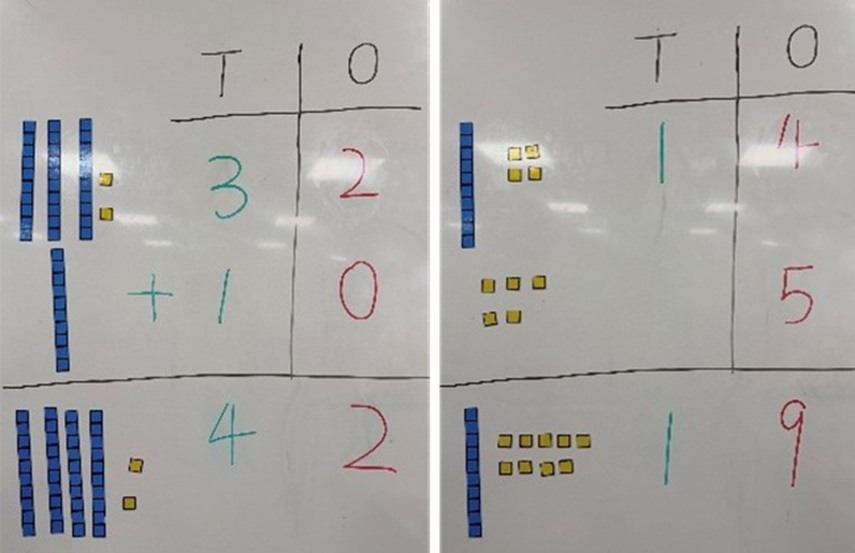
The assessment evidence then informed targeted teaching. I explicitly bridged representations and strategies. For example: MAB → place value chart → expanded form → 32 + 10. I then extended this understanding by teaching students to treat 10s as units. This enabled them to transfer known addition facts within 10 to problems such as 20 + 30, 40 + 50 and 90 + 10, rather than relying on counting.
Teaching impact
I then used an exit ticket with 3 questions to assess transfer, for example:
Q1: 47 + 10
Q2: 52 – 10
Q3: Write 2 equations that add to 70.
The results showed improved application of number and place value relationships beyond our now familiar Number of the Day routine.
Thirteen of the 16 students solved 47 + 10 correctly by recognising that adding 10 adds one 10 to the 10s place while the ones remain unchanged. Twelve students solved 52 – 10 using the same place value relationship knowledge, and 12 generated 2 different addition equations using 10s as units. One student extended this thinking independently with 52 + 18 = 70.
Reflection and refinement
This inquiry changed how I think about mathematical understanding and fluency. Students could explain place value confidently but did not always recognise when to use it. I now look beyond accuracy and speed to whether students can make connections, choose strategies and transfer their understanding.
It has also changed how I use assessment. I use questioning and change the representation, scale and context of the problem to identify where understanding is secure and where transfer breaks down. I then use this evidence to decide what to teach next and to check whether the teaching has had the intended impact.
How do assess where students are in their current understanding?
Do you check whether they can apply their number knowledge in new contexts? What has worked well in your own classroom?
When students experience difficulty, how do you pinpoint the challenge? For example, do they struggle with conceptual understanding or being able to transfer existing knowledge?
