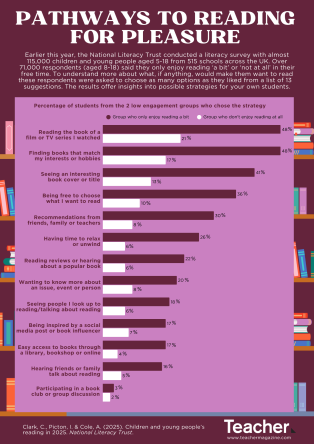
A large-scale study involving over 125,000 children and young people has shown an encouraging uptick in enjoyment of reading and daily reading habits.
The UK National Literacy Trust’s Annual Literacy Survey has been conducted each year since 2010. For the latest iteration, 2 surveys were conducted between January and March 2026 – one for children aged 5 to 8, and one for children and young people aged 8 to 18.
The findings released earlier this month show 36.1% of 8- to 18-year-olds enjoy reading in their free time ‘very much’ or ‘quite a lot’ – up 3.4% from the previous year. It is also the first increase in reading enjoyment recorded by the annual survey since 2021.
The percentage of those reading daily in their free time increased in 2026 – signalling the first rise since 2023.
‘After several years of decline, 2026 saw a small but important increase in both reading enjoyment and daily reading,’ the Trust’s report notes (Clark et al., 2026).
‘While children and young people who enjoy reading and read regularly are the most likely to see reading as supporting their learning, wellbeing and understanding of themselves and others, many who do not enjoy reading are still reading and still finding value in it.’
Children and young people’s reading enjoyment in their free time
The increase in enjoyment of reading during free time was seen across most participants aged 8-18. In fact, the largest increase was observed among those aged 14-16 and 16-18. Children aged 5-8, however, recorded a sight fall in enjoyment of reading – in 2025 the figure was 62.6%, and in 2026 it fell to 61.6%. This drop was driven mostly by a decrease in boys’ reading enjoyment.
One in 5 (20.3%) of children and young people aged 8-18 said they read daily in 2026, up from 18.7% in 2025. Again, the largest increases were observed for the 14-16 and 16-18 age groups.
The report also analyses differences between boys and girls and offers comparisons to previous years. In 2025, 25.7% of boys aged 8-18 said they enjoyed reading in their free time and for girls it was 39.1%; both saw an increase for 2026, to 28.8% and 42.3% respectively. The percentage of boys in this same age group who read daily increased by 1.4% on the previous year (to 16.8% in 2026), and for girls, the figure increased to 1.5% on the previous year (to 23.1% in 2026).
The Annual Literacy Survey also records findings specifically for students who receive the UK government’s free school meals (FSM) and compares these findings to those who do not receive FSM. In 2026, it found reading enjoyment for children and young people who received FSM was 32.1%, compared to 37.3% for those who did not receive FSM. Differences were also observed for daily reading habits – only 16.3% of those receiving FSM in 2026 read daily, compared to 21.4% of those who did not.
In light of these findings, the report’s authors considered how the 2 aspects of reading enjoyment and reading frequency relate to one another.
‘There is a clear positive relationship between reading enjoyment and how often children and young people read in their free time. … Those who enjoy reading are more likely to read regularly, with around half (49.8%) reading daily compared with just 4.5% of those who do not enjoy reading.’
What role does reading play in students’ lives?
‘While enjoyment and frequency remain important, they do not tell us everything about how children and young people experience reading. Many who enjoy reading also read regularly, but this is not always the case,’ the report shares. ‘Some continue to read at least weekly even though they do not enjoy it, while others read less often and report low enjoyment. Looking across these patterns helps us understand not just whether children and young people read, but how reading fits into their lives.’
As such, the Annual Literacy Survey also asked participants about how they experience reading in relation to learning, understanding others, and more. Findings from this section of the survey include that 74.1% of respondents who said don’t enjoy reading, but still read weekly, reported that reading helps them learn new words or things. In addition, more than half (52.9%) said it helps them do better at school, and 44.4% said it helps them understand other people’s views.
Children and young people are also aware of the impact of reading on their wellbeing. Almost one third (31.1%) said reading helps them relax, and 24.2% said it helps them when they feel stressed or anxious.
As for who encourages them to read, a majority of survey participants (65.8%) said their teachers encouraged them to read, and 54.8% said their parents encourage them.
‘Overall, the findings highlight the continued importance of enjoyment, relevance and encouragement in shaping children and young people’s reading lives,’ the report concludes.
References
Clark, C., Picton, I. and Arif, A. (2026). Children and young people’s reading in 2026. London: National Literacy Trust. https://literacytrust.org.uk/research-services/research-reports/children-and-young-peoples-reading-in-2026/
In this survey, students reported that reading helps them learn new things, understand others’ views, relax, or manage stress. Are these benefits communicated and modelled in your own classroom?
Are there students in your classroom who read regularly but do not describe themselves as enjoying reading? What might help make reading feel more relevant or personally meaningful for them?