Thanks for tuning in to this podcast from Teacher magazine, the resource for K-12 educators published by ACER, the Australian Council for Educational Research. I'm Dominique Beech.
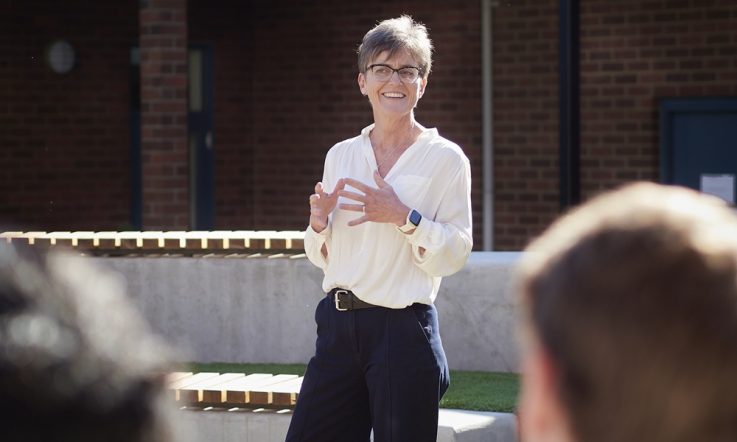
In today's episode of School Improvement, we're going to hear all about the Questions for Thinking program (also known as Q4T) – the professional learning program in place at Caulfield Grammar School in Melbourne. I'm joined by Gus Humphries, the Q4T lead at the school. Gus is also a Humanities and Politics teacher and has been an educator for 20 years. If his name, or the name of Q4T, sounds familiar to you, it might be because you read the article Gus published on Teacher back in March on this exact topic. In the piece, Gus delved into how and why he developed this professional learning program with the aim to better harness the determination and aspiration of their dedicated teaching staff and support efficient, effective and embedded change in teaching practice. Q4T is a professional learning program that allows teachers to investigate and develop an area of their practice. It's an opt-in, confidential partnership between a partner and a participant that's focused on empowering teachers to meet student learning needs. In our conversation today, Gus expands on the 8 key ingredients the program consists of and the impact it's having on staff and school culture. Let's jump in.
Dominique Beech: Gus Humphries, welcome to the Teacher podcast. I'm really looking forward to learning all about the Questions for Thinking (or Q4T) program today. You are a teacher at Caulfield Grammar School here in Melbourne and of course lead of the Q4T program at the school. Why was developing a program like this important to you?
Gus Humphries: Yeah, it's a great question to start with. It was super important to me because I feel like, as a practicing teacher I feel like teaching is really hard. And I also feel like over the course of my career, it's actually gotten more difficult, even though I would hope my skills have advanced.
And as a consequence of that, I sort of watch my colleagues around me – who are the most dedicated bunch of professionals, who just love being with young people and helping them thrive – and I just wonder whether I reached a point in my career where I had some ideas to push out, as opposed to just sort of learning constantly. And I sort of sat down one night and just rage-typed, perhaps, what I thought might be a vision for a better way to maximise the precious time of practicing teachers to ensure they got the best bang for their buck where it mattered the most.
And John Hattie's done a lot of research in terms of education, but the single most important and discriminating factor in the learning of our students, the most important variable, is the quality of the teaching (Hattie, 2003). And so, you asked the question about why it's important to me? Because student learning is at the centre of everything we do. And how can we assist those teachers to be the best they can be for the students that are in front of them?
DB: And so there are 2 key players in this program – the partner and the participant. Before we delve into kind of the details of the program, I thought it would be great to hear a little bit about the details of what these 2 roles are.
GH: Yeah, great. So, I'll start with a partner. Now, the word partner was chosen really specifically, and I have this argument with my boss at work, Renee Holland (who will be listening), but she loves the word coach. And I have worked deliberately and strategically using the word partner as opposed to coach. I feel like there is – rightly or wrongly – an interpretation with some people that a coach implies a sort of power dynamic or an experience dynamic or whatever it might be. But the role of the partner is essentially to be curious, compassionate, caring; just genuinely interested in the person they're working with.
And what the partner is charged with the responsibility of is to ask the right questions at the right time of the participant, to enable the participant to perhaps see what the partner sees, to reflect on what's happening in their classrooms, and then open the door to potential opportunities for growth. So, the partner's role is super important in establishing what we call in the model in Q4T, the relational space. We cannot access the further elements of the discussion model that Q4T uses if we don't have a relational space with the participant. So that is the number one primary job of the partner.
The participant, on the other hand, is someone who has opted in to the program, and they see an opportunity to work in a program that will (hopefully) efficiently bring about growth in an area of their choosing. What's interesting about teachers is I feel like teachers – maybe like every profession – suffer massively from imposter syndrome. When you ask a teacher about how things are going, they're far more likely to list 10 things they feel they're not doing well, than perhaps one thing they are doing well. I had a great experience at a coffee machine early last year with a teacher I know reasonably well. And I said to her, ‘what are your thoughts for this year? What are you looking to do this year?’ And she just reeled off this thing that was clearly sitting on her shoulders, just this list of things she wants to be better at. I remember saying to her, ‘I wonder if you're asking too much of yourself. I wonder if you're setting yourself up to fail there’. And I think a lot of teachers do. And I've lived that. And talking to a lot of teachers, they've lived that.
So what we try and do in Q4T with the participant is offer them a relational space where they can feel safe, comfortable, supported, affirmed, and perhaps have this pathway forward where they can walk with the partner to improvement that will make a difference, not only to their lives, not only to their sanity, not only to the effectiveness of the hard work they do, but also, and most importantly, on the learning of the students in their classrooms.
DB: As I mentioned in the introduction of this episode, you've written an article for us all about the Q4T program, and you mentioned in that piece that the program has 8 key ingredients that must be present to best support teacher growth. You introduced our readers in that article to choice, space, and context-informed practice. So, to catch people up who may not have read the article yet, on choice, you said: ‘Participants decide the area of practice to be investigated, and the partner will ask meaningful questions to understand why the teacher is interested in this area and what they might like to achieve in relation to it’. On space, as you mentioned just before, you explained that ‘The Q4T program endeavours to create a space – a relational space, where the conditions for teacher thinking and growth can develop so that teacher aspiration may be matched with opportunity’. Finally, on context-informed practice, you mentioned in the article that's all about the partner knowing and understanding the specific context of their Q4T participant. So, we won't go over those 3 in our conversation today, as listeners can jump on our website to read about those. But let's look at the other 5 key ingredients now. Firstly, I'd love to hear more about the second ingredient, which is the teacher is seen. What do you mean by that?
GH: Yeah, great. And just to move back slightly, it's interesting to say, you know, this program needs 8 things to succeed. But I would argue that teacher PL [professional learning], effective teacher PL that honours the really hard work of quality teachers out there, it's difficult to do well. It's really difficult to do well. And I couldn't boil it down to less than 8. So, I just wanted to start with that. I realise that can seem imposing, but I think all of these things are important in their own way.
So, in terms of the teacher being seen, one thing that exists in a lot of the literature around teacher PL is that professional learning that is offered to teachers, and that they experience, it doesn't recognise their experience at that point in time. What is a commonality that teachers experience with professional learning is, it's one-size-fits-all. And it's either something you go and experience and think, ‘well, I kind of know that and I feel like I'm kind of doing it’, or someone comes into the school in a whirlwind who's amazing and inspiring, goes ‘Let's all do this’, and then they disappear and that's the end. And this is the lived experience for a lot of teachers.
And as a consequence, I think 2 things happen. One, PL seems something removed from the classroom experience, and that's a real danger. And secondly, if teachers feel like that time is not being used effectively for them, they're not resistant to the next time, but they just become more apathetic around the next time. And what Q4T tries to do is try and start from a point where, well, the first thing I want to do is get to know you, and what are your needs? And once I've seen you, what can we do together to assist you on the area that you've already identified you would like some support with? I guess what the evidence I've read from around the world about this sort of program is that unless that person feels that they are seen, progress doesn't happen.
DB: Then we have trust with no judgement. That leads on quite nicely there. What does that mean in practice?
GH: Yeah, there's a guy in the UK called Craig Randall who runs something called Trust-Based Observations. And I feel like he and I are very, very similar in this. And I've had a couple of contacts with him over the last couple of months. And the issue with observations is, often observations of teacher practice are about performance. And what happens there is a teacher will feel like – rightly or wrongly – that, in some way, this is a judgement of what they're able to do.
Whereas, what appears to work in teacher practice is when that teacher feels like the person coming in to watch them is purely there to assist with that teacher on what that teacher wants them to look at, then we have a pathway where a follow-up discussion can genuinely move the needle on practice. And I guess this is why it's so crucial that the partner and the participant agree really clearly on what is to be looked at. And therefore, the teacher can feel very safe that the feedback – the questions and the discussion that occurs subsequent to that observation – is all around what they really want to know and how they might move forward on that.
And it's funny, I carry with me a paranoia in running this program and I'm constantly saying to my participants: ‘I really want you to know I'm only coming in just to see what you want me to see’. And we've gotten to that point where they're like: ‘Gus, relax, okay? We trust you. It's okay’. But I'm obsessive about that. And I feel very strongly that one wrong word by me or one wrong tone can move me back 10 places in terms of really assisting a hardworking teacher out there. And so, you know, this particular key ingredient is crucial.
DB: We mentioned earlier about context-informed practice being an ingredient, but another ingredient is evidence-informed practice.
GH: Yeah, and I'd like to offer that these 2 key ingredients kind of exist as a Venn diagram in that context-informed at some point has to meet evidence-informed and evidence-informed has to meet context-informed. Because one of my favourite quotes I like to use from Dylan Wiliam is that: ‘Everything works somewhere and nothing works everywhere’ (Wiliam, 2018). So, this is why this is not mentoring, it's not coaching, it is partnering. It is not for me to say, ‘Dominique, I've watched your class, here are the 5 things you now need to do’. Nothing is more ineffective than that.
Tom Sherrington, who runs the WalkThrus program, you know, he said what the partner thinks is irrelevant at best, at worst, it's actually damaging for the participant. And so, what evidence-informed practice means is that the partner comes from these tried and tested techniques that are evidence-supported that suggest – look, these things, on the balance of probabilities, tend to work in most places. Then it's the job of the partner, with care, ask the right questions to get the participant to the position where they're open to having a discussion about what a technique might be. And at that moment, the partner has the opportunity to share maybe an evidence-informed practice but make some suggestions or have an open discussion with the participant of what this might look like for that person.
And if we don't lean into the individual styles of the people we're working with, we fail. I have a very particular, quite a forthright persona in a classroom. Whereas I've worked with 10 teachers who, even if they did that word for word, it wouldn't land. It's not who they are. And unless I understand that as their partner and support them with that Venn diagram of evidence-informed and context-informed, only then can they feel like they truly own that technique and make it work for them.
DB: Support is another ingredient. What's involved in that one?
GH: Support is very broad and it's about ensuring that the partner knows that their job is to be there and be present. And putting together this program over a number of years, it's been a whirlwind. Fascinating, fun, challenging, but a whirlwind. But I set myself that challenge to whenever I'm either emailing or speaking with one of my participants, that they feel like they are the only person in my world. And I realise that's a high benchmark to have, but if I'm going to access the other key ingredients the teacher is seeing, trust with no judgement, I want them to feel like I am effortlessly being there for them when they need me and how they need me. And this even comes down to things as simple as organising our catchups, just near the room they were just teaching in, or just near their office, or really conveniently suiting the flow of their day.
What that shows is, I guess we're going to come to the 8-question rule and the emotional intelligence – that support has to be genuinely felt, and it's not support that the person feels like: ‘Oh, Gus is just trying to look like he's helping me’. And this is where that great line of like, if you could fake sincerity, you know, you'd have it made. You really need to be someone who's curious and who cares. And when Renee from school and I were going through the interview process for partners, it was really interesting about what we were looking for in people. And first and foremost, there's a person there. I thought initially when I wrote this program it would be a pedagogy piece. I thought this was a big pedagogy piece and it's all about teaching techniques. And I very quickly realised this is very much a people piece with a little, you know, with a little flavour of pedagogy. But this is a people piece first and foremost.
DB: Let's hear about that final ingredient then, the 8-question rule. Tell me about it.
GH: Yeah. So this is a bit of a weird one, and I do understand that, but it just so happened that I'd gotten to 8 ingredients, and EQ being emotional intelligence, and ‘8-question’ being the same letters, and I do like my little gimmicks (most teachers do), anything to sort of get people to learn stuff. So, this is my favourite one.
And when building this program, I realised at the very start I had to put aside my ego and my own thoughts about what could, should, or would happen, and focus really intentionally on the participant. And that absence of ego has been a thing that has stayed with me always. And it's a very difficult thing to do. We all automatically defer – when we're listening to people – in our minds about either what we want to say next or what we think the person should do. And I've gone through this really, really fun process of instead of doing either of those things, I'm actively listening and thinking about what is the most important next question to ask to help understand that person more.
And so what the 8-question rule says is to potential partners in this role, don't you dare even think about suggesting to a teacher an idea that you might have for how they might develop their practice, unless you've asked a minimum – a minimum – of 8 questions. And I guess, I mean, I'm one of those people who tears up at WorkCover ads on TV. I cry at the drop of a hat, right? Red Dog – have you seen Red Dog, the movie?
DB: Oh yes, I bawled my eyes out.
GH: Oh my God, like a wet t-shirt from that just streaming down my face. But you know, like there's an episode of Ted Lasso, it's the same thing where he uses the line, you know, ‘be curious, not judgmental’. I'm sort of tearing up now. But this is the message. This is emotional intelligence. Show curiosity about those people. They then feel like, this person is really invested in me, and it creates a relational space – just like with students – where anything's possible. And so, this 8-question rule says to partners, your primary job is to get to know these people. And your primary job that goes along with getting to know them is so they feel like you are absolutely there for them. Once that happens, I feel very strongly that anything is possible in terms of moving practice.
And I'm all ears to another method that works really well in terms of coming and telling teachers what they should do in the classroom. But I'm yet to see one with my own eyes that works more effectively and efficiently than getting to know someone, caring for them, discussing practice, and then being with them there when they embed that practice.
DB: So now that we have a really detailed grasp on what the Q4T program actually is, I'd love to hear a little bit more about the process of getting to the stage that you're at now. You built this program, you've said that it required 4 years of research, trial, reflection and development. Can you talk us through that process? What was it like?
GH: Yeah, I mean, on reflection, it was just super exciting. And I talked a little bit earlier about how initially I sort of rage-typed out the general sort of spine of the ideas of this. And to his great credit, our principal Ashleigh Martin, when I pitched this to him in an embryonic form, he was like: ‘Yeah, I want you to keep working on it. This is something I want to see in more detail’. And he and Head of Campus (who's no longer at the school), Leanne Guillon, they both supported me to run a pilot. And so, I ran this sort of 5-minute, very brief explanation for our staff, just after COVID, so it was a strange time in teaching.
And I ran this sort of explanation of what the program would be. And I remember clicking off the Teams link and shutting it down and thinking, what am I doing? You know, imposter syndrome kicked in straight away. What am I doing? Who am I to think that anyone might be interested in any brain fart that I've got, right? Who might be interested? And then some applications started coming in. And I'm eternally grateful to them. I want to name them too. Suzie Mariniello, Brett Payne, Caleb Bridge and Jess Jasper. You know, within 24 hours/48 hours, they put me out of my misery and said: ‘We'll jump on board’. You know, and there's a great video online, you can find it. It's not about the first one, it's the first follower. You know, like you can lead something and you can put it out there, but you need people to come along. And once you get one or 2, then all of a sudden, it comes along.
And I guess the experience of implementation, I've then had to be really careful about never, ever speaking about Q4T again. And the reason I say that – in a public forum like at the school – is because actually I'm the worst person to talk about a program that I wrote. Rather, the people who've now gone through the program are the greatest advocates for their experiences. And it's the conversations that I can't control and shouldn't control that matter the most. So, it's those conversations, those staff, and the subsequent Q4T participants have in their own staffrooms, in their own spaces with other teachers that matter the most to this program. And that keeps me grounded on the people who really matter in terms of the program. The program only works if the teachers feel benefit out of this.
DB: Let's talk about the impact in a bit more detail now. How are you measuring impact? And it sounds like you've had some great staff feedback so far. Can you tell me a bit about what staff are telling you?
GH: Yeah, so we get qualitative data from our teachers about their practice, and I've also got a huge amount of qualitative data from observation of teacher practice. But really, we're interested in, at this point, of the degree to which teachers feel this is moving their practice. And there are a couple of things built into this.
During the 6-month program, there's 2 feedback processes whereby they offer surveyed feedback on specific areas of the program. And then right from the very start, what I decided was very important is when teachers graduate from the program, there was a lunch put on with the principal and the Head of Campus where I wasn't there. And they were able to ask very direct questions about, ‘come on, no, seriously, tell me what's happening here’. Now, I thought there's multiple benefits here. One is it gives the Head of Campus and the principal – and some other leaders as well, Head of Teaching and Learning and Head of Staff Development have been in those as well – but it gives them an opportunity to talk to teachers just about teaching. And I think that's often something in the craziness of the institutions we work in, can become secondary. And it also gives those teachers an opportunity to talk to our school leaders about the thing they love the most. And so that direct feedback, with me not in the room, is really important. So, staff feedback's been really strong.
We're also using student surveys in the classroom to try and guide around that area of practice the participant's interested in. We're trying to use that to guide what techniques may be used. So, student data in is really important to help us inform what practices teachers might use as well. So, the impact – again, it's now, this is in its fourth year at the Caulfield Campus and it's in its first year at other campuses. And it's funny that this question comes up today because we've just had our first lot of data come in from the other campuses. And it's been very, very positive. But I said to one of the partners I work with at the moment, I said, just remember, running through the comments they've made is this feeling like they're cared for. And I said, this is the beginning platform of changing teacher practice, is them feeling like the school cares about them and we value them and we want them to succeed. And if they succeed, we all succeed. And so, the tone of the comments that are coming in absolutely reflect these 8 ingredients that we've decided must be present to move teacher practice in a meaningful way.
DB: And something that I loved in your article was that you said you hope this program develops and sustains what you call a ‘moving’ culture. I'd love if you could tell me a little bit more about that because it's clear from our conversation that, yeah, things are probably changing in the school culture as a result.
GH: Yeah, and I mentioned before that this is less a pedagogy piece and more a people piece. And I think also it's therefore a culture piece. Anything that relates to our people is a culture piece. What do we stand for? And I guess what it tries to provide is an avenue – not the only avenue – but an avenue for teachers to go: ‘If I determine I would like to, I have an opportunity that the school will invest in me to be better, if I choose that’.
And I guess that's a crucial starting point for that moving culture. I'm, as yet, undecided in my career – when a school as a whole just says to teachers: ‘We want you to be better’, right? – I'm, as yet, undecided as to whether that works. I'm not sure that works. Maybe it does. And there are millions of different programs out there doing stuff. But I've seen a number of iterations of that sort of thing, and I feel it has some challenges. Whereas, what this tries to do is say there is a constant ongoing opportunity for you to get yourself involved in more, in thinking more; What next? What next? What is the next thing I might try?
And there's no implication in any of the literature… And it's really important to sort of, I guess, get to this point with Q4T. I want to say something that it isn't. It isn't an assumption that teacher practice is poor. It isn't an assumption that teachers are no good. But rather what it says is that we actually think that teachers care so much about their kids, and this is such a vocation for teachers, that we want to provide them with an opportunity to develop if they wish. And what the evidence so far suggests is, that hunch about the quality people that we have as teachers was spot on.
DB: I suppose I'd like to throw that question back to you then, Gus, for our final question about what's next. What are you looking at next for the Q4T program? It's great to hear that you've got the initial data for the other campuses that are participating. What does the future look like?
GH: Yeah, each horizon I meet in this journey, I thought it was an end point, but I realise there's another horizon, you know, miles further down, which is wonderful for me, I suppose, at my age and my stage of my career. It's just so exciting to feel like there's that vision moving forward.
So, what's next is to ensure that these 8 ingredients are embedded in the program at our other campuses with integrity. And so, the end users – and I'll put plural there – that is the participants and their students, feel like they're cared for and feel like they can all make progress and be the best that they can be. And I know I use that line in the article, ‘the best that they can be’, because that is why we're here.
And my challenge moving forward is to never, ever lose sight of these 8 key ingredients and the fact that this is a people program. And if we start with the people, I feel very strongly that the pedagogy will follow naturally. But we must start with the people. And even though the horizon is growing in terms of taking it to new campuses, taking on new partners to reach more teachers, my challenge in the next few years is to maintain the integrity of the way these 8 ingredients are embedded for the most important person in our students' lives, that is that teacher in the classroom with them.
DB: Wonderful. It'll be really interesting to see where everything's at in the next few years and how it's all going for you, Gus. Was there anything else that you wanted to mention before we wrap up our conversation?
GH: So just one last thing, I was hoping to give a bit of a shout out to a podcast that I'm running with a colleague, Adrian Jansen, at Caulfield. It's called the Teach Tech Lead podcast. And in that, you can find lots of great guests, but also a whole lot of one-pagers of techniques that if you're a teacher out there listening, that might be fun for you to try. And there's a whole series on there of techniques you might try in the classroom tomorrow.
DB: Amazing. So, listeners can keep on listening on their podcast app and find your podcast then, Gus, too.
GH: If they're not sick of me yet, there's more out there.
DB: Wonderful. What a great note to end on. Thank you so much, Gus, for joining us today. It was a pleasure.
GH: Thank you so much for having me, Dominique.
That's all for this episode. Thanks for listening. Don't forget to visit our website to read Gus's article on the Q4T program. And that's where you'll also find the transcript for this podcast, where we've included any and all relevant links to further reading and listening from our conversation today. That, of course, will include the podcast that Gus co-hosts called the Teach Tech Lead podcast. If you enjoyed this episode, please take a quick moment to follow our show on your podcast app if you haven't already and leave us a review. Both of those things help more people like you to find our podcast and they're a really big help to our team. We'll be back with a new episode very soon.
Teacher magazine is published by the Australian Council for Educational Research.
References and related reading
Hattie, J. (2003). Teachers Make a Difference, What is the research evidence?. Australian Council for Educational Research. https://research.acer.edu.au/research_conference_2003/4/
Humphries, G. (2026, March 18). Questions for Thinking – a school program to move teacher professional learning from information to impact. Teacher magazine. https://www.teachermagazine.com/au_en/articles/questions-for-thinking-a-school-program-to-move-teacher-professional-learning-from-information-to-impact
Janson, A. & Humphries, G. Teach, Tech, Lead. https://podcasts.apple.com/au/podcast/teach-tech-lead/id1848072925
Wiliam, D. (2018). Creating the Schools Our Children Need. Learning Sciences International. https://www.amazon.com/Creating-Schools-Our-Children-Need/dp/1943920338
Thinking about the professional learning on offer at your school currently, where do teachers have choice? Do they have the opportunity to decide the aspect of their practice they investigate and develop through professional learning?