Teachers want to do the best by their students. We want to do what works. But too often, what ‘works’ is buried 30 pages deep in a dense academic journal article and when it comes to engaging meaningfully with research, the time between classes, marking, planning, playground duties … it just doesn’t cut it.
There is no shortage of professional commitment in schools, just hours in the day. So, what might it look like to craft professional learning in a way that tries to respect both time constraints and hunger for quality? How do we ensure that we keep the evidence central, while making it accessible on real-world terms?
This tension was immediately apparent when I first took on responsibility for leading professional learning at Roseville College, on Sydney’s North Shore in New South Wales, and it was this tension that led to the introduction of very simple model designed to help our teachers navigate the sea of educational research.
It was first developed and piloted in 2024 in response to staff feedback. Inspired by the broad concepts of differentiated learning and adult learning theory, this ‘skim-swim model’ offers staff choice in how they access material.
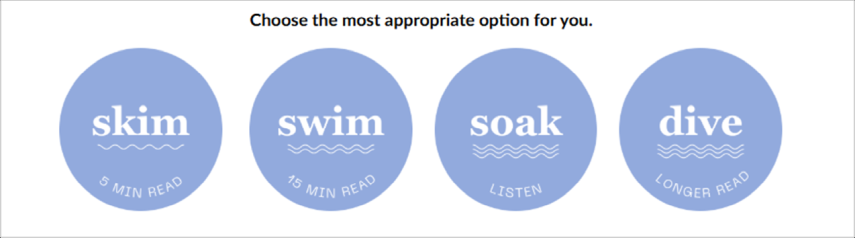
Screenshot of the skim-swim model on the Roseville College Canvas Professional Learning Growth page for teachers.
The same research is available in multiple formats and staff are prompted to ‘choose the most appropriate option for you’.
- Skim: a highly distilled summary designed to give staff access to key takeaways, frameworks, findings and strategies from the research in a 5-minute read
- Swim: a longer synthesis (pitched as the 15-minute version) which includes more comprehensive information and greater depth
- Soak: a 20 minute, AI-generated podcast version of the content (generated using Google Notebook LM), designed to present the research findings in a digestible format that staff can connect with while walking, cooking, commuting, etc
- Dive: direct access to the full set of research articles from which all other levels are drawn
Having engaged with the relevant research at a depth that fits their needs and capacity, our teachers then gather, twice a term in Professional Learning Groups (PLGs) – a popular and proven model of professional learning – to discuss, reflect, collaborate and apply the research to their practice.
This simple structure has become a core part of how we do professional learning at our school. The skim-swim model is designed to respect teachers' time and acknowledge the realities of workload while also creating a common platform for continued learning and meaningful engagement with educational research. To my delight, it has also been the element of PLGs which gets the most love among our teachers.
In the regular feedback form, PLG leaders have noted, ‘We LOVE the options as to how “deep” we go in our readings’ and, ‘My group are always very appreciative of the different options for accessing the research – a great example of differentiated instruction in action!’
Decades of research on adult learning makes one clear point: choice matters. When teachers are given autonomy over how they engage with research, they are more likely to find relevance, retain information and connect new ideas to practice. We’ve found that the skim-swim model lets them engage in a way that suits their needs, preferences and schedules.
Some teachers ‘skim’ during a break. A growing number ‘soak’ while commuting. Often, I speak to colleagues who picked up on an aspect of the ‘swim’ readings which was particularly pertinent to their role or goals and so decided to do a deep ‘dive’, knowing in advance the relevance of the research with which they were engaging.
This isn’t just about convenience. Research suggests that for professional learning to be effective, it needs to be sustained, collaborative, and connected to classroom practice (Darling-Hammond et al., 2017). It also needs to affirm the professional agency of teachers, respecting their ability to act purposefully and constructively as they direct their own professional growth (Ikpuri & Peter, 2024).
Because all PLG members are drawing from the same source material (just at different depths) conversations are still grounded in shared ideas. We’re building a common professional language – one that’s evidence-informed, accessible and free from the shame of ‘Sorry, I didn’t manage to do the readings …’.
This model doesn’t solve everything, but it is a small step towards making professional growth more possible, more personal, and more sustainable. At its heart, the skim-swim model is just one way of saying, ‘We see you. We see the effort you put into your craft, your desire to do the best by your students, the time you don’t have, and the learning you still crave’ and ‘the water is inviting. Come on in.’
References
Darling-Hammond, L., Hyler, M. E., & Gardner, M. (2017). Effective Teacher Professional Development. Learning Policy Institute.
Ikpuri, E. O., & Peter, G. O. (2024). Professional learning communities: a mechanism for enhancing teachers’ professional agency. International Journal of Latest Research in Humanities and Social Science, 7, 1, pp.74-81.
With a group of colleagues, make a list of the barriers impacting your ability to engage with educational research for professional learning.
Now, reflect on a time when professional learning felt relevant to your practice and manageable – what made it work?
Look at these 2 reflections together and consider how your school could adapt or build on ideas like the one shared by Lia Sharma to tackle some of the barriers you’re experiencing in your own context.