Thanks for tuning in to this podcast from Teacher magazine, the resource for K-12 educators published by ACER, the Australian Council for Educational Research. I'm Rebecca Vukovic and I’m Dominique Beech.
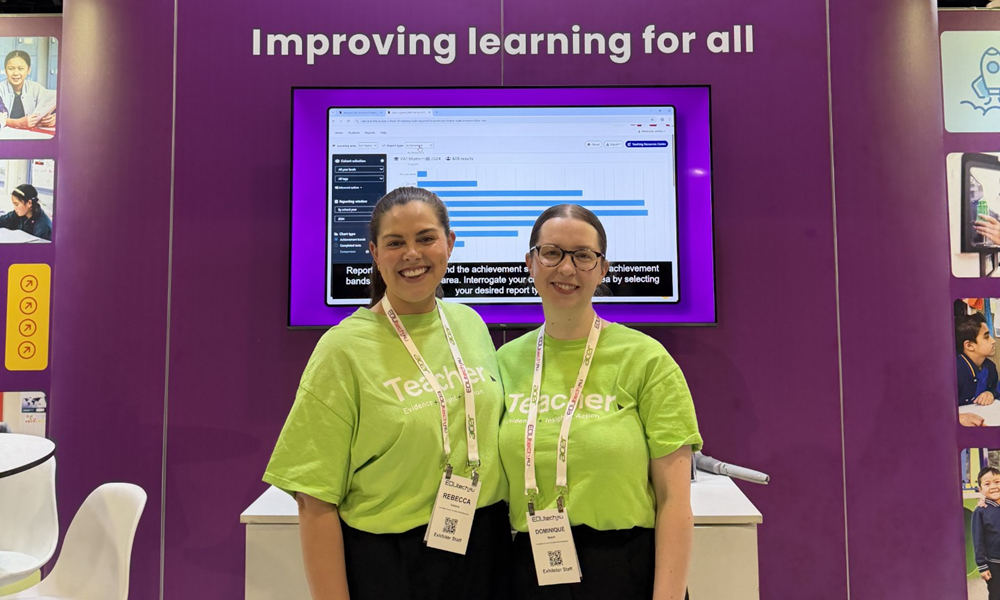
EDUtech is one of the largest and most prominent education and technology events on our calendar for 2026, and each year it brings together educators, school leaders and EdTech providers across K-12, higher education, and the vocational sectors. Over 2 days last week, Rebecca and I were there in Sydney to have conversations with the education community and hear from local and international speakers.
We had so many great conversations, didn’t we Dom? And as you’ll hear in this episode, we had our podcast mic with us throughout the entire 2 days, so we captured keynote sessions, panel discussions and even some of our chats with educators at the event.
What you’re about to hear are some of our honest and raw reflections on the sessions we attended. We include some short excerpts from the presentations and links to further reading as well. Most of the recordings were done in the packed exhibition hall so there is some background noise throughout. We hope you enjoy this episode as we take you along with us!
Rebecca Vukovic: Okay, you're here with Rebecca Vukovic and Dominique Beech this morning. We're at EDUtech 2026. We're really excited. Dom, how are you feeling?
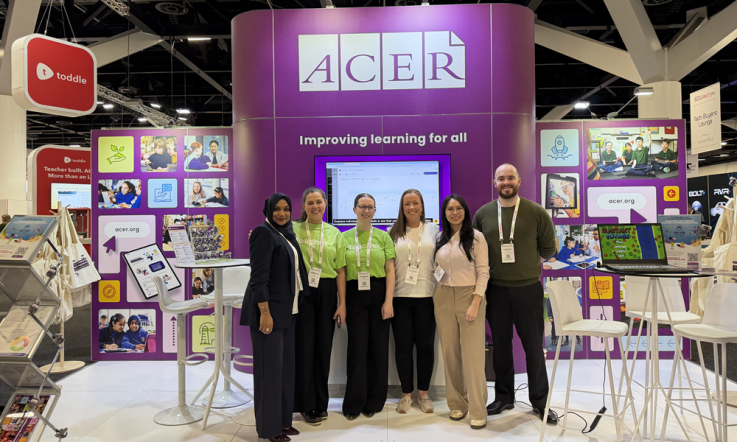
Dominique Beech: Yeah, as our listeners can probably hear, we're here at EDUtech already. It's been a really busy morning so far. We've met lots of people. We're here at the ACER stand. There are so many people to meet. I know we're just going to be so jam-packed, having so many great conversations with people.
RV: And we also have quite a few sessions that we're going to this morning. Dom, who are you looking forward to hearing from most?
DB: That's a tough question. We do have a jam-packed morning with back-to-back sessions. If you're making me choose one person I'm most looking forward to, I'd probably have to say Andrew Fuller from the University of Melbourne. His session is titled ‘Cognitive load to learning ease to cognitive velocity’. It sounds really interesting. I'm curious to hear what he'll be talking about.
RV: Yeah, it does sound really interesting. For me, I'm looking forward to hearing from Rose Luckin. She's from Educate Ventures Research Limited, and her session is titled ‘An education ecosystem vision for 2030’. And I just think it sounds fascinating and I can't wait to hear what she has to say. But we also have another one on the agenda first up this morning. We're hearing from Andy Hargreaves, aren't we, Dom?
DB: Yes, Andy Hargreaves is going to kick us off and his session is titled ‘Teaching to repair the world’. So, certainly, a varied range of sessions this morning. Really looking forward to it. We'll have to catch up at lunch and see what we thought of all of them!
RV: Yeah, we'll check back in after those sessions and let you know what we thought.
RV: Okay, Dom, so we just finished up the first session there. That was Andy Hargreaves talking about Teaching to repair the world. What was some of your key takeaways?
DB: Yeah, it's really tricky to pick just a couple. I was so interested by everything he had to say, and he took his talk in so many different directions. I guess the things that really stuck with me were, he got to a point where he was talking about how important it is to engage with your ‘resistors’ in education and acknowledging that everyone will have different opinions, different approaches to a similar task. And one quote that I wrote down was that he said, ‘your resistors make you stronger, you should ask them what is wrong and they will tell you’. That got a bit of a chuckle from the audience. And he also said that ‘resistors can be your allies’. So, it was really interesting to hear that perspective on how improvement can be gained by deliberately engaging with people who disagree with you. And I think that also brings me back to just what really stayed with me was how he was speaking about and he kept coming back to the fact that relationships are crucial and remembering people in the equation.
RV: Yeah, that was really the standout for me as well. He had some really remarkable quotes that I think will really stick with a lot of people. Particularly the quote that I love most where he was talking about the idea of sustaining teachers, not just retaining them and looking at the job itself. So, here's a quote from the presentation now that I'll play for listeners.
Andy Hargreaves: We also have a crisis of teacher recruitment and retention. It's not just Australia, it's not just Canada, it's not just the UK. It's global just about everywhere except China because rapidly falling birth rate means that actually they have too many teachers rather than too few. This crisis, we think we can solve the problem by treating it as retention. But you know what retention is? It's just the system clenching itself to keep people in. It's a totally wrong way… (That was a Donald Trump impersonation by the way). It's a totally wrong way to think about how we keep and how we motivate our best teachers, because rather than just retaining our teachers, we need to sustain our teachers, which means not just to keep them, but to feed them, to nourish them, to engage them. Everything I say about… everything I say this morning, applies to the teachers as much as the kids and the kids as much as the teachers.
RV: Of course that was Andy Hargreaves there. And I think the point that he was making that was really powerful is that it's the people that really matter. He also left us with a powerful quote about repairing. I think I'll play that for you now as well. It's really such a treat and that's how he finished off his presentation.
AH: Many of our kids come into school damaged. They're not broken, but they're damaged. They're damaged by trauma. They're damaged by war. They're damaged by intergenerational trauma. They're damaged by grinding poverty. Part of our job is repairing people as well as repairing things. And if we do these things together, we'll not only repair the stuff and repair the people, but we'll also show our kids now, not just for the future, but now through the projects they do and the impact they have on the communities that they and we can repair this world that is in disrepair and in despair – that together, right now in our schools, we can repair the world together. Thank you for your time. Enjoy the rest of the conference.
DB: That was a really powerful way to end the presentation. And as we were on our way out, Rebecca, we stopped and had a chat with a teacher from regional New South Wales. Her name was Kathleen Waters. And we asked her what was her main takeaway as an educator? And she picked up on what Andy was saying towards the beginning of his session about the real need to sustain teachers, rather than just focusing on retention.
RV: And that really brought back to that quote that I played for you earlier. So, here's Kathleen talking about the session from her perspective.
Kathleen Waters: My name is Kathleen Waters and I'm from St Francis de Sales Regional College in Leeton.
RV: And where is Leeton exactly?
KW: It's about an hour and a half northwest of Wagga Wagga, central New South Wales.
RV: Fantastic. And what was your key takeaway from that keynote there from Andy Hargreaves?
KW: Andy was very old school. I loved the way that he spoke to the audience in a very real way. He gave us a lot of truths, home truths. His delivery was very authentic.
RV: Is there anything from his presentation that you'll be able to apply into your own practice at the school?
KW: Maybe the awareness about the lack of teachers everywhere because of the sustainable engagement of teachers, where the teachers are so into administrative tasks rather than being totally present in the classroom with the students, finding how to engage them through meaningful connections.
RV: Fantastic. That was a key takeaway for me as well. Thank you so much for your time.
DB: Hi Dimity, thanks for joining us. So today we just wanted to ask you, you've come out of the Andy Hargreaves presentation that we were all in and we were just having a discussion about some of our key takeaways. Would you like to introduce yourself to our audience?
Dimity Budden: So, my name's Dimity and I work at Whitebridge High School. Something that really stuck out for me was when he was talking about resistance and that resistance can actually be powerful and be used as a tool. And instead of writing people off immediately, welcoming them to the table, asking them the questions, listening to what they have to say, and then using their advice to action, instead of getting so caught up in wanting to barrel forward in your own idea, listening to what some of the constraints might be, and then making a more informed choice about how you proceed.
DB: And do you think that's something that you'll take away to go and work at and kind of think about in your own setting?
DB: For me, I work with teachers a lot as a learning and support teacher about how they can approach learning and how they can improve student outcomes. All headspace can get impacted by the challenges that you face. So, trying to find a way to bring people to the table and make a plan for how we can go forward. Yes, I agree. I think it's really, the thing that he said was that you should actually get them to the table sooner rather than later. Don't avoid the hard conversation, like face it straight up, get in on it and see where the growth can be in that first.
RV: Okay, Dom, so we've just finished up the session with Professor Rose Luckin, which, as I mentioned earlier, was the one that I was looking forward to most today and she really did live up to my expectations. So, her session was on An education ecosystem vision for 2030. I've got a lot I want to talk about. I loved it. What did you think?
DB: I loved it too. Certainly, an appropriate session for an EDUtech conference. The thing that really stuck with me was when Rose was talking about the role of AI in assessment, and that's something that we've been talking about at the Teacher team for a while. And we know that there is a lot of research that's still emerging in this space, but something that Rose said put it brilliantly, she said, ‘we often as teachers ask, how do we catch students using AI for an assessment? Rather, what we should be asking is what about this assessment made AI a rational response for the student? Why did a student feel compelled to use AI to support them in this assessment?’ It was just put so brilliantly, and I think it's something that's going to stay in my mind for a long time.
RV: I felt like there was a lot of nodding in the audience as she said that. For me, I loved how she started talking about what AI is not good at. There were some things like knowing what is true, caring about the person in front of it, reasoning from first principles and judgment about what matters. Instead, she mentioned some of the things that AI is good at and probably not surprising to our listeners, but things like pattern at scale, drafting and reworking, generating options, tireless practice and explaining things differently. So yeah, I don't think they're going to be necessarily that surprising for our listeners, but it was really good to see her put it in such a succinct way. Rose had plenty of gems that she spoke about. I'm actually going to throw to a clip so that you can hear from her directly.
Rose Luckin: Really interesting piece of research came out a couple of weeks ago in the UK where their higher education thinktank, Wonkhe, had analysed 19 UK university AI policies. And one of the things that they'd identified was that in no policy does anybody say anything about trusting students. So, we go back to that enforcement rhetoric again. The message is about we don't trust you. No wonder students are anxious about being incorrectly accused of using AI because the rhetoric doesn't trust them. Now, I don't know about universities in the UK. I know TEQSA holds probably more than 203 since I wrote this slide a couple weeks ago. But there isn't a similar study for me to look at. But it would be interesting to see. My instinct would be that I suspect very few, if any of them, say explicitly, yeah, we trust you or we're going to support you to use the technology critically. Because, if we get the assessment right, of course we can trust students because we're not encouraging them to use the AI in a way to increase their grades and reduce their learning.
RV: So, as I mentioned, that was the presentation I was looking forward to most. But Dom, you have a bit of an update for listeners on the presentation that you were really looking forward to, the one with Andrew Fuller. What happened?
DB: Not a great start to our afternoon here, but this is what happens with conferences when there are just too many things that you want to go to. I'm sure our listeners can sympathise with it. I was rushing to the other side of the building to catch Andrew Fuller, what I've been looking forward to. And the seating was already at capacity. There were people sitting on the floor. There were people lining up to get in. So, it just didn't happen. I wasn't able to join in on his session, but he is speaking tomorrow. So, I think that makes me even more excited to hopefully catch him tomorrow because he's clearly incredibly popular.
RV: Definitely. We'll keep listeners updated. Dom, my fingers are crossed for you. Andrew Fuller, let's hope we hear from you tomorrow.
RV: Okay, so Dom, we're back. We're doing a quick check-in. We're nearing the end of day one, but we've just been to quite a few sessions. So, I thought we'd give listeners a brief update on where we're at. Do you want to go first?
DB: Yes, we have had a busy afternoon as expected. I have just come out of a panel session. That was the first one that I've been to for the conference. It was straight after lunch and the topic was ‘Technology integration in primary school’. It was really interesting because it was actually a lot of small group tables that they were gathering [around]. There were staff from Western Sydney University there, there was an educator from St Hilda's School and also our colleague Dharshani [Chandrasekara] from ACER. I was sitting with Dharshani and she was talking all about the early years and technology integration in the early years. We had a few teachers join us, talking about what is working well for them, what is not working well for them in terms of digital assessments and digital technology integration for key learning areas in general. It was really insightful and a bit of a different session, which was always nice.
RV: Yeah, it sounds great. While you were there, I was at another session. I was at the First Nations Theatre. I was at a session that was titled ‘Allyship in action: Embedding Indigenous perspectives in K-6 learning’. And there were 2 presenters at that stage. It was Bryce Ostini from Ascham and Aunty Maxine Ryan (she's A Dharawal Elder), and they've been working together for the past 4 years. They were talking about the importance of collaborating with community, and they provided some examples of how they've been doing that in their school context. They also touched on what respectful engagement looks like – so things like seeking guidance, listening, learning together and walking alongside each other. I found it really interesting that they also spent some time right at the beginning just defining what allyship is because a lot of teachers don't know where to begin, what it looks like in practice. So, I think that everyone walked away with some practical ideas on how they can embed allyship into their own school communities. And from there, Dom, we went to a session on starting a podcast. Do you want to tell listeners a bit more about that?
DB: Yeah, that one was such a highlight of the day for me. We were hearing from Siobhan Fembock and her principal from Gulgong Public School here in New South Wales. They're a regional school and they were talking all about how they got started with their student podcasting program which has now eventuated into a live radio station that they run at the school every Friday morning. The students present, produce their own radio program, they play song requests. It all was just so lovely to hear about and the thing that Siobhan kept reiterating throughout their session was that ‘innovation has no postcode’.
RV: They were really saying that any other school can do this. So, I think the really good thing was they provided so many practical tips on how schools can get started. They even ran through the equipment that they use, the software that they use, and provided a bit of a QR code for teachers to follow step-by-step if they want to start a podcast in their own school context. I really love the examples too. Did you love them, Dom?
DB: They were beautiful, weren't they? It was so engaging and so lovely to see the little videos that they shared with clips from the episodes that they've done and the amazing guests that they've had.
RV: I was so impressed. They've got some celebrity guests that they've had on their lineup, so that's really, really cool to see. So, we've got one more session to go to, Dom. We'll check back right at the end. So, we'll be back shortly.
RV: Okay, Dom, so we just finished off our last session. We just saw Todd Nelson from Ninti One. His presentation was titled ‘Measuring what matters: Embedding First Nations perspectives in government-supported national formative assessment’. It was a brilliant session, Dom, what did you think?
DB: Yeah, what a way to end day one. It was really fascinating to hear from Todd. He essentially spoke through 6 principles with us for assessment, and it was really, really fascinating. I think that something that really stuck out to me was when he got to a point where he said, ‘cultural responsiveness and psychometric validity in assessment are not intention, they are the same thing’. Such a simple way to put it. But yeah, that's definitely something that will stay with me.
RV: Yeah, that was a brilliant point. I think that the overarching message for me that I took away from the presentation was he kept saying ‘nothing for us, without us’ in respect to designing assessment with Indigenous perspectives in mind. He also spoke about the importance of having Indigenous people train others in the tools and the importance of First Nations leadership. I think the quote that really stuck with me was he said, ‘when the community builds a tool, the tool reflects the community’. And so, I'm going to play a clip for you now from his presentation because I think that this is the part that I found the most powerful from my perspective.
Todd Nelson: Nothing for us without us. The fundamental shift here is understanding that First Nation perspectives cannot be [retrospectively] fitted into a tool. It must be a continuous thread, woven from the very first scoping document, right through to design, trial and implementation. Because as Professor Tom Calma reminds us, ‘when First Nation people are empowered to lead educational design, outcomes inevitably shift from transaction to transformational’. But how do we actually do this?
It requires us to completely step away from the extractive Western research models. Instead, assessment architecture must be built using Aboriginal Participatory Action Research or APAR. APAR is a methodology led by Aboriginal community researchers that means collaborative knowledge construction and supported by co-design processes that give First Nation people real authority over the design. This means bringing together mobs from different cultural backgrounds and professional experiences in co-design workshops to determine when, how and in what ways children demonstrate capability, so the assessment experience is authentic rather than imposed.
It also means ensuring the strong representation of First Nation students and educators across both the developmental and trial phase, so the tool is shaped by the people it's intended to serve. The principle also requires First Nation content creators to develop up stimulus materials from and with First Nation people, ensuring the content reflects the lived realities, cultural context and community knowledge. And shout out to Wingaru for ours. It also requires capability visuals and learning progressions that include descriptions that reflect First Nation ways of knowing, being and doing rather than solely relying on Western developmental assumptions.
It also requires First Nation professionals to train others in how to use the tool with First Nation students. So, implementation on the ground in cultural perspectives, as well as the technical understanding. In this way, professional learning is not an add-on to the tool. It becomes part of the same continuous thread of First Nation leadership, authorship and accountability. Because when the community builds a tool, the tool reflects the community.
RV: So that was Todd Nelson from Ninti One there. So, Dom, that's the end of day one. How do you feel?
DB: Exhausted, but very satisfied and yeah, I feel very full. It's been a great day.
RV: We'll be back to do it all again tomorrow.
DB: See you tomorrow.
RV: It's day 2 of EDUtech 2026 and we've just come out of a session by Professor Jason Lodge. He was talking about Adaptive skills for the age of AI. Dom, what did you think?
DB: I loved it. He was a great presenter to kick off day 2. It was really interesting to hear from him, but Reb, something that I picked up on was Jason was the second person in the conference so far that I've seen anyway, that has brought up the book called The Digital Delusion. That's a book by Dr Jared Cooney Horvath. It might be something that our listeners are interested in having a look into. So, we'll leave a link to that book in the transcript because, clearly, it's something that a lot of people are finding really interesting.
RV: Yeah, I also love the fact that Jason mentioned there are a lot of different arguments or points of view when it comes to AI. For example, there's places like Estonia that are like all in on tech or places like Sweden who have taken tech out of the classroom. So, there's all these contradicting views on things. But for me, the key takeaway was when he talked about assessments; so, AI in assessment. And, you know, as teachers, how do we know that students have actually done the work? I think that's a question that all teachers are grappling with when it comes to AI. I think it was interesting that he made the point that universities can't actually detect AI use reliably.
So, we know that a lot of students in the tertiary sector are talking about the fact that they have these programs that can see whether or not they've used AI for their assessments. But to hear from Jason that this technology isn't all that reliable was something that I found interesting. And in fact, at his university, they've switched them off until, yeah, they can work out how they can do it properly. So that was interesting for me. I thought it would be nice to play a clip for listeners now. It's Jason talking about AI in assessment. So, I thought it'd be nice just to hear from him directly. So, I'll play that quote for you now.
Jason Lodge: The assessment side of things is going to be an ongoing problem. I think many of us who are working in the space where assessment is something that we need to consider, realise that this is an ongoing issue. I've been talking about this in relation to the things that we need to do now versus the things that we need to do and think about in the longer term. Now across our different education and training contexts this is impacting in different ways. For those of us in a higher education context we tend to have a lot of students who don't have a lot of contact time and not all of us have backgrounds in education. So, the issue there with secure forms of assessment that allow us to know whether the students have actually done the work is really pressing.
That's not to say that it's not also an issue in other education and training sectors. It is. It is just a particularly acute problem for us in higher education. We need to stem the bleed. If anybody's seen the media over the last 3 years, about every 8 weeks or so, there are major stories about how all our students are cheating. Is this just a Queensland thing? I'm sure it's not. Right? So, there is a clear issue there that we need to do something about right now, but to the point of my colleagues at CRADLE at Deakin, the assessment issue is more complex and something that we're going to need to revisit and rethink over time.
RV: So that was Professor Jason Lodge there. Dom, what are you looking forward to for the rest of today?
DB: I have to say, of course, I'm looking forward to hearing Dr Dan Edwards on a panel session this afternoon. Especially now that we've been through day one of the conference and assessment came up so much throughout the day. This panel session that Dr Dan Edwards – who of course is our colleague at ACER – is featuring on, the title is ‘Assessment reimagined: Charting the future for learners’. So, I'm really keen to hear all the different perspectives about innovation in that space.
RV: We'll check back in later today.
RV: We're here with friend of Teacher magazine, Holly Wedd. It's so nice to see you. How are you feeling and how are you enjoying your second day of EDUtech?
Holly Wedd: Hi everyone, I'm Holly Wedd. I'm from Orara High School in Coffs Harbour. I'm the Head of Maths there. It's been an absolutely wonderful conference so far. I've gotten so much out of it.
RV: What would you say your highlights have been?
HW: Look, I think every year when I come to EDUtech, I think I get 2 key takeaways and my main one is always getting to connect with other people, other educators and have that moment where you really get to step back from your own practice and reflect on what's working, what's not and what needs to change. I think for me, especially this one, this year, the takeaway has been on AI and how the elements of our teaching need to remain human and what needs to, or can, be offloaded to AI. It's been a really interesting contrast from previous years.
RV: Fantastic. It's so nice to catch up with you and enjoy the rest of the conference.
HW: Thank you very much.
RV: Okay, Dom, so we're finishing up day 2 of the conference. I've just been to a session titled ‘LEGO Education Computer Science & AI: A New Era of Learning’. And that was facilitated by Stacia Faith Jackson from LEGO Education and of course our former ACER colleague, the wonderful Rachel Parker from Global Play Lab. It was an amazing hands-on session where they got us to build our own little Lego characters and then program … using iPads we put code together and programmed the LEGO to move. And we were doing all these big like hand gestures and arm gestures to make the LEGO move. I have never seen anything like it. A lot of the teachers were really familiar with it because they either teach STEAM or they're technology teachers. So, they were amazing at it. I was kind of doing a bit of follow the leader because I didn't know what I was doing. But I loved seeing it because I just think it's a really engaging way to inspire students to use LEGO and to understand code in this way. So that session was definitely an amazing one for me to go to.
And then of course we have just been to the panel, the panel that we've been waiting for, Assessment reimagined: Charting the future for learners. And our colleague from ACER, Dr Dan Edwards was on that panel. Do you want to tell listeners a little bit about what you thought?
DB: I loved this panel and I must say I love panels in general because it's such a brilliant way to bring together people from different corners to talk about the same topic and get such a range of perspectives. Of course, Dan Edwards was on the panel, and he spoke about a lot that was covered in our podcast. So of course, listeners, if they haven't listened to our interview with Dan Edwards yet, scroll down a little bit in your feed to listen to that – really interesting perspectives. From another panellist though, Theo Clark, who was from the Queensland Curriculum and Assessment Authority; I loved what he said right towards the end of the panel when he was talking about, you know, we were back on the topic of AI in assessment and he was saying we really, you know, need to communicate to students that if we wanted AI's response to an assessment question, we would just ask AI for their response. What we're really interested in is the individual students' response and where their perspectives are at. So that was just a great reminder to finish the panel on, I thought.
RV: Yeah, Dom, there were a lot of nods in the audience when he was saying that. Let's hear a little bit from Dan now. He's talking about the future of assessment and making sure we know where students are at.
Daniel Edwards: One of the things in terms of when we're thinking about the future assessment, one of the things that we want to sort of push is that actually the purpose of assessment is not changing. What is changing, but the purpose of assessment and coming back to that first principle, why do we assess and what are we assessing for?
So, our approach is to understand where a learner is at, where they are at in the progression and where they've been and where they're going to and how we support them to work that way. So, the purpose doesn't change, but we are seeing things changing in the assessment area about the way we do assessment, what we measure and how much we measure and what data is available. So those are the sort of challenges that we're starting to face and we're starting to think about in terms of how we design assessments, support educators, support students, support parents to be able to work their way through the education system.
RV: And just like that, that brings our coverage to a close. We have to get to the airport, so we'll sign off here and we'll come back a little bit later for our reflections.
DB: We’re back in Melbourne now and have had the weekend to recover and digest all the key learnings from our time at EDUtech. For me, given all the conversations we had about AI, I was reminded of the importance of keeping humans in the loop, and that of course is so relevant to teacher judgement and teacher expertise.
RV: Yeah, keeping humans in the loop is something that came up again and again. And that reminds me that here at Teacher, we have the opportunity to speak with many people as part of our job – for interviews, or for podcasts, through advertising and partnerships as well. But often this is over the phone, or via Teams. But by attending the conference and meeting so many of those people face-to-face, it reminded me that human connection is just so important, and I was so energised by the conversations we had. We can’t wait to do it all again next year!
That's all for this episode. Thanks for listening. If you enjoyed this one, please take a quick moment to hit follow on your podcast app and leave us a review. Both of those things help more people like you to find our podcast and they're a really big support for the Teacher team. We'll be back with a new episode very soon.
Teacher magazine is published by the Australian Council for Educational Research.