Earlier this year, our podcast with Mandy Nayton – Educational and Developmental Psychologist and Chief Executive Officer of the Dyslexia-SPELD Foundation – explored ways to support students of all ages to read successfully. In the first of 3 follow-up articles, Professor Genevieve McArthur – of the Australian Centre for the Advancement of Literacy at ACU and Director of Research Translation at the Dyslexia-SPELD Foundation – shares how reading difficulties can impact student wellbeing.
In 2023, Hamish Kelly published a book. This was impressive for several reasons. First, he was only in year 10. Second, he had already published a book in year 6. And third, he wrote these books despite having severe and persistent difficulties with reading, which some people call dyslexia.
In his first book, Hamish explained how it felt when he first started to learn to read: ‘When I first started school, there was no homework and we learnt through fun and games. I loved coming to school! Then it got harder! We had to learn to read. Suddenly everything was hard! The letters in words were confusing and words often looked the same,’ (Kelly, 2023, pp. 4-6).
He also explained how his reading difficulties impacted his wellbeing: ‘Each year it got harder. Reading got harder and maths got twice as hard, as maths has lots of reading as well ... By year 5, I was down on myself. I felt stupid and dumb!! My Mum, Dad, and teachers told me I wasn't, but I still felt that I was. There [were] other challenges ... like anxiety and loss of confidence,’ (pp.10, 14, 39).
Hamish is not alone. One in 3 students in Australia fail to meet basic standards in literacy, and one in 4 experience high levels of psychological distress (ACARA, 2025; AIHW, 2026). Traditionally, reading and wellbeing have been considered unrelated. However, there is now sufficient scientific evidence to suggest that reading is related to certain aspects of wellbeing, which are shown in the cycle below (McArthur, 2022).
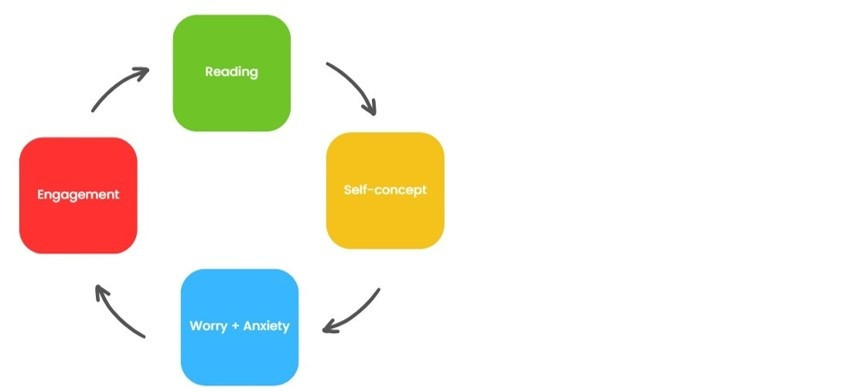
This cycle begins when a child – like Hamish – starts to fall behind their classmates in their reading (see green box in diagram). This may trigger negative feedback from significant others, and the self, about their reading ability. This can negatively impact their reading self-concept (e.g., ‘I am a bad reader’; orange box) which may increase their worries or anxieties about reading (e.g., ‘I worry that I am not a good reader’; blue box) particularly in social situations (e.g., ‘I worry that other kids will laugh at me when I read aloud’). To try to escape this anxiety, a child may reduce their engagement with reading by not paying attention in class (e.g., ‘I am often distracted by other things when I am reading’) or avoid going to certain classes entirely (e.g., ‘I often find excuses to get out of class’; red box). This reduces their reading practice and hence their reading development. This further impacts their self-concept, anxiety levels, and reading engagement, creating a vicious cycle between reading difficulties and wellbeing.
This causal cycle is based on evidence from studies that have measured the strength of the relationships between reading ability and reading-related self-concept (Chapman & Tunmer, 1997; Retelsdorf et al., 2014; McArthur et al., 2022), anxiety (Johnson et al., 2026; McArthur et al., 2024; Salins et al., 2026), and engagement (Taboada et al., 2026).
Most of these studies have focused on children. Far fewer studies have been done with adolescents, although this appears to be changing. The evidence we have to date suggests that some relationships within the vicious cycle may change during. For example, the results of a very recent study suggest that early reading ability in secondary school may predict later reading self-concept but not later reading anxiety (Jones et al., 2026). It is possible that anxiety is mitigated by other factors such as support from peers, teachers, and family. This aligns with Hamish's advice to other students who have dyslexia: ‘Let your friends help. Talk to your teacher and say, “could you explain it another way as I didn't get it”. Talk to your parents and try to explain what you find hard,’ (Kelly, 2023, pp. 39-40).
Given that reading may be related to reading self-concept in both primary and secondary school, it is important to understand how it might be protected, or treated, throughout development. Fortunately, Australia is home to one of the few evidence-based programs designed specifically to support facets of poor reading self-concept – Clever Kids.
Clever Kids was developed by the Dyslexia-SPELD Foundation (DSF) in Perth, Western Australia. It is a 9-week program designed specifically for upper primary school children with dyslexia, many of whom indicate that they are struggling with poor self-esteem. The focus of Clever Kids is on self-acceptance, positive coping strategies, goal setting, perseverance and help-seeking behaviours. The content is presented using a combination of explicit instruction, modelling, role-play and ongoing revision of the concepts being taught.
It was first tested in a small pilot trial with 40 children (around 10 years old) that has been published in the British Journal of Educational Psychology (Boyes et al., 2021). It was then assessed in a larger randomised controlled trial (78 children) across 2023 and 2024 (Boyes et al., 2025). The results suggest that those children who completed Clever Kids reported significantly greater gains in their coping, emotion regulation, academic and social self-esteem compared to children who did not do the program. Parents of children in the program also reported a significantly greater reduction in their child's levels of anxiety and depression. These improvements were still present 3 months after the program.
Stay tuned: The next 2 articles will be looking at some of the myths and misconceptions around reading difficulties, good practices and classroom accommodations after diagnosis, and spelling, reading and vocabulary instruction through word study.
References
ACARA (2025). NAPLAN national results. https://www.acara.edu.au/reporting/national-report-on-schooling-in-australia/naplan-national-results
AIHW. (2026). Mental Health. Australian Institute of Health and Welfare. www.aihw.gov.au/mental-health
Boyes, M. E., Leitão, S., Claessen, M., Dzidic, P., Badcock, N. A., & Nayton, M. (2021). Piloting ‘Clever Kids’: A randomized‐controlled trial assessing feasibility, efficacy, and acceptability of a socioemotional well‐being programme for children with dyslexia. British Journal of Educational Psychology, 91(3), 950-971. https://doi.org/10.1111/bjep.12401
Boyes, M., Melville, K., Nayton, M., Pizzey, H., & Leitão, S. (2025). Targeting coping strategies, emotion regulation, and self-esteem in children with dyslexia to support mental health: A randomised-controlled trial of Clever Kids. https://osf.io/q2v5k_v1
Chapman, J. W., & Tunmer, W. E. (1997). A longitudinal study of beginning reading achievement and reading self‐concept. British Journal of Educational Psychology, 67(3), 279-291. https://doi.org/10.1111/j.2044-8279.1997.tb01244.x
Johnson, R. M., Schaefer, M., Norris, C. U., Wagner, R. K., & Hart, S. A. (2026). The association between reading anxiety and reading achievement: A meta-analysis and systematic review. Psychological Bulletin, 152(3), 288. https://doi.org/10.1037/bul0000517
Jones, A., Johnco, C., Beyersmann, E., Robidoux, S., & McArthur, G. (2026). Longitudinal and Bidirectional Relationships Between Reading Ability, Internalising Symptoms, and Academic Self-Concept in Adolescence: Evidence from the Longitudinal Study of Australian Children. Child Psychiatry & Human Development, 1-13. https://doi.org/10.1007/s10578-026-02048-w
Kelly, H. (2023). My Dyslexia Journey. Dyslexia SPELD Foundation.
McArthur, G. (2022). Poor reading and anxiety (PRAX): building a theory and practice. Australian Journal of Learning Difficulties, 27(1), 169-180. https://doi.org/10.1080/19404158.2022.2054834
McArthur, G., Badcock, N., Castles, A., & Robidoux, S. (2022). Tracking the relations between children’s reading and emotional health across time: Evidence from four large longitudinal studies. Reading Research Quarterly, 57(2), 555-585. https://doi.org/10.1002/rrq.426
McArthur, G., Doust, A., Banales, E., Robidoux, S., & Kohnen, S. (2024). Are comorbidities of poor reading related to elevated anxiety in children? Annals of Dyslexia, 74(1), 47-65. https://link.springer.com/article/10.1007/s11881-023-00292-6
Retelsdorf, J., Köller, O., & Möller, J. (2014). Reading achievement and reading self-concept – Testing the reciprocal effects model. Learning and Instruction, 29, 21-30. https://doi.org/10.1016/j.learninstruc.2013.07.004
Salins, A., Khanolainen, D., Robidoux, S., Psyridou, M., Salminen, J., & Torppa, M. (2026). Understanding Reading Development: The Interplay of Fluency, Engagement, and Reading Anxiety in Early Grades. Reading Research Quarterly, 61(3), e70122. https://doi.org/10.1002/rrq.70122
Taboada Barber, A., Cartwright, K. B., Hancock, G. R., & Altani, A. (2026). Reading anxiety and reading achievement: Disentangling the role of reading engagement in the late elementary grades. Journal of Educational Psychology. Advance online publication. https://doi.org/10.1037/edu0001053
To what extent does your whole-school literacy strategy consider the wellbeing impacts of reading difficulties, as well as academic outcomes?
Professor Genevieve McArthur shares how reading difficulties can contribute to a cycle of low self-concept, anxiety and disengagement, which may further hinder reading development. What actions could you and your colleagues take to break that cycle as early as possible?
DSF provides a half-day workshop for teachers, learning support staff, psychologists and counsellors who wish to deliver the DSF Clever Kids program in a small group setting. For more information about DSF and the training, visit https://dsf.net.au/our-services/professional-learning/event-details/clever-kids-facilitator-training-1026ck-9f6d64b3.