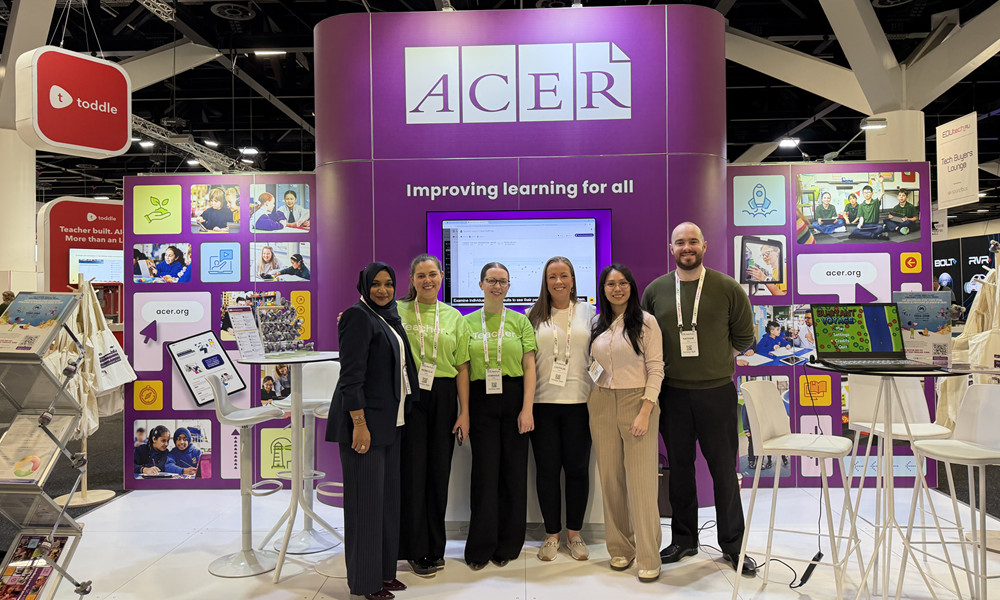
EDUtech has just wrapped up for 2026, and the Teacher team were in Sydney for the 2-day conference to have conversations with the education community and hear from local and international speakers.
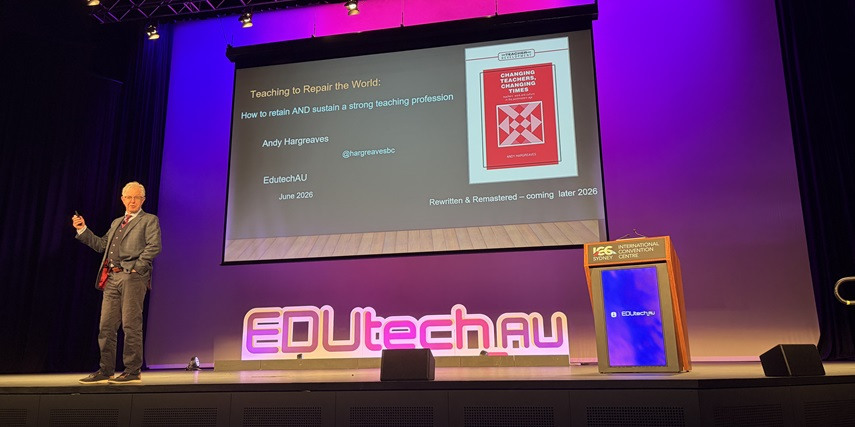
Day one kicked off with a keynote from Professor Andy Hargreaves, Creator, President & Co-Founder at ARC Education. Professor Hargreaves is also Visiting Professor at the University of Ottawa, Canada, and Research Professor at Boston College in the US. His session was titled ‘Teaching to repair the world’ and addressed student absenteeism and teacher retention. Professor Hargreaves spoke about the importance of sustaining the teacher profession.
‘Rather than just retaining our teachers, we need to sustain our teachers. Which means not just keep them, but feed them. To nourish them. To engage them,’ he says. ‘Everything I’ve said this morning applies to the teachers as much to the kids, and the kids as much as the teachers.’
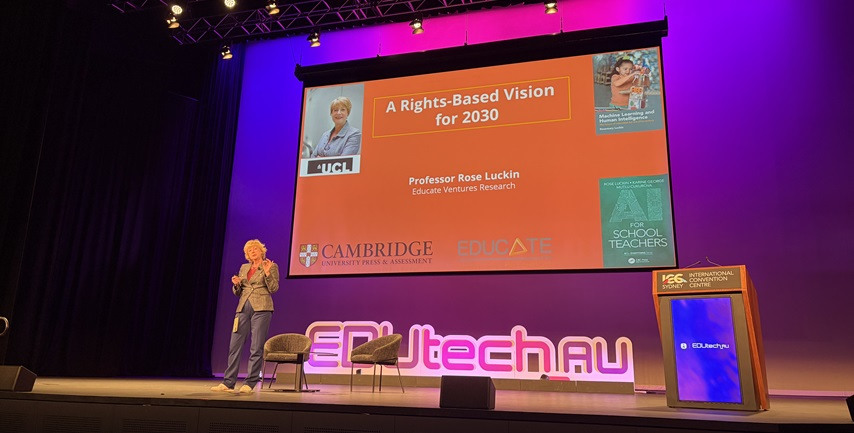
We also heard from keynote presenter Professor Rose Luckin, Founder of Educate Ventures Research. She is a recognised expert on AI in education, and her session was titled ‘An education ecosystem for 2030’. She presented a range of recent local and international research to delegates on the topic of student use of AI, sharing that contrary to popular opinion, many senior students are only ‘light users’ of AI, and only a small portion are ‘power users’.
Professor Luckin also addressed AI in assessment. ‘We’re very much in an enforcement space,’ she says. ‘If we look – across multiple education institutions – the rhetoric is very much about enforcement. How can we catch students using AI? And that’s the wrong question. Very rarely do we hear … what about the assessment made AI use the rational response?’
Delegates reflected that what came through from both of these sessions was the importance of relationships in education.
As Professor Luckin put it, ‘the AI does not care about you. It might tell you you’re lovely and you’re doing a fantastic job … and that’s really important, because the relational part of what we [educators] do is so important.’
Later that afternoon, the Teacher team also attended an interactive session, ‘Technology integration in primary school’, featuring Dr Dharshani Chandrasekara from the Australian Council for Educational Research (ACER); Lesley Gough, Grant Jones and Kerrie Quee from Western Sydney University; Ronelle Sanders and Deb Wilson from St John’s Anglican College; Ben Witheford from Shotover Primary School, Jessie Muir from SHORE Preparatory School; and Jennifer Muir from St Hilda’s School. The session encouraged delegates to share with each other – in small groups facilitated by the session hosts – what they’re already doing in their own settings about technology integration across key learning areas in primary school. Dr Chandrasekara spoke with early years’ educators about their experiences with integrating digital technology in the early years, and about their use of digital assessment tools.
We ended day one hearing from Todd Nelson, Education Manager at Ninti One. His session was titled ‘Measuring what matters: Embedding First Nations perspectives in government-supported national formative assessment’ and he introduced delegates to 6 core principles that demonstrate how First Nations perspectives can be structurally embedded into formative assessments.
‘The assessment must adapt to the child, not the other way around’, Nelson says. ‘There is a common, persistent misconception in educational assessment design that you have to make a choice. The assumption is that you must choose between cultural responsiveness on one hand and a rigorous psychometric validity on the other. Our theory of change asserts they are not in tension. And, in fact, they’re exactly the same thing.’
Day 2 was also jam-packed with thoughtful discussion and insightful perspectives. It kicked off with a keynote from Jason Lodge from the University of Queensland whose session was titled ‘Adaptive skills for the age of AI’, where he acknowledged the differing views of AI in the industry.
‘If we had a good answer for what to do about AI in education, that is all we would be talking about right now. We don’t,’ he says.
The session also covered the topic of AI in assessment and how we can’t yet reliably detect AI use in assessment. He also spoke to delegates about the urgent need for research in this space. ‘The research is still catching up. Now, as some of you may know, the gap between the sort of basic research about some of these issues and when that actually impacts on policy and practice at scale, is somewhere around 17 years. And we’re still trying to get the research right. Does anybody think we can wait 17 years to figure all of this out?’
EDUtech 2026 also featured a Show and Tell area. The Teacher team caught the popular Australian STEM Video Game Challenge presentation hosted by Lisa van Beeck, ACER Research Fellow and Project Director for the challenge. She took delegates through what the challenge is and the related teacher resources.
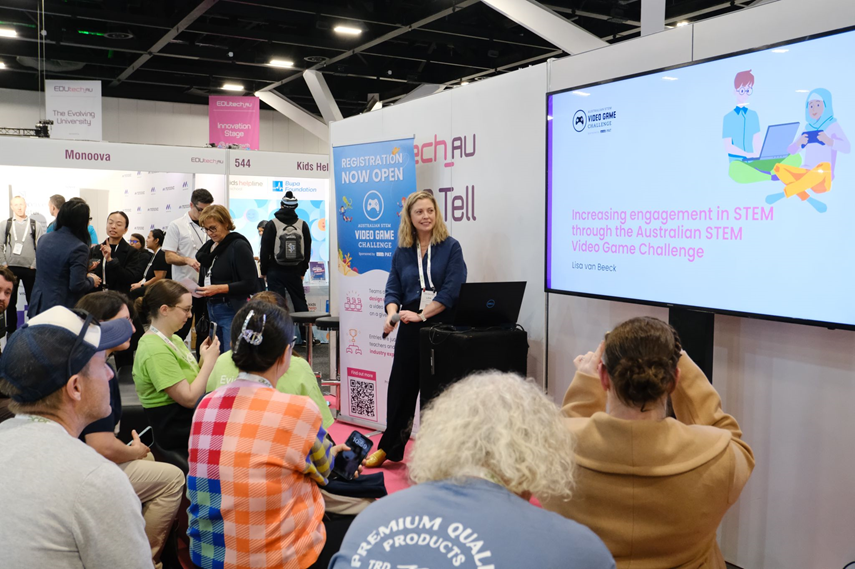
She also explained that ACER runs the challenge because data – such as PISA 2022 – show that we need to support students to apply their reading, mathematics and science knowledge and skills to solve real-life problems. ‘It’s data like this that makes ACER run our challenge, because we want to help provide solutions to these problems,’ van Beeck says.
‘What we’re trying to do is demonstrate that actually doing something fun like creating a game exposes them to a whole raft of technology and STEM-related skills,’ she said.
We ended our time at EDUtech by listening in to the panel session, ‘Assessment reimagined: Charting the future for learners’ featuring Dr Dan Edwards, Acting Head of ACER's Student Learning and Progress Division, alongside Scott O’Hara, Principal at Jerrabomberra High School; Jenny Hanson, Assessment and communications Officer at the ACT Board of Senior Secondary Studies; Theo Clark, Manager of Syllabus Services, Senior Curriculum and Assessment at Queensland Curriculum and Assessment Authority (QCAA); and John Cleary, Director of Students as Partners at Education Services Australia.
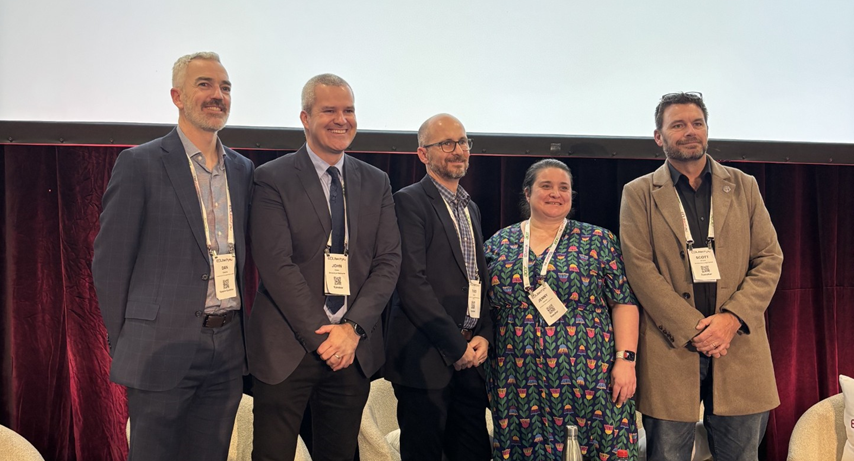
Dr Edwards caught up with Teacher ahead of the panel session to share his insights on the topic. At EDUtech, he reflected on the purpose of assessment in light of the rapidly changing landscape.
‘The purpose of assessment is not changing… Our approach is to understand where a learner is at in the progression and where they’ve been, and where they’re going to and how we support them,’ Dr Edwards says.
‘The purpose doesn’t change but we are seeing things change in the assessment area about the way we do assessment, what we measure and how much we measure, and what data is available. So those are the challenges we’re facing in terms of how we design assessments, support teachers, support students and support parents to work their way through the education system.’