
In almost every school you’ll find one or more diagrams that provide a high-level overview of teaching and learning practices. It may be called an instructional model, a pedagogical model, practice framework, lesson structure, way of working, or something else entirely. These are not all the same thing, and we could go down a rabbit hole defining and delineating each, but the common theme is that they seek to provide an anchor for common practice.
It is widely acknowledged that there is value in having common models of effective pedagogical practices in schools, and the important role that leaders play in developing and enacting these (ACER, 2023; Hunter, 2022; Rogers et al., 2023; Sherrington, 2026). In many cases these will also draw on and connect to system-wide models, such as those from Melbourne Archdiocese of Catholic Schools and the Education Departments in Victoria, Tasmania and New South Wales. Or other external frameworks such as AERO’s Model of Learning and Teaching or Rosenshine’s Principles of Instruction.
An anchor for common practice
These anchoring models are, by their nature, very high level and whilst we all love a one page starting point it is rarely enough on its own. To this end, many of these models are paired with some kind of ‘playbook’ or ‘toolkit’ that elaborates on the nuance and details of practice within the specific school context. This level of detail and focus on practice can help teachers deepen their understanding of specific practices, improving the likelihood of making a positive impact on student outcomes (Knight et al., 2020; Rogers et al., 2023). Increasingly, these may include valuable highly specific examples through samples of resources, student artefacts or videos. Many have generously shared their work on playbooks for the greater good (Boyd et al., 2024).
All of these anchoring resources can be useful, and may positively impact teaching and learning, but that is not guaranteed just by their existence. Indeed, most educators can likely recall one or 2 examples of such things gathering dust on a staffroom noticeboard, languishing in an online platform, or not making it off the pages of a brochure. In this brief article we unpack some key lessons from the journey of Clover Hill State School – a co-educational P-6 independent public school on Queensland’s Gold Coast – in developing and implementing a pedagogical model that impacts practice.
‘Our ambition was never a polished framework that looked impressive on a classroom wall. It was to strengthen the quality of teaching inside every classroom, every day. A model only has value if it changes the decisions teachers make in the moment.’ (Martine Gill, Clover Hill State School Principal)
A considered iteration
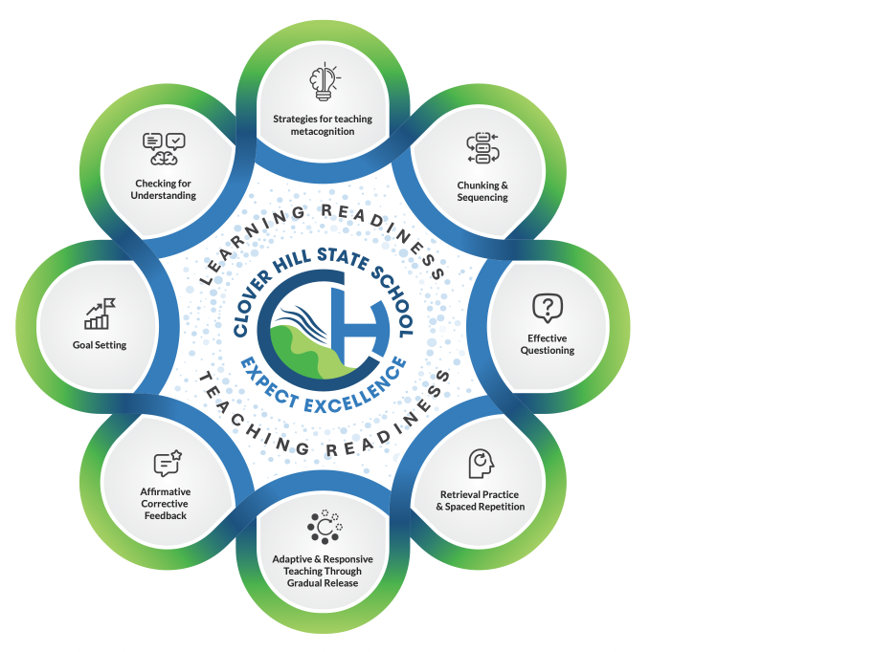
The development of a pedagogical model could be seen as the start of one journey, or the end of another, however the likely reality for most schools is that it is very much in the middle. The Clover Hill Pedagogical Model (see below) was developed as a considered iteration, drawing on many years of experience in the school. It is a deliberate sharpening, focusing and elevating of existing practice rather than a shiny new thing.
The team was conscious of avoiding the additive trap (Breakspear & Rosenbrock, 2024) and went through many iterations to land on the highest leverage 8 core practices. The resulting model is not a ‘laundry list’ of all that could be ‘good practice’, but rather a clear mental model that all staff in the school can use. This was not a smooth process. Landing on 8 took repeated drafts, real disagreement, and a willingness to let go of things the team valued.
‘Every initiative, framework and priority competes for teachers’ attention, and over time even worthwhile ideas can create complexity rather than clarity. We are not seeking improvement for its own sake. We are seeking coherence.’ (Martine Gill)
An evidence-informed approach
The development and implementation of a pedagogical model can represent a very significant investment of finite school resources. It is therefore vital that the approach taken is informed by evidence.
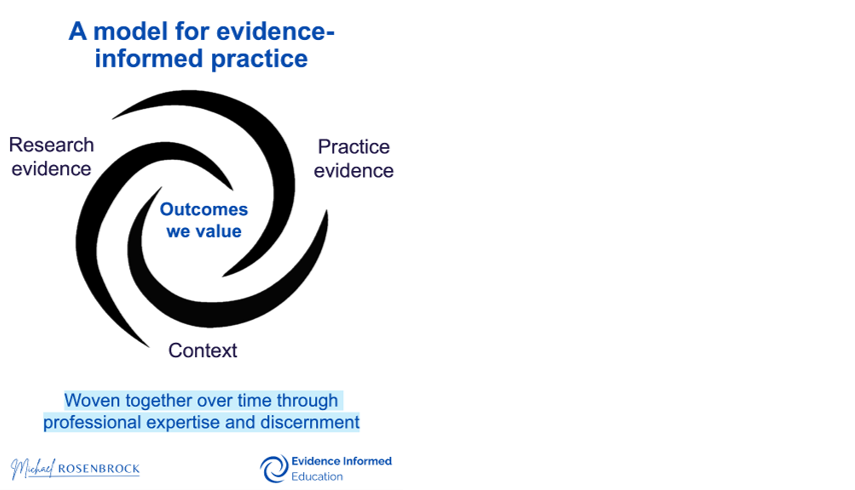
So, what does it mean exactly to be evidence-informed? To translate evidence into practice requires drawing together research evidence with evidence from classroom practice and school context. This is done using professional expertise and discernment, with a deliberate focus on making a difference to the outcomes that matter most for the school (Rosenbrock, 2025).
‘We engaged Michael to test our thinking against the strongest available evidence. The real value was in the respectful challenge – helping us separate the practices we valued because they were familiar from those genuinely supported by research.’ (Martine Gill)
Avoiding pitfalls
The team at Clover Hill were keen to avoid potential pitfalls that can occur with models of practice, such as: surface level implementation; one-size-fits-all thinking; drifting into compliance; and overly rigid structures and processes. These issues are not the fault of models of practice per se, but rather common sticking points in the messy middle of implementing something new.
To guard against this, the model was developed with the adaptive nature of teaching in mind. It is deliberately not a lesson structure, but rather a series of key practices for teachers to draw upon. The emphasis is then on teacher intellectual preparation and expertise to determine when, where and how best to deploy the strategies. A shared way of thinking gives teachers a more precise focus for the judgements they make.
Developing teacher expertise
Designing a great model is only part of the picture. Key to making an impact on practice is using the model as an anchor for developing teacher expertise.
To enable this, the team at Clover Hill worked collaboratively over several months to refine the model and develop a comprehensive set of supporting resources. This included a detailed ‘playbook’ that included a practical overview of the underpinning research evidence, details on supporting practices such as engagement norms, and a detailed unpacking of each of the 8 core practices. Each core practice includes: details of the practice to build shared understanding; guidance on opportunities to elevate practice and avoid common mistakes; implementation indicators; and teacher reflection prompts.
‘The model gives every teacher a shared language, but clarity alone is never sufficient. The playbook is not designed to create compliance, rather to cultivate expertise, and to be returned to over time.’ (Martine Gill)
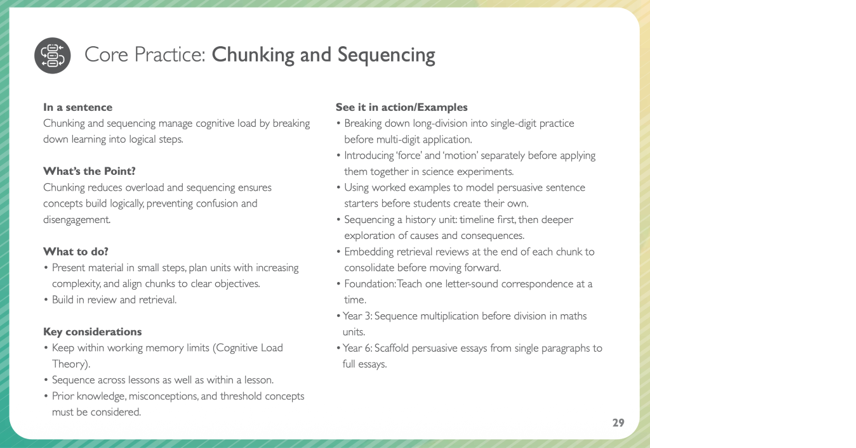
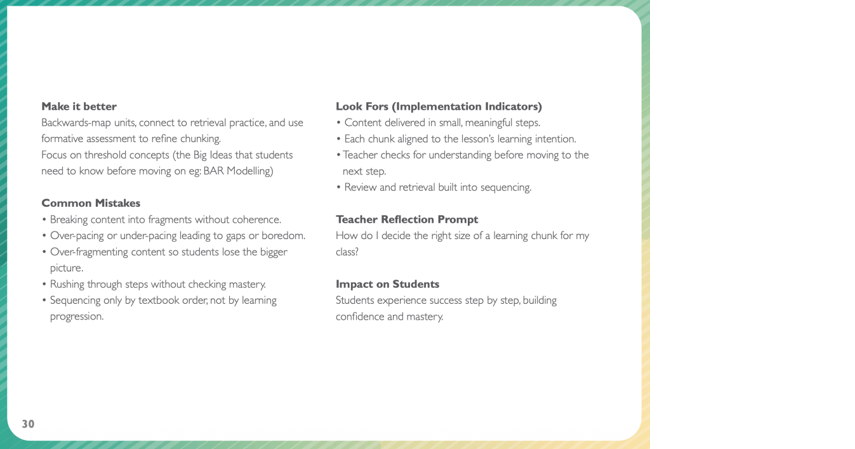
Figure 3. The Clover Hill Pedagogical Framework – sample (Clover Hill State School, 2026)
The final stage of this process involved designing an impactful approach to professional development, drawing on research evidence and experience from practice (Rosenbrock, 2026).
- Aligned focus: Anchored by the model, this then allows for adaptations to meet teachers at their point of expertise, avoiding the one-size-fits-all trap for new teachers and experts alike.
- Balanced mechanisms: Designing in-school PD around effective mechanisms instead of programs or forms of PD (Sharples et al., 2024) to increase the chances of impact on practice
- Data-informed iterations: Supporting teachers to use the indicators and reflection prompts in the resources to gather data, reflect on, and further iterate to keep improving practice
- Practical details: Drawing on the pedagogical model resources, and building in the time, processes and structures that support all teachers to develop over time
‘Models of practice and resources alone do not improve teaching – teacher do. From instructional coaching to protected collaborative planning time, everything is designed to build expertise over time, not to deliver isolated events. This is an iterative process – we are constantly gathering evidence, reflecting on our impact, seeking feedback and refining our thinking.’ (Martine Gill)
Long-term thinking and sustaining impact
This work has been a long-term effort, rather than a quick win. The team at Clover Hill have drawn on evidence on effective implementation (AERO 2026; Sharples et al., 2024) and planned a deliberate and staged approach.
The model is not treated as a finished product. The team continues to gather evidence, seek feedback and refine their thinking, including by opening classrooms to visiting educators and colleagues from beyond the school, whose questions test the direction being taken.
‘Schools do not improve because they launch more initiatives. They improve because they build better habits. One of the greatest responsibilities of leadership is not to add complexity, but to create clarity about the practices that matter most. That has been our purpose throughout this journey. Not to build a pedagogical model, but to build a culture where evidence informs decisions, professional expertise continues to grow, and every student benefits.’ (Martine Gill)
References
Australian Council for Educational Research (ACER). (2023). School Improvement Tool. Australian Council for Educational Research. https://research.acer.edu.au/tll_misc/37/
Australian Educational Research Organisation (AERO). (2026). Taking an evidence-informed
approach to implementation. (Implementation explainer 1). https://www.edresearch.edu.au/summaries-explainers/explainers/taking-evidence-informed-approach-implementation
Boyd, R., Lehr, R., & MacNeill, N. (2024, February 22). The Instructional Playbook+ : A Bespoke Model for Pedagogic Improvement in Schools. Education Today. https://www.educationtoday.com.au/news-detail/The-Instructional-Pl-6153
Breakspear, S., & Rosenbrock, M. (2024). The Pruning Principle: Mastering the Art of Strategic Subtraction Within Education. Amba Press.
Clover Hill State School. (2026). Clover Hill Pedagogical Framework.
Sharples, J., Eaton, J., & Boughelaf, J. (2024). A School’s Guide to Implementation. Education Endowment Foundation. https://educationendowmentfoundation.org.uk/education-evidence/guidance-reports/implementation
Hunter, J., Haywood, A. & Parkinson, N. (2022). Ending the lesson lottery. How to improve curriculum planning in schools. Grattan Institute.
Knight, J., Hoffman, A., Harris, M., & Thomas, S. (2020). The Instructional Playbook: The Missing Link for Translating Research into Practice. ASCD.
Rogers, C., van der Kleij, F., & Taylor-Guy, P. (2023). School Improvement Tool: A summary of the underpinning research. Australian Council for Educational Research (ACER). https://research.acer.edu.au/tll_misc/41/
Rosenbrock, M. (2025). A model for evidence-informed practice in education. Available from https://michaelrosenbrock.com/evidence-into-practice
Rosenbrock, M. (2026). Designing impactful professional development. Available from https://michaelrosenbrock.com/impactful-professional-development
Sherrington, T. (2026, April 11). Cold Call Codification. An exploration of various versions – and the immense value of codification in general. Teacherhead. https://teacherhead.com/2026/04/11/cold-call-codification-an-exploration-of-various-versions-and-the-immense-value-of-codification-in-general/
What anchors common practice in your school, and what evidence do you have that it shapes the decisions teachers make day to day?
If you sharpened your current practices down to a small number of core ones, which would make the cut — and what would you need to let go of?
Which of your current practices are valued because they are familiar, rather than because they are supported by evidence?
Beyond the model itself, what time, structures and support would your teachers need to build genuine expertise in it?