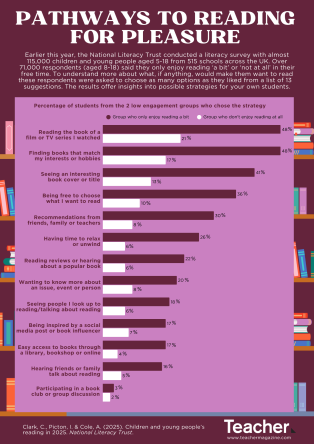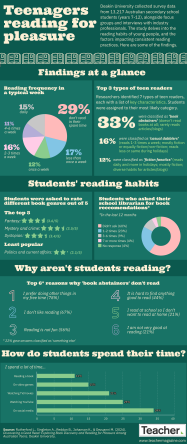
We know students have varying interests when it comes to reading and that there are many different pathways to readings for pleasure for young people. For instance, some students may gravitate more towards reading graphic novels, and others may prefer to read poetry (Earp, 2025).
Some may even prefer to engage with books by listening to audiobooks. New large-scale research from the National Literacy Trust in the UK (Arif et al., 2026) has examined the audio listening habits of over 110,000 children and young people. Findings show that almost half (47.3%) listened to audio in 2026, and of these, 22.3% listened exclusively to audiobooks, 28.7% to both podcasts and audiobooks, and 49.1% to podcasts only.
Respondents were aged between 8 and 18 and were also asked about their enjoyment of audio listening, how they discovered the audio they listen to and what makes them engage with the medium. The researchers defined ‘audio’ in this context as referring to audiobooks and podcasts.
Lead author of the report and Research Manager at the National Literacy Trust, Aisha Arif, tells Teacher that understanding audio is increasingly important to understanding children and young people’s wider literacy lives.
‘Our own and others’ research shows that audio is becoming an increasingly important part of how children and young people access stories, ideas and information,’ she says. ‘Asking about audio in our Annual Literacy Survey allowed us to explore who is engaging, how this changes with age and what encourages children and young people to listen.’
Responding to students’ interests
‘One particularly interesting finding was the shift in the types of audio children choose as they get older, with engagement moving away from audiobooks and towards podcasts,’ Arif shares. ‘This suggests that audio does not simply become less relevant as children grow up; rather, the ways in which they use it change.’
Differences between genders was also observed in the survey results – more girls than boys listened to audio overall (49.6% and 44.6%, respectively) and girls were more likely to listen to audiobooks than boys (24.2% compared to 20.0%). The reverse was true for listening to podcasts – 55.5% of boys compared to 44.5% of girls listened to podcasts in 2026.
‘We were also struck by just how important children and young people’s own interests were. Content that reflected their interests was the strongest motivation for listening to audiobooks and podcasts. This reinforces the importance of giving children choice and recognising audio as another way for them to explore the stories, subjects and ideas that matter to them.’
Participants were also asked to share how they discover audio to listen to. Younger children relied more on family, while older teenagers mostly discovered content through social media and browsing apps or websites.
Audiobooks as a pathway to reading
The survey findings show 57.8% of children and young people said they enjoyed listening to audio. In comparison, 36.1% said they enjoy reading.
Many children and young people are also listening to audio on a frequent basis – 38.2% said they listened to audiobooks every day or almost every day, or a couple times a week in 2026.
The most cited reasons for listening to audio was to pass the time, learn new words or new things, or understand other people’s views. However, different reasons were cited for listening specifically to audiobooks – audiobook listeners more often associated audio with imaginative, immersive and reading-related experiences.
In fact, 34.2% of all respondents said listening to audiobooks feels like reading, 28.4% said listening had got them interested in reading books, 23.3% said they listen to audiobooks to try books or topics they might not normally choose, and 21.0% said they sometimes read along with the audiobook. Almost one in 4 (22.4%) said they listen to audiobooks to access stories when reading is hard.
What does this mean for teachers?
‘Many teachers and school leaders already recognise the value of audio for supporting literacy and learning, as well as how embedded it is in many children and young people’s lives beyond school’, Arif tells Teacher. ‘We hope this research gives them a richer picture of how children and young people choose to listen in their free time, what draws them to audio and the benefits they feel they gain from it.
‘Importantly, the findings suggest that we should not think about audio simply as an alternative route into reading or as something primarily for children who struggle with print. Children and young people described benefits for their enjoyment, confidence, wellbeing and learning, while audiobooks and podcasts also offer opportunities to explore interests, encounter new vocabulary and engage with stories and ideas in different ways.
‘We hope that schools would see audio as another valuable part of a rich literacy environment: one that can complement print, support reading for pleasure and curriculum learning, and provide children and young people with different ways to engage with language, stories and information.’
In September, another audio report will be published by the National Literacy Trust which will look specifically at how primary and secondary teachers are using audio to support students’ learning.
References
Arif, A., Clark, C. & Picton, I. (2026, July). Children and young people’s audio listening in 2026. National Literacy Trust. https://nlt.hacdn.org/media/documents/Children_and_young_peoples_audio_listening_in_2026.pdf
Earp, J. (2025, November 20). School Improvement Episode 64: Managing, restocking and refreshing library spaces. Teacher magazine. https://www.teachermagazine.com/au_en/articles/school-improvement-episode-64-managing-restocking-and-refreshing-library-spaces
Thinking about the students in your classroom, are you aware of their audio listening habits? Are there any podcasts you’d recommend your students listen to, to learn new words or new things, or understand other people’s views?
Do you model your reading habits to students? What was the last book you read for pleasure? Would you recommend the book to colleagues or students?