School leaders and designers alike want to authentically engage with students when implementing changes to their schoolyards.
Yet in many cases engagement doesn’t happen.
At the University of Canberra, we recently engaged with over 1,500 stakeholders on how schoolyards can be better designed to improve the wellbeing of students. Through this process, we tested and refined a range of engagement methods. We have outlined these in the Schoolyard Greenprint Engagement Toolkit, which is free to download. In this article, I’ll share how you can use some of these methods with your own students, and how you can consider engaging other members of your school community in the design process.
The desire for engagement
Our research shows aspirations for school community engagement in the design of school outdoor spaces are high. As one designer told us: ‘one of the things we would have loved to have done would have been to engage with students.’ (Landscape Architect, Queensland).
And yet, for many re-designs to schoolyards, engagement does not happen.
Design professionals and schools can find it challenging to engage with young people throughout the design process. As one principal noted: ‘some support in that field [of engagement] would be of benefit.’
So, why is engagement so hard? And how can you rapidly engage with your school community to make change in your schoolyard? A few themes emerged from our research.
Resource constraints
Both designers and principals told us that they don’t have time to engage students. As one designer put it: ‘there’s not a lot of breathing room for engagement.’ (Landscape Architect, Queensland).
Vocal cohorts and unrealistic requests
Some school leaders and designers are worried that if they engage with students, or other stakeholders, they will be lobbied for unrealistic solutions. As one designer said: ‘you get these wild ideas like, “we want a water park,” and you’re like, “that’s really cool, but not achievable.”’ (Landscape Architect, Queensland).
Lack of student knowledge
Making change in the schoolyard can be technically complex, with some designers being concerned that students don’t have relevant knowledge or life experience. As one Landscape Architect from South Australia responded: ‘they can’t read plans. That’s fair.’, while another from Melbourne wondered ‘if you don’t know what you don’t know, how do you get things to change or innovate?’
The result: financial and wellbeing costs
As a result, we spoke to designers who had never engaged with young people, or others that outsourced engagement to engagement consultants.
We believe this is a missed opportunity for both students and the design community.
Our research with students indicates they take the design process seriously and feel that involving them fosters a sense of autonomy and competence as emerging adults.
Ultimately, not engaging with students results in poor design outcomes. As one student commented about architects: ‘they think we are going to be boring [in high school] no offence or anything… I want to bring my inner child out as well.’
Schools can also save money by engaging. One designer explained: ‘the school would have been more than happy to put a play item in here, but the children told us they didn’t want it. We fully went in expecting to put in $200,000 worth of play, and we didn’t have to because they didn’t want it.’
How to respond
Good engagement doesn’t have to be resource intensive. I was recently asked to run an engagement process with students at a government high school here in Canberra. I had 1 hour and 20 minutes. In that time, I ran all the activities outlined below. And none of the students asked for a water park!
Use a range of methods
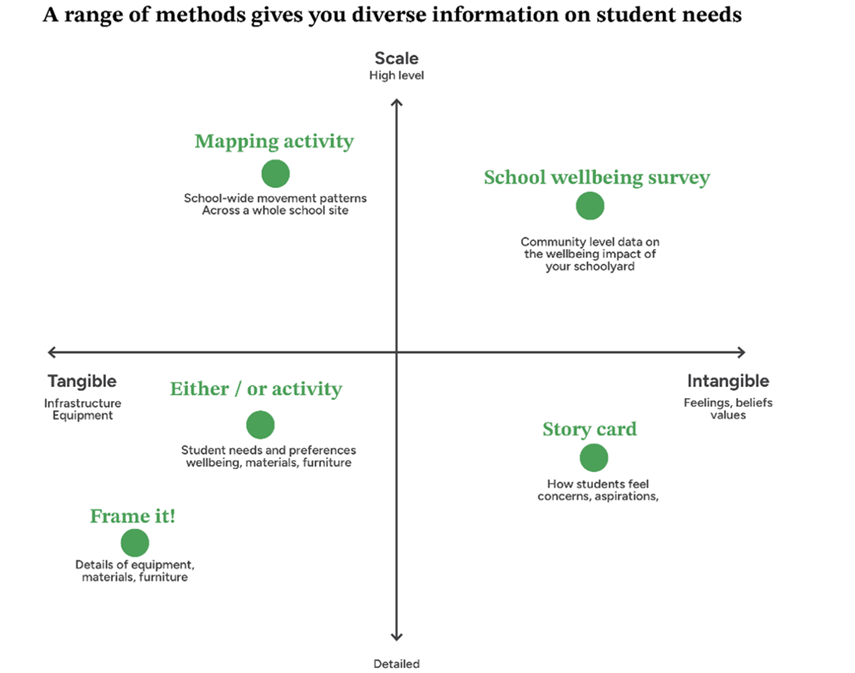
It’s important to use a range of engagement activities that draw out different types of information – from the big scale through to the detailed, and from tangible features, like furniture, to the intangible, like the way a space makes you feel. Different methods also suit different students, including those who are linguistically diverse and neurodivergent.
The diagram below outlines 5 methods you might like to use in your school. In the remainder of this article, I’ll share 3 of the activities, but you can find out more about the others – a mapping activity and a school wellbeing survey – in our Schoolyard Greenprint Engagement Toolkit.
The either/or activity
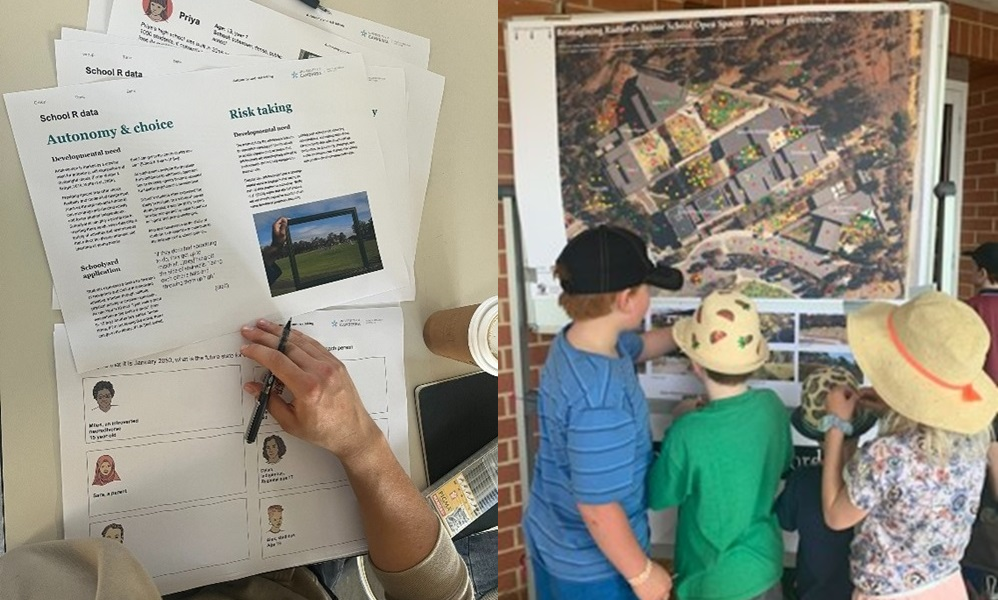
Our team developed a quick visual survey, called the either/or activity that you can use to articulate the needs of your students in the outdoors. Structured around the core wellbeing needs of adolescents, it gives students 11 questions each with an option (A or B) matched with an image. Students must choose either option A or B, not both. You can download the template here.
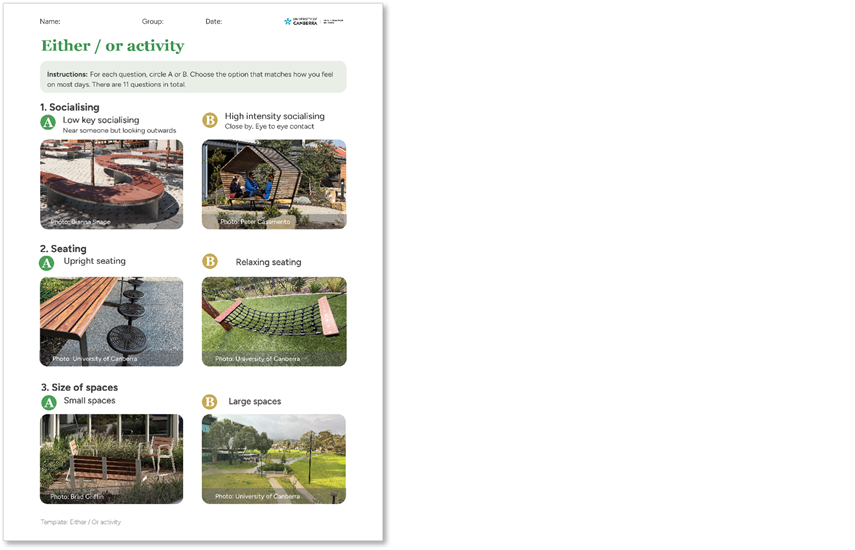
Not only does this activity build students’ knowledge in wellbeing and design features, it makes for a great warm up activity for a focus group. When we used this method, the data that came from it surprised us and other adults. Students want playful spaces – like chairs that swivel or a sculpture that can be climbed on – not play equipment. They also want more lounge-like furniture.
As a paper-based survey, it’s easy to administer and doesn’t need complex statistical analysis. Because it uses images rather than words, it’s a great option for young, linguistically diverse or neurodivergent students. And empowering a designer with evidence on what students need is a great way to ensure any future design meets those needs.
The Frame It activity
The Frame It activity gets students out into the environment, using their skills of observation to document what works well and what does not. Adapted from photo frame methods used by Isami Kinoshita and others (Derr et al., 2018), this activity gives students a photo frame with one side painted red and the other painted green. Armed with cameras, they take photos around the campus of spaces they like (green) and don’t like (red).
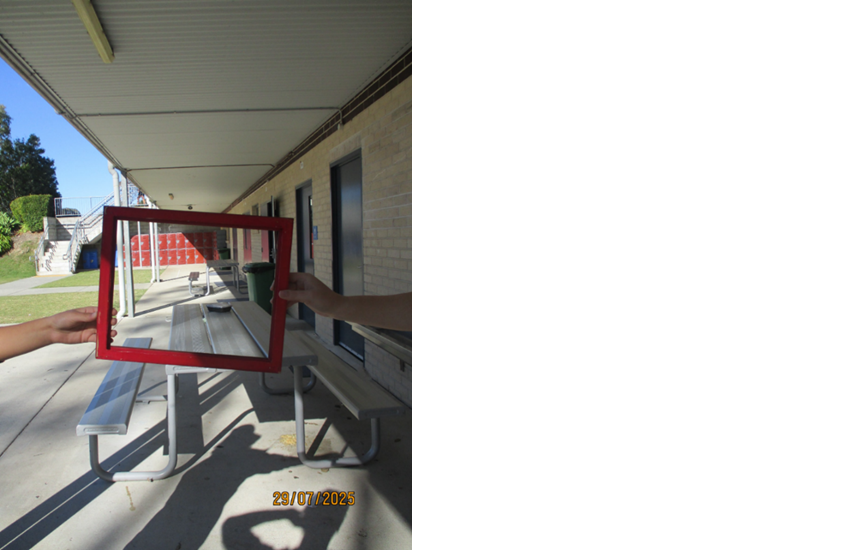
If you run this activity in your school, it’s important to give students the Frame It template so they can write down why they like or dislike spaces. Sometimes their answers will surprise you!
The Story card
As experts in qualitative research with young people, we knew not all students would feel comfortable voicing their concerns or desires in front of their peers, let alone unknown adults. We also knew that sometimes it’s not what’s in a schoolyard that matters, but how it makes students feel.
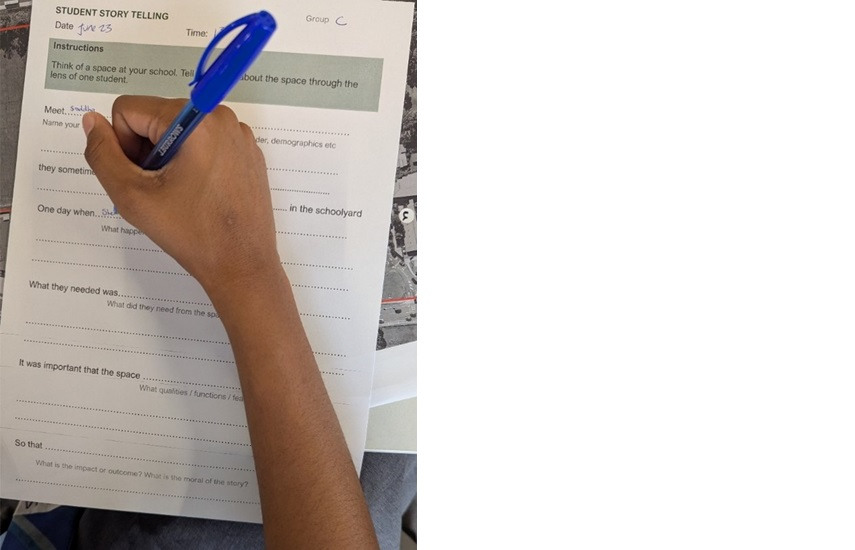
Inspired by the Jobs to be Done framework popularised by Clayton Christensen (Christensen Institute, n.d.), we developed a story card template specifically for schoolyard engagement.
This template, available here, gives designers the core information they need to make design decisions: the students’ needs, goals and feelings in spaces, and it does so in an intuitive way for students.
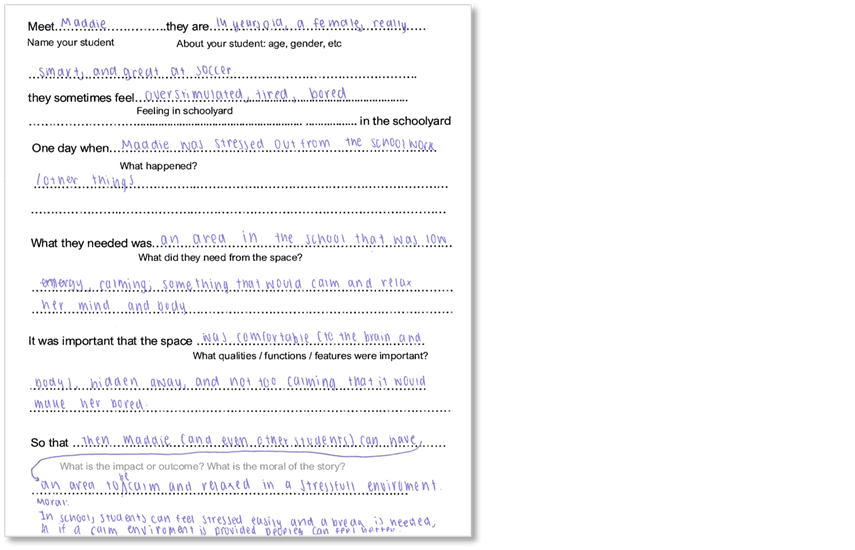
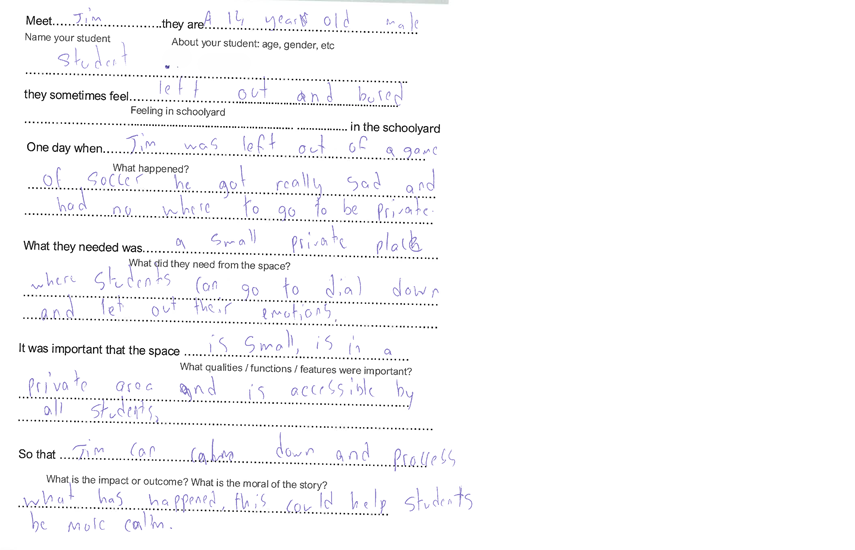
When using this template, it’s important to give students the opportunity to be anonymous and tell them they don’t need to read their stories to others. In this example, students were told they could use pseudonyms, but were encouraged to describe their own experiences. We were surprised by the kinds of stories students told. Because this was a private activity students let down their guards, telling us their fears and desires.
One story that sticks with me was from a sporty kid – ‘Jim’ – who described his sadness and need for privacy, despite being an active and rowdy kid. If we had relied on focus groups or observations alone, we would never have seen this side of Jim.
Using the techniques with teachers and other adults
These methods are not just for students. We used these techniques with teachers and other adults – it’s a great way for adults to build empathy with young people. Our templates include a story card for teachers and parents.
Ultimately, schoolyards are for students, and these methods give you data on how your schoolyard is performing while also bringing your students along on the design journey. And, if we want schoolyards that work for students, the first step is simple: ask them.
References
Christensen Institute. (n.d.). Jobs to Be Done Theory. https://www.christenseninstitute.org/theory/jobs-to-be-done/
Derr, V., Chawla, L., & Mintzer, M. (2018). Placemaking with children and youth: Participatory practices for planning sustainable communities. New Village Press.
When was the last time you asked students for their feedback on the outdoor leisure spaces at your school?
Do you have any upcoming plans to update the design of outdoor spaces in your school? How could one, or all, of the activities shared in this article be included into the design planning process?