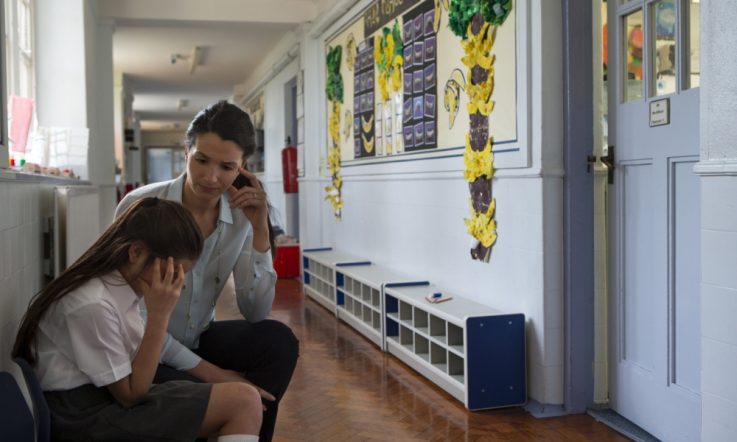
How well do students at your school understand what bullying is? Do they feel comfortable intervening when they witness bullying behaviour on the school grounds? Does your school’s anti-bullying program include supports for students in these 2 areas?
New research shows children recognise bullying as intentional and emotionally harmful behaviour, and they want to help, but many don’t feel able to intervene. The findings (Pervez, et al., 2026) have just been published in an open access paper in the journal School Psychology International.
The study involved 36 students in years 4 and 5 in England and aimed to understand how children interpret bullying, exclusion and the question of whether and how to step in when they witness bullying behaviour.
Lead author of the journal paper, Dr Aneeza Pervez – Betty Behrens Research Fellow in the Faculty of Education at University of Cambridge – says it was important for her and her colleagues to conduct this research to shine a light on how children themselves make sense of these situations in their everyday school lives.
‘What emerged very clearly is that children are not passive observers,’ Dr Pervez tells Teacher. ‘They recognise bullying as intentional and emotionally harmful, and many express a desire to help. However, their responses are shaped by peer dynamics, social risk, and uncertainty about what they can do safely. This matters because it shifts the conversation away from whether children care, towards the conditions that make acting on that care possible or difficult.’
Focusing on children’s reasoning
In the paper, Dr Pervez and co-authors Tanvi Masrani and Elle Pemberton share that the study involved semi-structured, activity-based interviews to create a child-centred and ethically sensitive way of exploring the topic.
‘The aim was to make the conversations accessible and to support children to reflect on bullying and exclusion without feeling exposed,’ Dr Pervez tells Teacher.
‘The interviews combined open-ended questions with visual cue cards and a short vignette featuring a fictional child, Alex. These kinds of prompts help children talk about sensitive peer situations by giving them something concrete to respond to.
‘We also conducted the interviews in pairs, which helped create a more comfortable and supportive setting. This approach allowed us to focus on children’s reasoning: how they interpreted situations, how they understood harm, and how they thought about possible responses.’
‘The gap between empathy and action’
Thematic analysis of the interview data revealed 3 key themes. The first, understanding bullying dynamics, highlights that students were able to distinguish bullying from isolated peer conflict and recognise its emotional impact.
The second theme – empathy constrained: barriers to moral action in school settings – captures the tension between moral motivation and contextual constraints. Specifically, the children described barriers to defending, including fear of becoming targets, immediate needs, or lack of clarity about how to act.
The final theme, moral dimensions of prosocial defence and reciprocity, reveals that moral reasoning is shaped by children’s relational experiences. The authors share here that children articulated moral values of kindness and care but also evaluated whether others ‘deserved’ help based on past behaviour.
‘What stood out most was the gap between empathy and action,’ Dr Pervez says. ‘Many children expressed clear concern for peers who were being left out or hurt, and they often knew that what was happening was wrong. But that did not always mean they felt able to intervene.’
‘It was also striking how often children drew on ideas of fairness and relational history. Decisions about whether to help were sometimes shaped by whether a peer had been kind or unkind in the past, which adds a more complex moral dimension than a simple empathy-based account.’
Implications for anti-bullying program design
In the paper, the authors suggest these research findings demonstrate that anti-bullying programs should extend beyond recognising bullying behaviour, and also support students to feel confident, clear, and safe enough to act.
Dr Perez says schools need to support not only moral understanding, but also what action looks like in practice. ‘Children benefit from opportunities to work through situations, think about possible responses, and develop a sense of what they can do if they witness bullying or exclusion. Approaches such as role-play, peer discussion, and restorative dialogue can support this.
‘The wider school context is also important. Children were more likely to imagine intervening where adult support felt visible and reliable, and where prosocial behaviour was understood as shared rather than individually risky. Clear expectations and accessible ways of responding matter because they shape whether action feels possible in the moment.’
Avenues for further research
While this study focused on children’s perceptions and anticipated responses, Dr Perez says a next step would be to examine how these dynamics actually unfold in everyday school interactions.
‘This study highlights that children are already thinking carefully about harm, fairness, and responsibility in their everyday interactions. Their accounts show a strong awareness of what is happening around them, even when they do not act on it.
‘For me, this reinforces the importance of taking children’s perspectives seriously. They offer insight into how bullying and exclusion are actually experienced and navigated in school, including the points at which acting becomes difficult. Attending to those perspectives can help us better understand what enables, and what constrains, prosocial action in practice.’
References
Pervez, A., Masrani, T., & Pemberton, E. (2026). Children’s perceptions of bullying, exclusion and defending in English primary schools: A qualitative study. School Psychology International, 0(0). https://journals.sagepub.com/doi/10.1177/01430343261422416
Dr Aneeza Perez says activities like role-play, peer discussion and restorative dialogue can support students to develop a sense of how they can intervene if they witness bullying. How could you incorporate one of these activities into your school’s anti-bullying program? Which activity do you think would work best for students in your classroom?