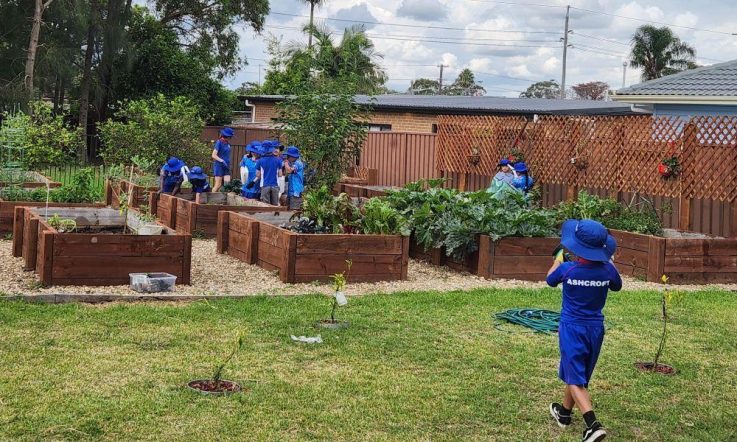
‘Community collaboration does not need to begin with a new program or excursion. Often, the simplest starting point is creating a small, clear role for an organisation within something your school already does.’ As a 2024 Churchill Fellowship recipient, Dr Luke Steller, Questacon Regional Leader for the Northern Territory, has been exploring authentic community collaboration in education. In this article he shares 6 practical ways educators can build stronger school-community partnerships and questions for reflection around what this might look like in your own context.
Over the past decade, I have worked on education projects across Australia, from remote communities in the Pilbara to large metropolitan schools, from small neighbourhood centres to the Sydney Opera House. Now, working as Questacon’s Regional Leader for the Northern Territory, I’m part of a team of 8 place-based staff around Australia. In this role I collaborate with schools across the Territory, supporting educators to develop and deliver their own STEM programs and to connect through communities of practice.
These experiences have given me a unique view of what helps students get the most from their education. I consistently see students enthusiastically learn, with tangible outcomes, when their interests, experiences, and communities are reflected in the classroom. Families and communities are also more likely to value and support schools when they see young people developing knowledge and capabilities that are applicable beyond the school gate.
The importance of community collaboration in schools is not just from my personal observations, it is clearly stated in the national framework that shaped the current Australian Curriculum, the Mparntwe (Alice Springs) Education Declaration (2019). A key goal of the Declaration is for all young Australians to become ‘active and informed members of the community’. To achieve this, students should be able to experience every day how their learning connects with their community and life beyond school.
Bringing this kind of community learning into the classroom is not always easy. Relationships with stakeholders take time to establish, and with teachers’ already full workloads, administration, funding, transport, and child safety requirements, an exciting idea can quickly turn into another item on a long to-do list.
In 2025, I was awarded a Churchill Fellowship to explore how schools overcome these barriers and deliver best-practice school-community collaboration. During the Fellowship, I visited 19 programs across Hawaiʻi, Arizona, New York, and London to see how schools and community organisations connect learning with local knowledge and priorities.
Drawing on those experiences, and Questacon’s work with Australian educators, here are 6 practical ways educators can strengthen school-community collaboration.
1. Start with a shared purpose, not subject content
When creating a project between a school and a community organisation, finding links to the curriculum can sometimes be the easiest part. The hard work is finding a partner you trust, agreeing on what you hope to achieve, and making the logistics work for everyone involved.
One example of a partnership done well was between Hanahauʻoli School, in Hawai’i, and the nearby Mānoa Heritage Center. It began not with a curriculum outcome, but with a shared interest to hands-on learning and helping young people care for their local environment. Students design and build a propagation shed for the centre’s native plant nursery, which produced assessable outcomes on mathematics, science, and design throughout the process. The partnership was built around a shared purpose first, with teachers then identifying the curriculum connections that supported the project.
What could this look like in your school?
- First ask: what do you want for students beyond completing a unit? This might include confidence, job-ready skills, better health knowledge, caring for Country, etcetera. Use this to shape how you search and engage with partners.
- You could draw inspiration from your school motto, values, or the curriculum’s general capabilities. Linking a project to an existing priority can help bring leadership on board.
2. Bring all school staff on the journey
Community-connected learning is easier to build when its value is understood across the school, rather than sitting with one enthusiastic teacher.
In an example of a whole-school approach at Hanahauʻoli School, professional learning includes teachers, leaders, administration, maintenance teams, and other support roles. Bringing everyone into the conversation can produce unexpected benefits. Someone responsible for maintaining the school, for example, may notice an issue with recycling, water use, or the grounds that could become the basis of a student project. Front-office teams are often the first point of contact for outside organisations, and when they recognise the value of an opportunity, they are better placed to direct it to the right person.
What could this look like in your school?
- Use professional development to visit a local museum, cultural centre, or community organisation. It can be a fun way for colleagues to explore their local area together.
- Give staff the chance to experience these places for themselves, without also having to supervise students.
- Invite a community organisation to give a short presentation or activity at the end of a staff meeting. Even 10 minutes can introduce a new opportunity and bring some fresh energy to the usual format.
3. Start with families and carers
Families and carers are often the most direct bridge between the classroom and the wider community. They know the school and its students, but they also bring their own knowledge, professions, and connections.
Through the University of Hawaiʻi’s STEMS² program, teacher Bella Melenaite Finau-Faumuina described using potluck dinners to build relationships with families. Importantly, the conversations were not always about the children. They created space to get to know parents and carers as people, discover their interests and expertise, and uncover connections that could contribute to learning.
What could this look like in your school?
- Hold an informal BBQ or afternoon tea where families and teachers can talk about their interests, skills, and work (not just their kids).
- Use times families are already at school, such as assemblies, parent-teacher interviews, or drop-off, rather than always asking them to attend another event.
- Make existing community-linked projects visible through showcases, assemblies, or work sent home so families can recognise where their own knowledge or connections might contribute in the future.
4. Focus your engagement
No school can meaningfully involve every group in its community in every learning experience. The aim is not to represent everyone at once, but to understand who your students are, including noticing who is missing, and invest properly in the relationships that matter.
The New York Hall of Science is based in Queens, New York, one of the world’s most linguistically diverse areas, where more than 100 languages are spoken. Its approach included identifying communities that were strongly represented in the surrounding neighbourhood but underrepresented in its programs. They then concentrated on building a deeper relationship with that particular group, rather than trying to engage everyone at once.
Schools can apply the same thinking. Compare the cultural, linguistic, and community experiences represented in school activities with the demographics of your students and local area. That can reveal where some groups are highly visible while others, despite being a significant part of the school community, rarely appear in learning experiences or partnerships.
What could this look like in your school?
- Look at who currently contributes to excursions, classroom visits, projects, celebrations, and partnerships, then compare that with the students and families your school serves.
- Focus on building one meaningful relationship rather than trying to create several surface-level connections at once.
5. Use language that matters outside the school gate
Because of the context they work in every day, teachers naturally speak in curriculum outcomes, assessment tasks, and achievement standards. Community organisations may describe the same goals very differently, which can create an unnecessary communication gap.
Through the Arizona SciTech Institute, educators speak directly with local employers about the capabilities they wanted young people to bring into the workplace. Their language was practical: how students follow instructions, communicate clearly, and speaking up when something was not working. Teachers mapped these workplace outcomes back onto curriculum achievements, creating a shared language between employers and the school.
The same principle applies elsewhere. A business may talk about work-ready skills, while a First Nations organisation may want young people to understand and value culture and Country. These outcomes often have clear curriculum connections, but starting with language that reflects an organisation’s priorities and context makes it much easier to find common ground.
What could this look like in your school?
- Keep curriculum and assessment terminology out of the first conversation where possible.
- If you are unsure how an industry or organisation talks about its priorities, ask someone (for example, a parent) in your school community who knows that sector. They may be able to help you frame the conversation in language that makes sense outside education.
6. Start small and make involvement easy
Community collaboration does not need to begin with a new program or excursion. Often, the simplest starting point is creating a small, clear role for an organisation within something your school already does.
A local example from Australia is Dripstone Secondary College in Darwin, where students develop projects that culminate in a science fair. Community organisations and STEM professionals can contribute real-world questions for students to explore, then return to hear what they developed. The teaching, supervision, and assessment are already in place, allowing outside involvement to strengthen an existing program rather than create another one.
It also makes it easier for organisations to say ‘yes’. Instead of asking someone to host an excursion, you might invite them to spend 20 minutes explaining a real problem, then return later to hear students’ ideas.
What could this look like in your school?
- Look at projects, exhibitions, fairs, and assessment tasks you already run, and identify where an outside voice could add value.
- Make the first invitation small, specific, and easy to deliver: remove the barrier of entry for the organisation.
- Consider reaching out to organisations that already sponsor the school: they have already shown an interest in the school and may be keen to contribute expertise for students to explore, rather than just funding.
You can read and download Luke’s full Churchill Fellowship report (2026) here, as well as extracts on Hanahau’oli School here.
Luke is currently working as the Northern Territory Regional Leader for Questacon Educator Programs, facilitating community-led networks and place-based STEM professional development for educators across the NT. Questacon Educator Programs are supported by Diamond Partner Department of Defence.
If you would like to know more about Luke’s work or have a story of community-school collaboration you would like to share, please reach out at Luke.Steller@Questacon.edu.au.
References
Steller, L. (2026). How Authentic Community Collaboration can Empower STEM Education in Australia. Winston Churchill Trust. https://www.churchilltrust.com.au/project/to-explore-how-authentic-community-collaboration-can%C2%A0empower-stem-education-in-australia/