
To complement the widely adopted Driving School Improvement books by Pamela Macklin and Vic Zbar, the new Driving School Improvement Workbook offers school leaders a practical framework for turning improvement plans into action. Through guided activities, reflection tools and planning templates, it supports leaders to assess their current context, strengthen leadership practice, build collective capacity and lead sustainable change. This extract for Teacher readers is taken from a chapter on knowing you are making a difference.
Often, when we visit and work with schools, we find that as we walk around and interact with teachers and students what we see and hear differs markedly from what leaders have told us is the case. In general, this takes the form of less-consistent implementation of initiatives than the leaders seem to believe.
The question we inevitably raise when we talk with leaders about implementation across the school is, therefore, ‘How do you know?’ And commonly the response is somewhat thin.
One of the challenges for leaders in schools is to get a fix on just how consistently initiatives are being applied across the school.
Involving middle-level leaders to a higher degree than often is the case can help. Middle leaders are generally closer to the action and work with more manageable-sized teams, so they can often give an insight into the degree of consistency that may or may not exist in the school.
Beyond that, there is much to be gained by simply walking around, observing classes and being available for unscheduled chats. This will very soon tell you if there is an orderly learning environment in the school, students are generally engaged in class, purposeful teaching and learning is underway, and much, much more.
Gathering and analysing data also has an important role to play in monitoring the implementation of initiatives in the school. It helps us to track implementation, determine outcomes, monitor long-term progress and make improvement visible to all the stakeholders involved.
But what data, and how should it be used?
Gathering the evidence you need
Data to monitor the implementation of a new strategy and answer the question ‘How do you know?’ can and arguably should be both quantitative and qualitative to help capture the impact of the initiative and the effect it is having on those who are involved.
Quantitative data provides objective, measurable and timely evidence of the extent to which the strategy is being implemented as planned and delivering its intended results. It allows us to track progress through a range of numerical benchmarks that go beyond just anecdotes about what might be happening in class. But the measures we adopt must be appropriate to the initiative itself and manageable in terms of their collection and use.
Activity for leadership teams: What quantitative data do we need?
Instructions
1. What is the key strategy your school is seeking to implement?
2. As a team, specify what successful implementation would look like by completing the sentence ‘If consistently implemented in the school we will see’:
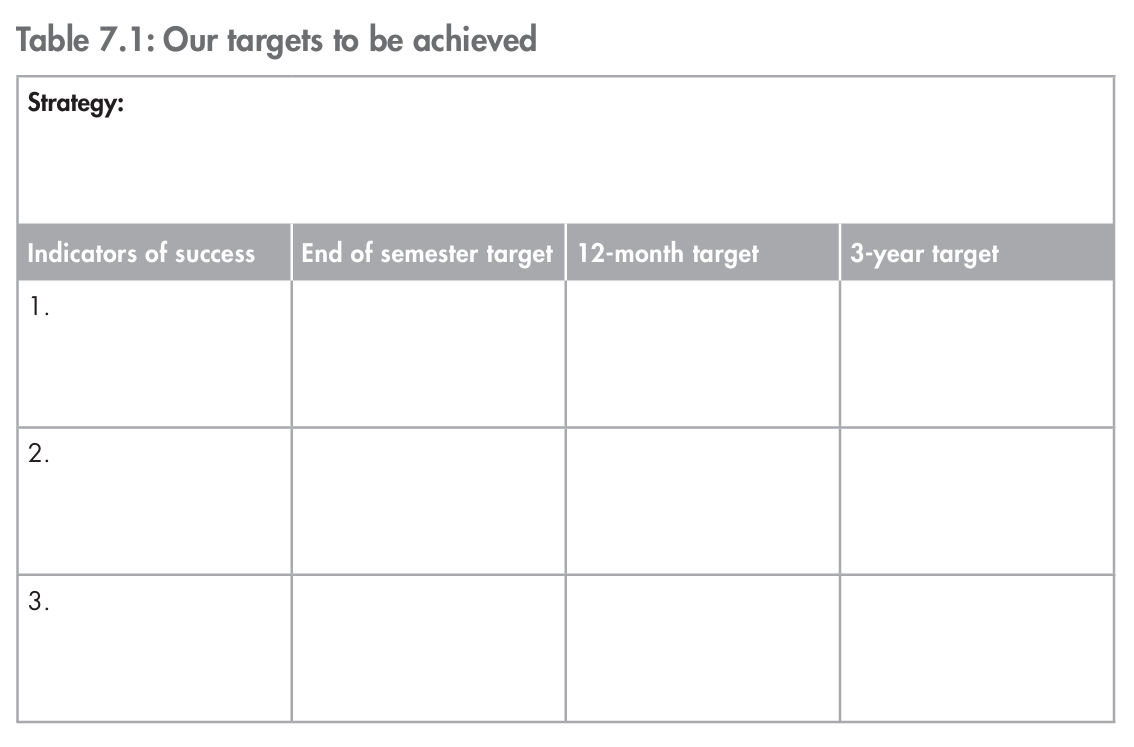
3. Identify a specific target to be achieved over the next semester, 12 months, and three years for each dot point (i.e., indicator of success) and complete Table 7.1
4. What data do we currently collect that can enable us to monitor the achievement of these staged targets?
5. What if any data sets do we need to create in order to know how consistently the strategy is being applied?
6. How will we collect our data in an efficient and effective way?
While vitally important for monitoring implementation of initiatives in the school, quantitative data does have limitations that need to be acknowledged and addressed.
For example, all effect sizes, which are a major source of the quantitative data we use, are averages, and hence can mask quite different outcomes depending on the quality of implementation of the strategy in use. After all, if we had our head in the freezer and our feet in the fire, we would, on average, be comfortable, though that’s not an outcome we’d seek.
Qualitative data provides a more nuanced understanding of implementation than just quantitative data affords, and an insight into the human response to that implementation and its impact in the school.
Two approaches that enable us to gain qualitative feedback in a timely and efficient way are the use of questionnaires, which give a snapshot of feelings about things that are underway, and focus groups, when we need to go deeper still.
As is evident from the preceding pages in this workbook, we design and use a range of pro formas and questionnaires aimed at eliciting qualitative data from respondents in the school. While each questionnaire must be specific to the topic at hand, there are some guidelines that can help you to develop your own.
Number of questions
We generally recommend around eight to 12 questions in total. At least eight are needed to give a rounded picture of responses to any issue, while more than 12 starts to test the willingness of participants to be thoughtfully engaged. Limiting the questions to ten has the advantage of allowing you to use SurveyMonkey free for an online response, which can then be analysed in a range of ways using the software on that site.
Nature of questions
This depends on the focus of your questionnaire, but generally you are seeking responses to a range of questions/statements designed to provide insight into the impact respondents feel the initiative is having, their experience of implementing it, what is or isn’t working, and how it can be improved. For example:
- To what extent do you think this initiative is achieving its aims?
- How effective is the support provided to implement this initiative?
- How confident do you feel in implementing this initiative?
- The extent to which I use this approach on a daily/weekly basis is…?
- The extent to which the implementation of this initiative is meeting my expectations is…?
We generally also try to provide an opportunity for respondents to comment in some way should they wish. This can involve inviting them to outline ways in which implementation can be further improved, and identifying strengths of the experience so far and/or a particular weakness they think needs to be addressed.
Rating scale
The purpose of using questionnaires and other pro formas to monitor implementation is not so much to make a judgment, as to foster a productive conversation in the school.
We believe that you get a better-quality conversation if people take a stand, rather than seek the safe middle ground. With this in mind, we favour a four- rather than five-point scale when designing questionnaires, to take away the option of a ‘neutral’ response.
Common four-point scales you can use, depending on the nature of questions/ statements used, include:
- 1 = Strongly disagree, 2 = Disagree, 3 = Agree, and 4 = Strongly agree
- 1 = I/we don’t do this, 2 = I/we sometimes do this, 3 = I/we often do this, and 4 = This is a routine part of how our school works
- 1 = Not evident, 2 = Sometimes evident, 3 = Often evident, and 4 = Always evident
Driving School Improvement by Pamela Macklin and Vic Zbar will be published on 21 October, 2026. It is available for pre-order now via Amba Press, the publisher.
The book launch, presented by Teacher’s Deputy Editor Rebecca Vukovic, will take place at the Amba Press Community Day on 17 October, 2026. Visit the website for more details on this free event.
As the article states: One of the challenges for leaders in schools is to get a fix on just how consistently initiatives are being applied across the school. As a school leader, how do you know whether a school improvement initiative is being implemented consistently across your school? What data or evidence do you use to monitor the progress and impact of improvement efforts?
Pamela Macklin and Vic Zbar suggest that middle leaders are generally closer to the action and work with more manageable-sized teams, so they can often give an insight into the degree of consistency that may or may not exist in the school. How regularly do you involve middle leaders in discussions about implementation? What insights have middle leaders provided that have strengthened, challenged or refined your understanding of what is happening in practice?