PISA 2025: Five ideas for turning evidence into better decisions for young people
‘The true measure of our system is not what it measures, it will be what it changes on the basis of these data. Our responsibility is to ensure that the future is not predicted by these data but improved because of it.’ The 2025 results from the Programme for International Student Assessment (PISA) have just been released. The Australian Council for Educational Research (ACER) is responsible for the design and implementation of PISA globally and it led the transition to a fully digital assessment platform for PISA 2025.
Teacher magazine is delighted to welcome Lisa Rodgers – CEO of ACER – as a columnist. In this first article, she offers a different story about PISA that is built around 5 ideas – position, direction, distribution, resolution and ambition.
According to the Wurundjeri Seasons, it is now Poorneet (or tadpole season), so the grey clouds are meant to shift, the day's length increases, the new life stirs and the natural world signals renewal. Learning has its seasons, too. There are periods of progress, there are periods of consolidation, there are times when possibilities emerge and times when we must confront what's not working.
The latest results from the OECD’s Programme for International Student Assessment (PISA) were released last week. This should be one of those moments of renewal for us. Not because there's a new set of numbers, but because those numbers give us a chance to look honestly at ourselves and decide what we'll do differently. What will we take on? What will we choose to do with what PISA is telling us?
Data on its own changes nothing, only decisions change things.
Let me start with an uncomfortable proposition. Every 3 years (which will become 4) 760,000 15-year-olds are assessed, and on the basis of that assessment, they represent around 33 million 15-year-olds across the world. That is one of the largest, most curated studies that we have in education. But here's the truth: no education system has ever improved because of a ranking. Systems only improve because they learn. That's what PISA is here to help us do, not celebrate, not despair, but just learn.
If we only think about where Australia sits, we will have missed the most useful thing that the data gives us because ranking isn't a strategy, a score isn't a plan, and a position is not destiny. Instead, I want to offer a different story about PISA, in regards to leadership, that is built around 5 ideas – position, direction, distribution, resolution and ambition.
5 ideas, one responsibility
Idea 1: Position
The first idea – position – is knowing where a school or a system stands at any point in time. Position matters. Good measurement cuts through rhetoric. It gives us a common reference point. It tells us what 15-year-olds can do and how that compares with 15-year-olds across the world. PISA gives us a mirror. It asks us to look at ourselves without spin, without defensiveness and without selective memory. Australia should look into that mirror, and we should look into that mirror with confidence.
We remain a strong performing education nation. Our young people bring substantial knowledge, capability, and potential. They are preparing not only for further study of work, but for citizenship, participation, and a world shaped from uncertainty. But confidence isn't complacency. Too often, our public debate swings between 2 lazy extremes. When the results suit us, we celebrate. When they do not, we declare a crisis. Neither response actually requires any degree of thought and neither produces much change.
A ranking tells us where we sit relative to others, but it doesn't tell us why. It doesn't tell us what's changing underneath the average and it certainly doesn't tell the teacher, a principal, or indeed a minister what to do on any given morning. Position is a mirror, not a verdict. A score should begin a conversation, not end one. The question is not simply: Where does Australia rank? A better question is: What does this position have to see that we were either previously unwilling to see or indeed unable to see? Leadership begins where the ranking ends.
Idea 2: Direction
The second idea is direction – so the line matters more than the dot. One of the most persistent mistakes in education policy is treating a single result as if it were a trend. A score is a dot. Leadership is understanding the line. One measurement cannot tell us whether a learner, a school or a system is improving, stable or declining. We need comparable measurements across time. We need to distinguish signal from noise. We need to see if we are seeing a moment or a movement. It's critically important. This is one of PISA’s greatest strengths. The real value is not confined to any single cycle.
Read over time, it shows us trajectory. Direction changes the meaning of the position. When we know a student sits below a benchmark, but is making rapid progress, that student needs something different from the student who's sitting at the same position, but actually they're learning has stalled. Two systems can occupy exactly the same position but they're moving in opposite directions. We have to acknowledge that.
Yet, we still organise too much public commentary around the latest dot. We reward or blame people standing close to it. We announce quick fixes and we attach sweeping explanations to small movements in order to get a better headline. Sometimes we prefer the certainty over the accuracy. Certainty does make a better headline, but serious leadership asks harder questions. Where are we going? When did this trajectory start? How fast are we going up and down? What appears to be driving it?
PISA gives us the mirror, but it also gives us the window because it allows us to look outwards and not to copy another country's policy without regard for context, but to test our assumptions against the experience of others. Again, countries do not improve because of who they are, they improve because of what they do.
Idea 3: Distribution
The third idea is distribution – how performance, opportunity and need are spread across a population is really very important and needs a discussion. One of the most influential people in education policy is the ‘average student’. The problem is the average student does not exist. No teacher has ever taught one, no principal has ever met one, and no parent has ever had one. Averages are useful but they are ruthless editors. They simplify a population into one number, and they leave most of the story on the cutting room floor. An average can conceal excellence, it can conceal disengagement, it can conceal inequity, and most dangerously, it can conceal the children that most need our attention.
Two systems can share the same average and have profoundly different realities. This is why PISA’s contextual information matters so much. Achievement matters, of course, but so does belonging, engagement, learning climate, bullying, technology use – those things are critically important aspects of PISA. So, while 2 countries can produce similar scores, they produce very different experiences for young people. One may develop young people who achieve, feel connected, curious, capable. Another country with the same score may reach exactly the same position while leaving many, many students alienated or anxious. PISA will tell us this. If we judge an education system only by the average score, we're not measuring enough of what matters.
Distribution also shifts the policy question. We know that socioeconomic circumstances are strongly connected to achievement. Schools cannot carry the weight of income inequality, of housing instability, of health or family instability – they cannot. Pretending that they can is not ambition, pretending that they can is avoidance by another name. But it is equally wrong to conclude that schools and systems are powerless.
Education policy can influence the quality of teaching, and it can influence student expectations. What happens in a school in regards to climate, engagement and meaningful use of technology is so important – it does shift the dial. Everyone remembers a teacher who inspired them. So, equity is not achieved by treating every student the same. It's achieved by seeing clearly the need and responding differently.
Idea 4: Resolution
The fourth idea is resolution – the level of the detail at which we can see learning. PISA operates at a broad resolution. It's not a flaw, it's a purpose. It reveals patterns that are durable, measurable over time, measurable over systems and populations in countries. It gives system leaders a view at 30,000 feet; but improvement doesn't happen at 30,000 feet. It happens in schools and it happens in classrooms.
We report at the system level, we improve at the classroom level. A national assessment cannot tell a teacher precisely which strategy one student needs tomorrow. A map doesn't actually replace somebody that knows the terrain, but local knowledge cannot by itself reveal whether thousands of classrooms are experiencing the same shift. And indeed, if thousands of classrooms are experiencing the same shift, and there is something going on with those classrooms, we need to learn about them. We need both at once in terms of system level information and school level information.
The skill for us is to move between those resolutions without confusing them. We should not make claims about individual children from the system level data. Equally, we should not dismiss a national pattern because it's not visible in every school.
PISA’s major focus domain was science this cycle. Science literacy isn't just about preparing students for scientific careers. It's about daily reasoning with evidence, testing trustworthiness, and distinguishing fact from assertion. And we're being asked to do that with these data. Science literacy is about the ability to reason with evidence, to ask ‘how do we know?’, to test whether a source is trustworthy, to distinguish fact from assertion, signal from noise. In a world of misinformation and generative AI, that's not an optional capability, it's actually a civic capability.
Idea 5: Ambition
Lastly, my fifth idea is ambition. So, position tells us where we stand, direction tells us where we're heading, distribution tells us where to look, resolution will tell us the particular aspects we need to look at, and ambition actually is about us choosing what we do about it.
So, as the Chief Executive of the Australian Council for Educational Research, I stumble when I say this, but it is true: educational evidence has no intrinsic value. The thing that has value entirely is whether somebody makes a decision on the basis of that evidence. If as a result, no policy, no investment, no teaching practice, no leadership conversation, and no outcome for a young person happens, then it's simply information. And education does not have a shortage of information. Our problem often is the distance between knowing and doing.
The goal is not a bigger data set – it's faster and better aimed decisions. Ambition also requires us to resist despair. A disappointing trend is not proof that a decline is inevitable. International surveys show us that actually you can improve. There are, however, no magic jurisdictions that we can just import. You can't just import a policy. Context matters, implementation matters, professional capability matters, persistence matters, and scaling is super hard at a system level. And there's also a warning with this. Better data can help us identify risk early, but it could also become a very efficient machine for labelling young people.
The history of predicting children's futures is filled with predictions that harden into expectations. ‘Not capable’, ‘not academic’, ‘not ever go to university’. A likelihood in data is not a destiny. A forecast exists only for us to prove it wrong. A label is a prediction we organise a child about. A trajectory is a prediction we intervene against. The information may be the same, but the use is morally different.
Evidence should expand possibility, not narrow it. It should strengthen professional judgement, not replace it. It should prompt earlier support, not judgement. If prediction comes true because we saw and did nothing, that's not the triumph of the model it is the failure of the adults.
Our responsibility moving forward
PISA gives us a mirror through which we can see ourselves and it gives us windows into what other education systems have attempted, achieved and learned. But neither the mirror nor the window makes change happen. That depends on us.
Position tells us where Australia stands without turning that position into a verdict. Direction will tell us the line to follow; do not obsess over the dot. Distribution will tell us look beneath the average and find the students whose experiences are too easily concealed. Resolution tells us to connect the system, the school and the classroom with the learner, while respecting what evidence that each level can do. And ambition asks whether any of this will change what we do next.
Five ideas, one responsibility to ensure that a young person's future trajectory is never mistaken for their identity. Likelihood is not destiny – not for a child, not for a school, and not for the Australian education system. The true measure of our system is not what it measures, it will be what it changes on the basis of these data. Our responsibility is to ensure that the future is not predicted by these data but improved because of it.
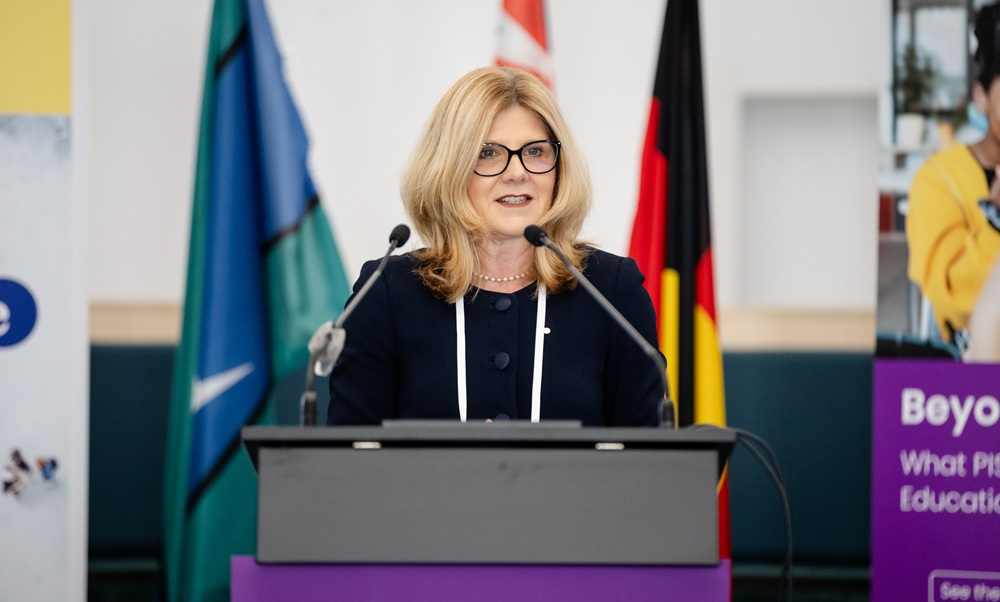
This column from Lisa Rodgers is based on her address to the ACER and University of Melbourne symposium Beyond the Results – What PISA 2025 means for education in Australia.