A recent study conducted in the United Kingdom has found children trust what they hear from a person, more than what they see in their body language. Researchers say improving the aural environment could therefore be important for supporting students’ learning.
A paper published in the Infant and Child Development journal (Ross et al., 2026) shares that when children are shown a video of someone expressing one emotion through their body language and a conflicting emotion through sounds, children overwhelmingly trust what they hear rather than what they see. The opposite was found for adults.
The researchers say this is the first evidence that children tend to rely on what they hear when determining how someone is feeling, compared to adults who rely on what they see.
Lead author, Associate Professor of Psychology at Durham University, Dr Paddy Ross tells Teacher this research was inspired by a study in the 70s (Colavita, 1974) where participants were required to hit a button when they saw a flash and a different button when they heard a beep.
‘The flash and beep were then played simultaneously, and the participant was just asked to hit whatever they wanted. They found that primarily the adults would hit the button for the flash (Colavita effect/visual dominance). But they found the reverse in children, where they would primarily hit the button for the beep (auditory dominance). We wanted to know if this effect extended to emotion recognition,’ he explains.
What did the new research involve?
The study led by Dr Ross involved 164 participants broken up into 3 groups: younger children aged between 4 and 8; older children aged between 9 and 11; and adults aged 18 and over.
Participants were shown a range of videos that displayed an adult expressing an emotion through their body language, and by making a sound at the same time.
‘We created audiovisual stimuli of people moving in an emotional way (for example, cowering in fear), but coupled them with mismatched auditory emotional bursts (for example, someone laughing/crying) and asked participants, “How is that person feeling?”. We found that the adults either had no preference or chose how the person looked (visual dominance), but children primarily chose, for the same stimuli, how the person sounded,’ Dr Ross shares.
There were differing patterns of responses depending on the emotion combinations used. When participants were shown a combination of sad and angry emotions, children labelled the emotion as what was expressed audibly, while the adults didn’t show a preference. When participants were shown a combination of happy and fearful, the researchers discovered a ‘stepwise movement in responses’ – younger children would preference auditory, older children didn’t show a clear preference, and adults would preference the visual.
‘The explanation for these patterns likely lies in the emotional combinations used. One can be sad and angry at the same time but arguably cannot be happy and fearful,’ the authors write in their journal paper, adding that it appears that when there is ambiguity, children fall back on relying on what they hear to make their decision, whereas adults are guessing and show no preference.
‘However, when it could not be both and must be one or the other, young children still rely on what they hear, but then there is a transition through older children to adulthood, where they eventually rely on what they see to determine emotion.’
Implications for classroom teachers
Dr Ross tells Teacher that the team has repeated this effect with emotional musical bursts too (for example, happy violin/clarinet arpeggios) and see the same result; even when the auditory stimulus isn’t human, when asked to ignore it, children will show a reduction in the ability to recognise body emotion if it’s coupled with a mismatched auditory stimulus.
‘This means it could be that any aural stimulus is affecting how children are perceiving what they see.’
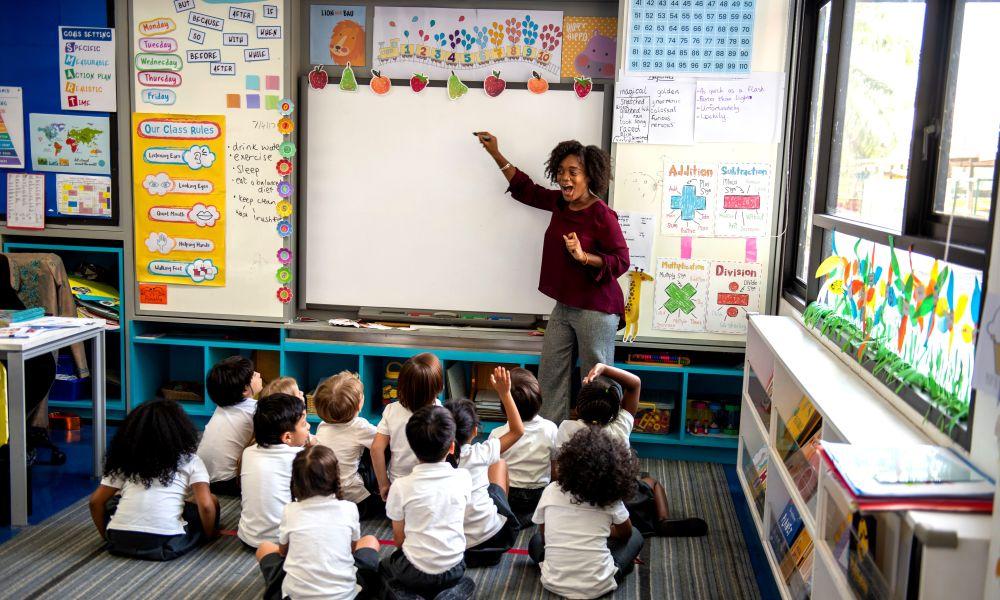
On implications for classroom teachers, he reflects that a lot of work goes into making classrooms visually appealing places, but the same amount of research hasn’t been put into the classroom aural environment.
‘What there is focuses on teacher clarity, so concludes that “less noise is better”. However, if it’s the case that children are influenced by what they hear, it could be the case that “better sound” is much more important than “no sound” in creating the ideal learning environment.’
Looking ahead to future research
When it comes to future research in this space, Dr Ross says a next step is to investigate whether positive and negative general background auditory environments affect children’s ability to recognise not only visual emotions, but other cognitive abilities – such as the ability to pay attention and their attitudes towards work.
‘If children are learning in a negative aural environment, is that reflected in their attitudes to the work they are presented with visually? And do positive aural environments produce better engagement and more enjoyment of work?’
Now, though, there is still plenty for schools to consider based on these initial findings.
‘We know that children show this auditory dominance, so in situations where things may be stressful, or unpleasant, we should perhaps be focusing more on improving the aural environment for children, as it may have a far greater impact than the visual.’
References
Colavita, F. B. (1974). Human sensory dominance. Perception & Psychophysics, 16(2), 409-412. https://doi.org/10.3758/BF03203962
Ross, P., Munro, K., Prasetyo, C., O’Toole, A., Hewakadawedduwage, C., Smith, M. & Davies, E. (2026). The (Reverse) Colavita Effect in Emotion Recognition: Children and Adults Come to Different Conclusions When Categorising Incongruent Emotional Audio-Visual Stimuli. Infant and Child Development. https://doi.org/10.1002/icd.70139
Consider the aural environment in your own classroom. Does it receive as much attention as the visual environment?
When you are setting up your learning spaces – whether in the school or outside – do you consider the impact that noise may have on students (positive or negative)?