
In Teaching Strategies in the 21st Century, Where to Now? Dr Loretta Bowshall-Freeman, Dr Rozi Binte Rahmat and Michael Colbung discuss the complex challenges faced by pre-service and early career teachers. Topics include mentoring, collaboration and networking, designing lessons, and First Nations education inclusion and engagement. This exclusive extract for Teacher readers shares strategies for preparing for a new teaching role.
Entering a teaching position for the first time is a professionally significant milestone, one that requires attentive preparation, strategic planning and active engagement. With this in mind, several strategies are explored in this chapter, with the aim of supporting early career teachers in effectively transitioning into a new educational setting. Understanding expectations of the teaching role, actively engaging in orientation and/or induction and undertaking initial classroom setup are all necessary requirements that early career teachers must tend to so that they are best placed for a successful start.
Equally vital to a successful transition is the cultivation of positive professional relationships and recognition of the role of personal wellbeing in sustaining effective teaching.
Strategies for preparing for a new teaching role
Commencing a new teaching role calls for intentional preparation, to ensure an effective and confident beginning for both the teacher and students. Familiarising with the educational context is an important component of this preparation, inclusive of school values, policies and community expectations, and these elements are essential in aligning your classroom practice with the school’s expectations and the learning needs of students.
So, too, it is important to develop a sound knowledge of the curriculum, to attend to the pedagogical setup and physical layout of the classroom, to support a safe, inclusive and stimulating learning environment for all students and to establish a well-planned initial week during which clear routines and consistent expectations are established. Such actions support student engagement from the very beginning.
Importantly, preparations also require a proactive approach to inclusion, diversity, organisation, assessment and reporting. Understanding the diverse learning needs of all individual students and putting in place differentiated and culturally responsive strategies helps to develop an inclusive and safe classroom learning environment. Implementing efficient and effective organisational approaches for lesson planning, tracking student progress and managing communication has benefits for teachers in maximising their time with the learning program so that it is designed to positively impact student learning and engagement. Early familiarisation with assessment and reporting requirements contributes to the teacher’s ability to ensure that data obtained about students informs their teaching and aligns with the school’s expectations and requirements. Collectively, these preparations support early career teachers to successfully engage: coherently, purposefully and professionally with their new teaching role.
Familiarising yourself with the educational context
Familiarising yourself with the educational context is an important first step in preparing for your first teaching position. The following strategies are intended to guide and support you in your initial approach.
Mission, values and strategic plan
Documentation about a school’s mission, values and strategic plan can often be accessed through its website, handbook, magazine and/or staff induction materials. Taking sufficient time to carefully read these documents can assist you to identify how the educational setting’s ethos aligns with your own expectations for teaching, learning and community engagement.
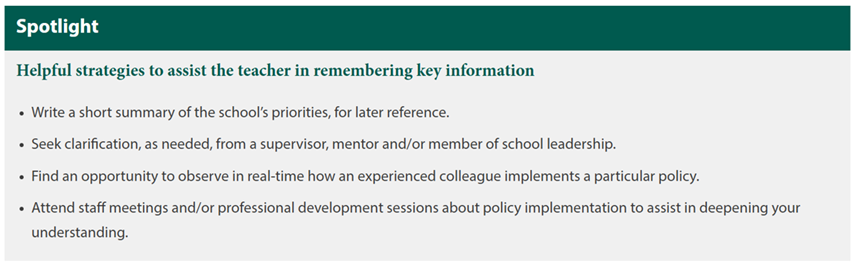
When reading these documents, aim to identify recurring themes. This can be achieved by taking notes on key principles that arise throughout the documents and by identifying key terms, such as inclusivity, responsibility and mutual respect. Importantly, reflect upon how your own teaching philosophy and classroom practices can be informed by these principles. This reflection may be enhanced by discussions with mentors, supervisors and/or school leadership figures. Such discussions have proven helpful to teachers across many educational settings when clarity has been sought about a school’s strategic plan and how it can be actioned into daily practices, such as curriculum implementation and student engagement. Furthermore, referring to the school’s strategic plan when planning your lessons or engaging in professional dialogue demonstrates your willingness to align your professional practice with the school’s mission and values. Such action can also enhance your professional purpose and sense of belonging to a school community.
Familiarise yourself with school policies
Initially, you might familiarise yourself with the school’s policies by reading the key documents on the school’s intranet and/or during induction. There may be many documents to read and digest, so it is helpful to begin with the school’s policies on inclusion, behaviour, assessment and wellbeing, as these directly inform classroom practice.
For an early career teacher in a new educational setting, effective and inclusive teaching can be supported by continuing familiarisation and discussions about school policies.
Compliance and duty of care
Understanding your professional responsibilities is central to beginning well in any new teaching role. Teachers hold a legal and ethical duty of care for every student under their supervision. This means teachers should take reasonable steps to protect students from foreseeable harm and to ensure their safety, wellbeing and dignity at all times, both in and beyond the classroom.
As an early career teacher, you should be familiar with your country’s or your state or territory’s mandatory reporting requirements relating to child protection. These outline the legal responsibility to report suspected harm or abuse. Every school provides training and guidance to support its teachers in meeting these obligations, confidently and appropriately.
Professional conduct also extends to the way in which the teacher builds and maintains relationships with their students. Boundaries must always be clear, consistent and professional, whether in person, by email or online. As a teacher you should never engage with students on personal social-media platforms, or communicate through private channels outside approved school systems. Maintaining a professional distance protects both teacher and student and upholds public trust in the profession.
Compliance also involves being familiar with broader frameworks such as work health and safety regulations, privacy legislation and school emergency procedures. Knowing what these require and how to act in each circumstance ensures that you can carry out your role with confidence, integrity and accountability.
Understand the demographic and cultural context
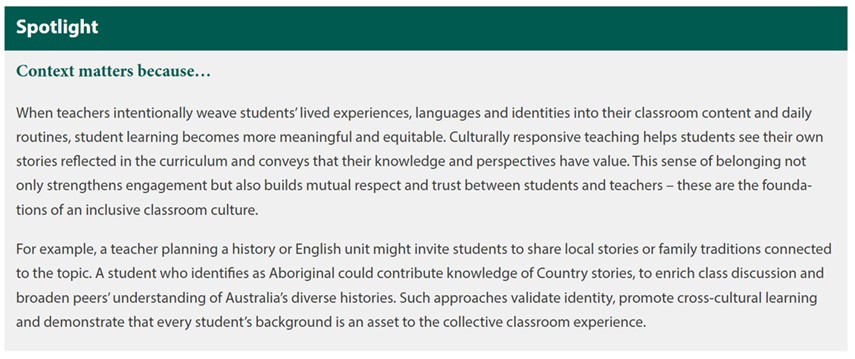
It is important to understand the demographic and cultural context of the school’s student population and the local community; this can be achieved by respectful inquiry and relationship building. The school’s context statement can be one way to find out about specific demographic and cultural context characteristics of the school, including enrolment trends and special programs.
Respectful conversations with families, experienced staff and support workers can offer deeper insights into prevalent languages, traditions and values of the local area.
School assemblies, cultural celebrations and community events organised by the school can also provide important information about what is valued by the school community.
As an early career teacher, you can gain support through these engagements by reflecting on how the demographic and cultural contexts align with the communication styles and approaches you have gleaned from these experiences.
Teaching Strategies in the 21st Century, Where to Now? by Dr Loretta Bowshall-Freeman, Dr Rozi Binte Rahmat and Michael Colbung, is available from all major book retailers and Cambridge University Press, the publisher.
References
Bowshall-Freeman, L., Binte Rahmat, R., & Colbung, M. (2026). Teaching Strategies in the 21st Century Where to Now? Cambridge University Press.
When applying for a new role, do you look on the school website, in the handbook, or induction materials for documentation about a school’s mission, values and strategic plan?
What are the recurring themes and key terms in these documents? How does this inform your view of your potential new employer and whether the school will be a good fit for your own teaching philosophy and educational values?