How often are teachers using AI in their work and the classroom? What type of tasks do they use it for? And what are the common tools? These are some of the questions being explored in a 5-year study investigating the influence of AI in teaching, learning, and assessment.
The Tracking AI in Education (TRAINE) Study is being carried out by the University of Melbourne’s Assessment and Evaluation Research Centre and focuses on secondary school teachers in Australia. In a webinar hosted by the Australian Council for Educational Research (ACER), Dr Samantha-Kaye Johnston and Professor Therese Hopfenbeck shared insights from the 2025 teacher data.
Facilitated by ACER’s Pru Mitchell and Dr Fabienne van der Kleij, the session was a follow-up to an expert discussion exploring the implications of AI for assessment feedback in schools.
How are teachers using GenAI, and which tools do they turn to?
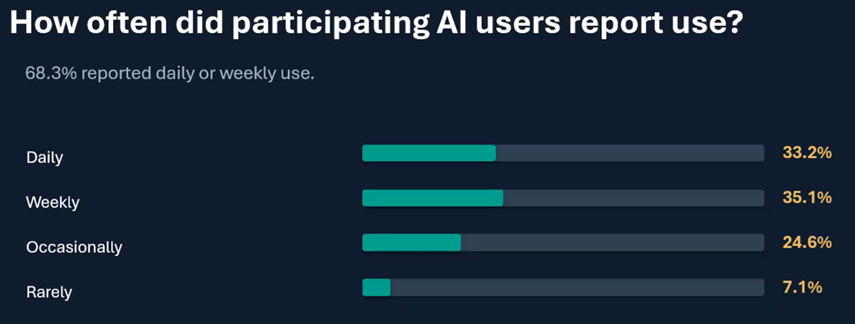
McKenzie Research Fellow and Principal Investigator on TRAINE, Dr Johnston said 2025 survey data collected from teachers show, of those who reported using AI, just over two-thirds (68%) were using it daily or weekly.
When it came to which tools they’re using, Dr Johnston told the webinar, ‘… it’s a broad range, it’s really beyond ChatGPT.
‘When you talk about GenAI – especially when AI first came onto the scene globally when it was being implemented at quite a large scale – a lot of times when you asked people, they would typically say ChatGPT. But we weren’t seeing that in the actual survey … there was a broad ecosystem.’
Tools that 2025 TRAINE study participants reported using include:
- General purpose assistants not specifically designed for the education sector, such as ChatGPT and Copilot, Claude and DeepSeek.
- Education-specific tools such as Magic School and Brisk Teaching; creative tools such as Canva and Adobe Firefly.
- Those that support research, searching and writing, such as Perplexity and NotebookLM.
- Those provided by education systems, such as EdChat and Corella AI; and tools already embedded into learning platforms, such as Stile and Education Perfect.
- Teachers were also using embedded AI functions in Google and Microsoft products, and unnamed school-provided tools.
Digging deeper, Dr Johnston said the tasks teachers were using the tools for offered up more useful information. ‘What we can see from here is mostly the teachers were using it for designing tasks or learning activities, followed by either the creating of assessments or planning lessons or units.'
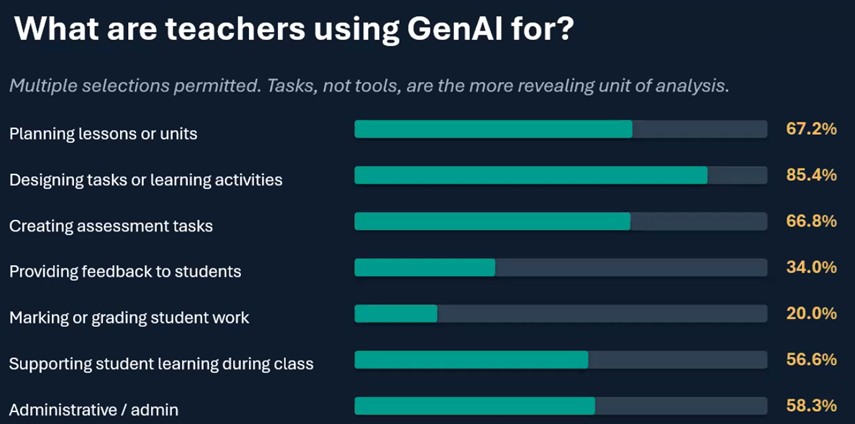
‘What was also really more revealing is that in addition to these fixed response categories [they could also give open-ended answers], and we got some really rich responses.
‘For example, teachers were using the AI feature in Canva to teach their students about things like language precision. … one of the teachers described helping students to explore how the words that they ultimately choose to use can really affect an image. So, essentially the teacher had the students create an image and then each time they changed a word or a group of words, the image would change at the same time.’
In this activity, the teacher was using AI to get students to think about the consequences of the words we use and linking it to an everyday context. ‘So, we know we're on social media and we're behind keyboards and we tend to use these words. And so, it's important to understand how we can best communicate ourselves to get across the arguments that we want,’ Dr Johnston said.
Other examples included using the tools to make student writing weaker and stronger to illustrate different levels and points for improvement, using GenAI to help quickly find texts with the same literary features to use as resources in class, and building an application for recording data from the school sports day.
Time saved or creating extra work?
Webinar attendees heard efficiency, or perceived efficiency, of AI use is a complex matter. The researcher illustrated this by sharing quotes from 2 survey participants.
‘I rarely use the output directly, always having to make changes/tweaks/accuracy checks etc. but for simple worksheets and such it is so efficient.’ (Year 7-12 Arts teacher)
‘Mostly though AI has increased my workload, because of the increased difficulty around verifying student work.’ (Year 11-12 English, HASS teacher)
‘… they're describing different activities, of course,’ Dr Johnston said, ‘but I think this contrast is quite important, and it reveals a lot because much of the discussion … tends to focus on the time saved producing something, but what we hear much less about is the work that follows. This includes things like checking outputs, investigating the suspected use of AI, and even questioning the students about authorship.’
Expertise was also a factor in whether the tools produced efficiencies.
'I have come to see the usefulness of AI in generating examples, scaffolds and templates to save me time in my planning, but more needs to be recognised in how I can only understand what is useful because I have reached a particular level of expertise.’ (Year 7-8 and 10-11 English teacher)
‘I find my prompts have been improving, and I am getting the mundane paperwork/emails done quicker as it has no academic merit and it’s ticking boxes.’ (Year 7-12 Technologies teacher)
The 2026 data collection is also looking at secondary school teachers who don’t use GenAI tools to better understand why this is the case and what supports they’d like to receive.
Creating a community of practice
Aside from tracking the progression and use of AI across several years, Dr Johnston says an important aim of TRAINE is creating a community of practice. Survey participants are invited to share resources that they’re using – in particular, around assessment of critical thinking – so that other educators can benefit.
Open access resources for teachers from the 2025 survey included:
- A student reflection journal to support teacher planning
- A template to help students reflect on how they’ve used AI
- An AI use disclosure form using a traffic light system
Participate in the TRAINE Study survey
Secondary school teachers in Australia can participate in the Tracking AI in Education (TRAINE) Study survey, which is open until the end of December 2026. Click on the survey link to find out more.
Sharing expertise on AI in education research and practice
In 2027, Teacher will continue to share examples of how teachers and education systems are trialling and using AI tools in their contexts. We’ll also be updating you on the latest research, including new insights from the TRAINE Study.
Sign up to the Teacher bulletin to stay up to date with the latest. If you’d like to share what’s happening in your school, email teachereditorial@acer.org and we’ll be in touch.