Thanks for tuning in to this podcast from Teacher Magazine, the resource for K-12 educators published by ACER, the Australian Council for Educational Research. I'm Dominique Beech.
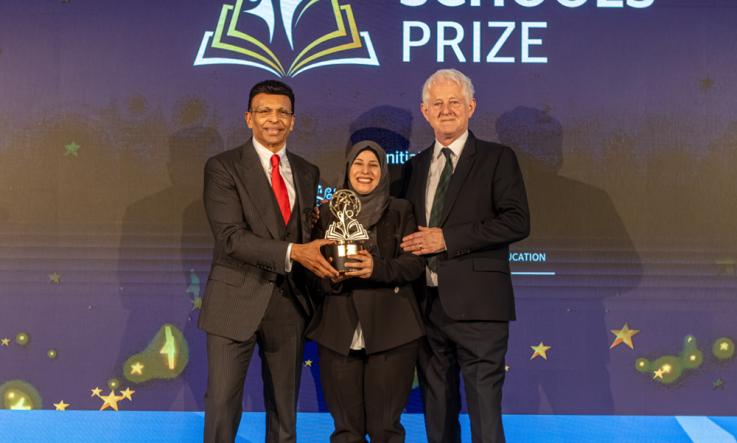
Recently on Teacher, we shared the news of the inaugural winner of the Global Schools Prize. Lebanon’s The Alsama Project – an education organisation supporting displaced Syrian and Palestinian teenagers to remain engaged in education – has taken home the US $500,000 in prize money to scale its impact globally. The Global Schools Prize is an initiative of the Varkey Foundation that aims to recognise and celebrate the world’s most innovative and impactful schools that are reimagining education for the future. The prize is organised into 10 categories, and each category winner is awarded US $50,000.
Excitingly, Australia’s very own Larrakeyah Primary School in Darwin were recognised as a top 5 finalist in the AI transformation category for the Prize. They were recognised for transforming education through IntelliLearn – a custom-built AI writing platform that provides students with curriculum-aligned and scaffolded feedback. It’s an incredible achievement, particularly because the platform was designed by teachers at the school. In this episode, I’m delighted to be joined by Larrakeyah Primary School principal Fathma Mauger to hear all about IntelliLearn. Let’s jump in.
Dominique Beech: Thank you, Fathma Mauger for joining us on the Teacher podcast today. It’s a delight to be about to speak with you. To kick us off, I'd love to hear a little bit about the school context at Larrakeyah Primary School and also your role as well. How long have you been principal there?
Fathma Mauger: Yeah, sure. I've been principal at Larrakeyah Primary School for 14 years. So quite a long time, but it's just a great school. Larrakeyah Primary School is a large urban school in Darwin city. It's very multicultural. We are, in fact, the first government school in the Northern Territory to be accredited as a Cambridge International School. So that status is quite important for us.
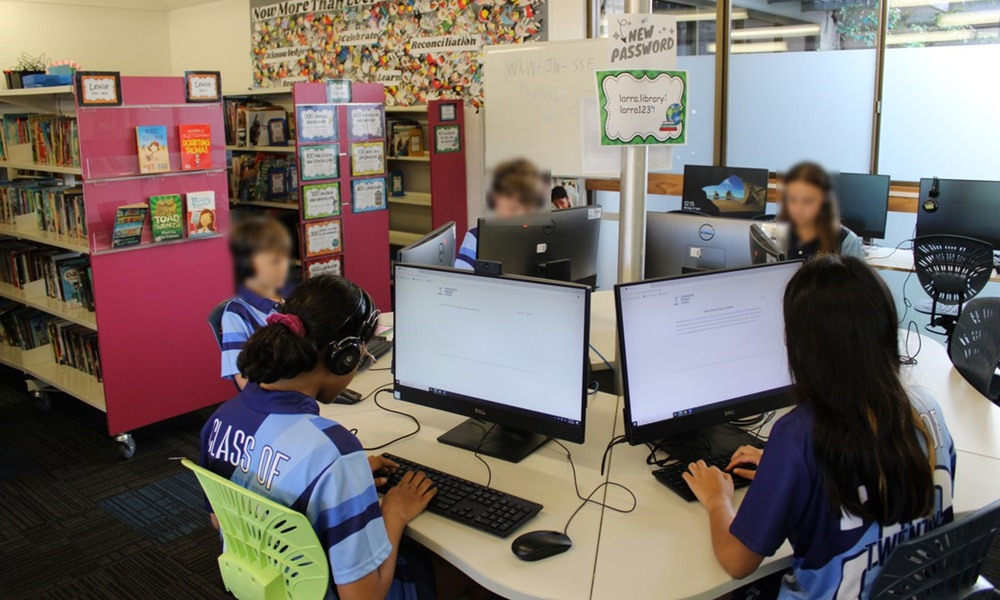
We have approximately 540 students at the school, with more than half having English as a second language. We have a unique situation because our school is actually situated next to a naval base; so, about 30% of our students come from defence families. So we have quite a transient student population. The school is known to be a high performing school. We've had national and international recognition for a number of our school programs. So yeah, it's quite exciting being here.
DB: Yeah, and of course, we're here to celebrate the fact that you were named as a top 50 finalist for the Global Schools Prize. That's from over 3,000 nominations worldwide. An incredible achievement. I'd love to know how your nomination came about and also, of course, what the recognition means for you in your school?
FM: Yes, certainly. We're still on a high over that. The school has previously entered international awards – like the International School Awards and the World’s Best School Prize, and we were finalists in both. So we saw the inaugural Global Schools Prize and thought we'd give it a go and we'd enter. We did. We actually entered 2 categories. We entered Health and Wellbeing and AI transformation, and we were named a top 50 finalist, as you said, over 3,000 nominations from actually 113 different countries around the world. So that was huge for us. There were 10 categories and we were a top 5 finalist in the AI transformation category.
And I think the recognition was a significant achievement for our school as it actually meant that our program, which is IntelliLearn, was considered worthy not only at a national level (because the school won the best use of technology last year at the Australian Education Awards for IntelliLearn) but now at an international level, and this is just amazing for a primary school in Darwin.
DB: Absolutely. And like you say, you're recognised for your AI writing platform, IntelliLearn, and we're going to talk a lot about the details of that program, because I'd love to know the ins and outs of it. But first, before we get into the detail, I'd love to know where the idea came from. How did this come about?
FM: Yeah. Well, we were initially inspired by Khanmigo, which is an app that uses an AI personal tutor for students. And a few years ago, we sent staff to Wesley College in Melbourne. And they had developed an AI school platform that catered for students within their school context. And this helped us to understand the initial developmental stage, or process.
But, however, what we wanted was a tutor support for students that the teacher could control and that we could control by setting our own boundaries, using the Australian Curriculum and our own school programs. So, I guess that's where the inspiration came from.
DB: And so the platform itself was custom built by staff at the school. What was involved in that process? How did you kind of get from the idea and the concept in general to having a functioning platform?
FM: Yeah, it was quite a process. IntelliLearn is an AI tool, as you said, developed by staff, but we also had an IT consultant who supported with the coding side in 2024, and it was designed to support students to improve their writing.
So, given the challenges we thought – of large class sizes and the varied needs within each classroom – the tool was actually designed to assist teachers with differentiated instruction. So, IntelliLearn is not [ChatGPT]. It doesn't give the answers. It doesn't replace the teacher, and it operates within the boundaries that we've set, such as the curriculum and school programs.
So, as this tool was created for a student cohort, we thought it was essential that the tool would benefit our students to engage with in real time. And we wanted the feedback to be given, but the work had to be completed by the student. The students receive feedback from IntelliLearn on their text, they must apply it, taking the feedback into consideration and crafting their text. So, to ensure IntelliLearn gave age appropriate feedback, we placed in the parameters and work samples we wished for it to use to draw information from to guide students with their learning.
So, the samples that we embedded in our AI tool included written work samples of varying abilities created by our own students, the Australian Curriculum content for writing, and the Cambridge Curriculum Framework code. So, we built those into the platform. And IntellilLearn, we found offers teachers a powerful tool to deliver highly individualised scaffolding support to each student at the same time. And in a modern classroom, I think you find that teachers often try to balance the need for focused small group instruction with the challenge of how to engage the rest of the class. And so, by integrating an AI-driven tutor alongside a teacher, we empower teachers to work closely with small groups of students while IntelliLearn adapts to other individual student needs in real time.
DB: Amazing. Yeah, that's fascinating to hear about all the different parameters and the different elements of the framework that you've built together over a number of years. I'd love to know then – perhaps looking at it at the classroom level – what does the platform do for a student? Perhaps an example of what that might look like and the ways that it is used by students? I've read there's a text-to-voice feature, which is particularly beneficial for students with English as an additional language. Is that something that is a real-life example of how it’s being used?
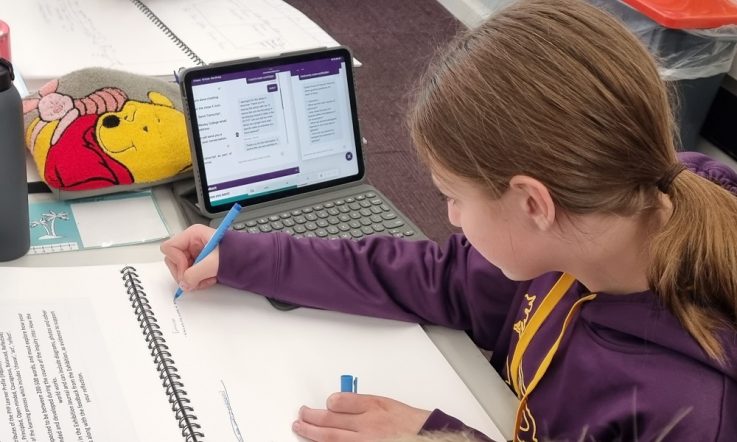
FM: Yeah, definitely. I mean, during writing lessons, the teacher sets the learning intention/success criteria for the lesson, and the AI offers guidelines within – or offers guidance – within those objectives. For example, if the lesson focuses on developing ideas with writing a story, for example, the AI prompts students to ask questions and provides guidance rather than giving students the direct answers. So, this allows the teacher to focus on providing quality feedback for students while the AI tool supports them.
So what they do is, the students use a blank writing pane that comes up on the screen to craft a text. And when they feel that they need some guidance, they highlight the parts of the text they wish to receive feedback on. So it could be, ‘can you have a look at the adjectives that I've used and offer some feedback?’, ‘can you have a look at how I've started the story?’ and they highlight that bit. So, once the section is highlighted, they ask the tutor – they select ‘ask tutor’ and type in a question they have about the text they're creating. If students are stuck on a question to ask, the AI tool provides guiding questions, prompting them and ensuring they stay on task. So, the tool never gives the answers. It keeps students on task and the feedback provided is positive and encouraging.
And another important feature of IntelliLearn is the prompt initiated when no interaction with the writing pane is detected. So, if a student's sitting there for 5 minutes, it can prompt them. ‘Oh, I haven't heard from you for a while. How do you feel about this?’ So, they're actually trying to engage the student back on task. It also redirects the student if questions typed aren't relevant or are random. So it will focus on the story. It provides personalised support based on each student's needs. It offers prompts, offers instant feedback on written text, and as you said, the option to hear the feedback aloud.
DB: And so what's been the impact of IntelliLearn so far on student outcomes?
FM: Yeah, it's been interesting because we've really monitored the data on IntelliLearn. It has measurable improvements in student engagement and literacy outcomes. We looked at both qualitative and quantitative data.
Teachers observed students’ improved confidence in writing, on-task behaviours and significantly improved writing skills and writing quality, particularly from students who have English as a second language. So, the speech-to-text and text-to-speech feedback from IntelliLearn really engaged students more deeply in their learning. And when we looked at the data in terms of growth for students, we had remarkable growth. We had 92% of our year 5 students and 100% of our year 6 students, they were meeting or exceeding the literacy benchmarks, comparing when we compared pre-test and post-test writing data.
We have A to E grades that we give students. So, our A to E data highlights that 85% of years 5 and 6 students achieved a C grade or higher as their writing grade. We also looked at our NAPLAN data. It showed an upward trend in writing proficiencies and, notably, the school's large English as a Second Language cohort – they have significantly benefited as IntelliLearn provides, that real-time grammar, tense, vocab corrections, and it really has enabled those students to refine their English language proficiency. So, 50% of our year 5 and 6 cohort are EAL/D [English as an Additional Language/Dialect] learners and 86% of them are achieving at or above their expected level in writing. So, it's just been huge growth for our students.
DB: Looking ahead then, what are the future plans for IntelliLearn or perhaps other uses of AI at your school, considering the success you’re experiencing?
FM: Yeah, we have thought about it – and obviously IntelliLearn is just focusing now on writing because that was a lot to get it to that. But our future plans are to expand IntelliLearn to include reading – supporting students with reading fluency, comprehension and vocabulary. We're also looking at trialling IntelliLearn in some remote Aboriginal schools in the Northern Territory to obtain writing data from different school contexts. So, we thought that would be interesting because if we can show that it actually is having a significant difference to students in different school contexts and that's going to be amazing for schools.
DB: Wow, and Fathma, for school leaders who are listening to this podcast who might be thinking that they'd love to get started on a similar project for their own setting – or at least investigate what the potential could be for their context – I'd love to know if you have some words of advice to share or perhaps some tips for getting started?
FM: Yeah, there's lots of advice, this has been a huge project! But I guess my main advice would be that there always seems to be some negativity or fear around AI. So, my advice would be to really, before you venture into this space, to have a very clear policy around technology and AI. Because, while approaches to AI might be different in each school, clarity around policy is really essential for there to be trust and confidence amongst students, staff and the community. And I think that unless there is a clear policy, schools – or rather principals – will open themselves up to risk. So, that's one thing. I guess while we're still on about policy though, but policy must clearly outline, I think, the purpose of using AI – what it means to use it in your school – and of course, guide the responsible and ethical use of AI in ways that benefit the school community.
My other advice would be; however you're using AI – whether it's a platform like we've developed, or apps or anything else – but I think it's really important that you don't forget the human in the loop. And when we developed IntelliLearn, we were very conscious of the teacher having some control. I think that's really important, particularly in a primary school.
A big one too would be the ongoing professional learning for staff around the use of AI. So they really must understand how AI can benefit themselves as well as their students.
DB: Brilliant words of advice there, Fathma. That was everything that I wanted to cover with you today. It was amazing to hear all about IntelliLearn. Before we wrap up, was there anything else that you wanted to mention?
FM: I really have thought about this whole project over the last couple of years and where we're going and what it's done for kids. And it really has made us think here about changing our mindset in education because I think that there has to be this understanding that many students these days are digital natives. AI is part of their world and it's also part of innovation. And innovation needs to ensure that we're preparing kids for future jobs. Many of them don't even exist at the moment. And we need to be prepared then as educators to think outside the box, as students now think differently and they learn differently. I think that teachers need to be prepared to change their teaching and schools need to be abreast of the current trends in education; because, particularly with AI it's here to stay and it's becoming not just part of students' world, it's part of our world.
DB: You've certainly given our listeners much to reflect on, I’m sure. Thank you for taking the time this morning to share your insights with us and, of course, congratulations again on your recognition with the inaugural Global Schools Prize.
FM: Thank you very much. It was a pleasure speaking about IntelliLearn and what it means and what it could mean for other schools.
That's all for this episode. Thanks for listening. Don't forget to visit our website to access the transcript for this podcast, where we've included any and all relevant links to further reading from our conversation today, including a Teacher article on the inaugural winner of the Global Schools Prize, The Alsama Project. If you enjoyed this chat, please take a moment to follow our show on your podcast app if you haven't already, and leave us a review. Both of those things help more people like you to find our podcast, and they're a really big help to our team. We'll be back with a new episode very soon.
Teacher Magazine is published by the Australian Council for Educational Research.
Fathma Mauger says it’s important for schools to have a clear policy around technology and AI. Does your school have an AI policy? Is it still fit-for-purpose? How often is it reviewed? Are staff consulting the policy before they experiment with AI?
How might an AI tool support differentiated instruction in your classroom? Would text-to-voice features be useful? How would you ensure the teacher is kept firmly in the loop?