How do we nurture the next generation of curious thinkers, problem-solvers and innovators? That's the question at the heart of National Science Week, which runs from 15-23 August this year. The 2026 theme ‘Seeds of Science: Nurturing knowledge for all’ celebrates curiosity, inquiry and shared learning, while highlighting how scientific knowledge grows when it is cultivated and applied to real-world challenges.
A place that lives those values every day is the Victorian Space Science Education Centre (VSSEC), a specialist STEM learning facility located on the campus of Strathmore Secondary College, around 10 kilometres northwest from Melbourne’s CBD.
Michael Pakakis, Director of VSSEC and Assistant Principal of Strathmore Secondary College, says that 2026 marks a huge milestone for VSSEC, which is celebrating 20 years since it first opened.
‘For the last 20 years, every week has been Science Week here at VSSEC,’ he tells Teacher.
VSSEC uses the theme of space exploration to engage students and teachers in STEM learning. It offers a range of hands-on learning programs and immersive experiences for students from year 3-12.
Since 2006, more than 250,000 students and teachers have participated in VSSEC’s programs. Nearly 20,000 students visit the centre annually.
The origin story
Pakakis has been at the school since 1992. Towards the end of the 1990s, the then maths/science teacher found himself increasingly concerned about the falling enrolments in his subjects.
To re-engage students in science, Pakakis arranged to take a group of students in Year 9-11 on a 2-week trip to the United States to visit the Kennedy Space Centre in Florida and NASA’s Space Camp in Alabama.
Inspired by the experience, Pakakis returned home with a vision to develop a facility in Australia, not just a copy of NASA’s Space Camp, but something truly original that would better engage, challenge and educate Australian students.
With colleagues, they lobbied local members to secure a $6.4 million grant from the Victorian Government to build the purpose-built facility. VSSEC is now one of 6 specialist maths/science centres funded by the Victorian Department of Education.
An integral element of the vision for VSSEC was to deliver professional learning to primary and secondary school teachers.
‘One thing we picked up really early was that for students, one day here on excursion is not going to do that much,’ Pakakis says. ‘The thing that's going to make a difference is if we have our science teachers teaching effectively in the classroom.’
The VSSEC team has developed materials that educators are encouraged to use to prepare students for their visit to VSSEC. Post-visit materials are also available to allow teachers to follow-up and consolidate the learning that happens at VSSEC.
The Mission to Mars program
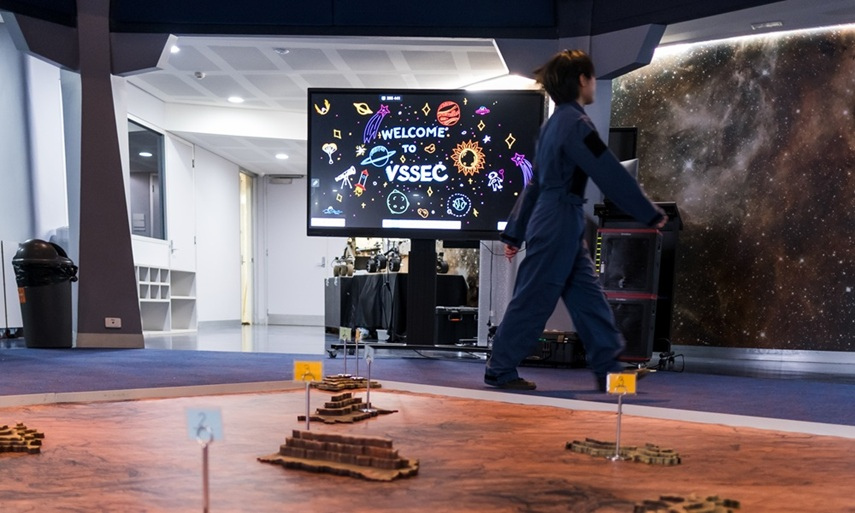
Mission to Mars is VSSEC’s flagship program designed for secondary school students. It is essentially a geological field trip that is delivered in a simulator which has 2 elements:
- A Martian analogue surface, where students gather data and specimens, for later laboratory analysis
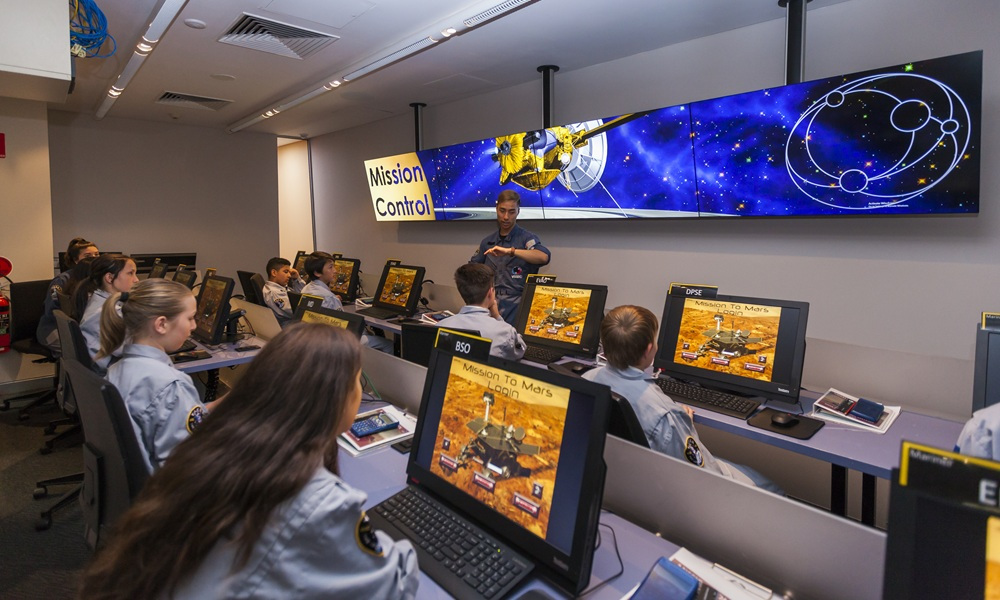
- A mission support system that ensures that mission objectives are met whilst keeping a close eye on environmental conditions and other factors that could compromise the safety of those on the Mars surface.
The aim of the program is to have students investigate how they can prove that Mars has changed over geological time. Throughout the excursion, students work as a team and use their problem-solving skills to successfully complete a geological survey of the Mars surface.
Marion Anderson, a planetary scientist from Monash University, provided vital input into the representation of Martian geology. Her original design was a recreation of Gale Crater – a real impact crater found on Mars.
Throughout the excursion, students are encouraged to suit up and step out onto the Martian surface to collect soil and rock samples, drill an ice core, conduct a thermal survey and measure seismic activity.
Pakakis explains that VSSEC used set designers from the film industry to help the team design the outer part of the floor. ‘When you go in, there’s a large inflatable and behind it is a film set,’ he says. ‘It's got all these different lights, and those lights are set up on a computer program to go on and off in a particular sequence to simulate things like dust storm clouds approaching or solar flares hitting the area.’
In the simulator, the lights will show that there is a dust storm approaching, but mission control will be responsible for using their mathematical skills to determine how fast it is travelling and when the team on Mars will need to evacuate.
‘For the solar flare, again the team will have to work out a mathematical calculation of how long that solar flare that has just been released from the Sun – how long it will actually take to hit, and the level of radiation that will hit the surface – so that was built into the program as well,’ Pakakis explains.
A ‘learning by doing’ approach was applied to the design of the program and the design of the supporting infrastructure – the Martian landscape, the mission control centre, clothing, communications and other supporting materials.
Working with universities
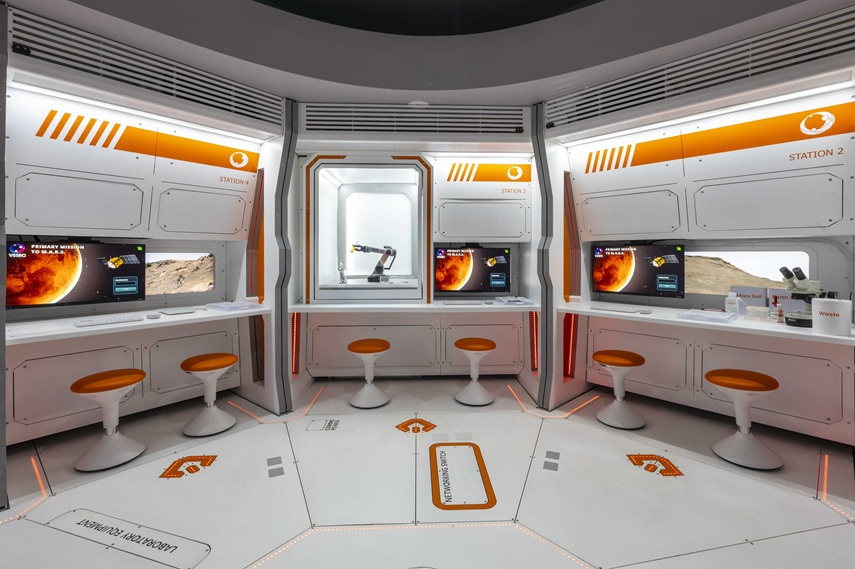
VSSEC works with university students to not only build their programs, but to teach them as well. For example, they engaged university students with skills in gaming design to build their mission control for Mission to Mars.
‘We thought, there's no way we can put together a mission control the same as NASA's mission control or the European Space Agency's mission control, because that'll take hundreds of millions of dollars,’ Pakakis explains.
Instead, the university students built them a program for a fraction of the cost.
Pakakis says that the idea was borne out of something he witnessed at Space Camp in the US, where they had university students on their summer break supervise the students.
‘We thought, why don’t we try that model here but with a bit of a twist?’
They again reached out to their university partners, specifically seeking students who would be excellent communicators to deliver the centre’s programs and interact with the visiting students and teachers. He says that each year they have an influx of students of different disciplines – biology, physics, engineering, aerospace – showing interest. VSSEC then offers them an intensive course on pedagogy.
‘The other thing was we wanted them to talk about themselves because we wanted the students to be exposed to young scientists and engineers and to see themselves in them. That was the other reason why we went down this road,’ he adds.
An evaluation of Mission to Mars
Jo Doyle, a Research Fellow at the Australian Council for Educational Research (ACER) undertook an evaluation of the Mission to Mars program as part of her Master of Evaluation at the University of Melbourne.
‘I approached the project with a lot of curiosity and enthusiasm because I could see from the outset what a fantastic opportunity it was to work with such an innovative organisation,’ Doyle tells Teacher.
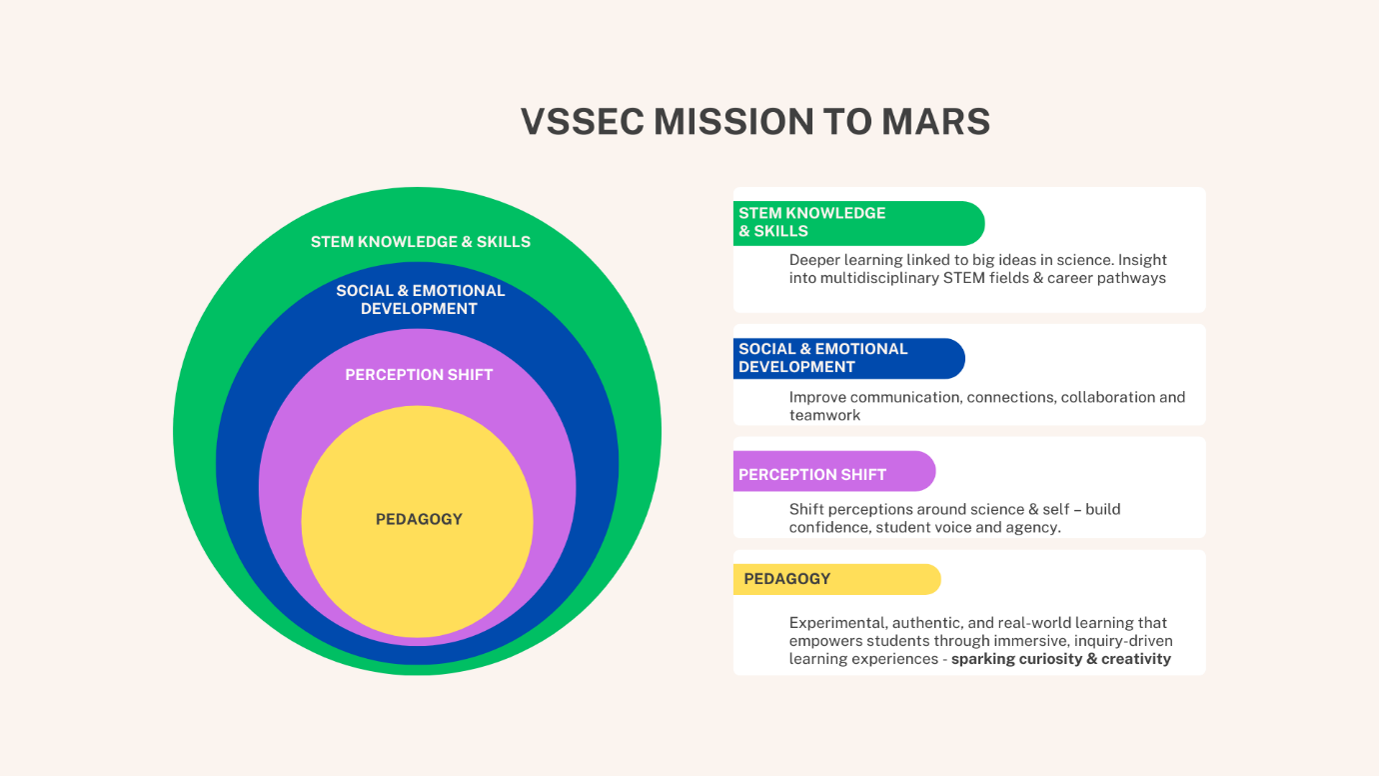
She proposed a Theory of Change (ToC) through which to view the Mission to Mars program to gain insight about the program’s effectiveness and where, from a student impact perspective, it might be strengthened.
‘Through an in-depth consultation process with VSSEC staff, I developed a visual Theory of Change to capture the program's underlying logic and make explicit how change was expected to occur,’ Doyle explains.
‘Central to the model was the role of pedagogy. It demonstrated how immersive STEM experiences contribute not only to knowledge acquisition but also to the development of teamwork, communication, resilience, and connection. These outcomes help challenge narrow perceptions of who can participate in science – supporting students to see STEM as accessible, relevant, and achievable while also delivering the big ideas of science (in this case Geology).
For students who don’t see themselves as ‘scientists’ or ‘techies’, Doyle says that the program really helps to change the narrow view of who belongs in STEM.
‘One of the strengths of Mission to Mars is that it breaks down those barriers through play, making science hands-on, practical and fun. Instead of learning about STEM from a textbook, students step into an immersive mission where they use science and maths to solve real-world problems.
‘Immersion, role-play and dressing up are a big part of what makes this work. These props give students permission to play and to see themselves as scientists and problem-solvers, even if they wouldn't normally identify that way.’
Doyle says that her work at VSSEC reinforces the broader work being done at ACER.
‘While this was a relatively small project, I think it reinforced some of the things ACER cares deeply about: understanding what works in education and how play can strengthen learning experiences, even for teenagers,’ she says.
‘It also reinforced something that is relevant across ACER's work: when students are actively involved in learning, they're more likely to build confidence, curiosity, and a sense of agency. I came away with a deeper appreciation of how innovative pedagogy can shape not just what students learn, but how they see themselves as learners.’
If you’re running a National Science Week event, The Australian Science Teachers Association (ASTA) has published a free ‘Seeds of Science’ teacher resource book, which offers educators practical ways to explore the 2026 theme with students. Activities for F-10 students include: learning about sustainability and waste by designing a seed bomb; observing how plants grow towards the light; and investigating the conditions leading to successful seed germination.
How are you celebrating National Science Week in your school setting? We’d love to hear from you. Share your story in the comments below or email the team.