Filter by category
‘It’s a great reminder that what is consuming your thoughts now may not consume your thoughts forever.’ Teacher Frances Ardern shares why she has enjoyed journalling for most of her life, and her tips for getting started yourself.
With the growing use of STEM across various industries in Australia, how can we ensure equitable opportunities and pathways for all students? How can schools build successful partnerships with industry specialists to rethink STEM education? In this article, we outline five further readings which explore STEM education in Australia.
With plenty of ‘get rich quick’ hype circulating around social media, and well-marketed trading apps luring people in to investing, it’s important to understand cryptocurrency. In this context, schools and teachers have an important role to play. Here, Dr Carly Sawatzki, Dr Jill Brown and Peter Saffin explore how teachers can understand students’ learning needs in this area.
Students miss school for a whole range of different reasons, such as illness, suspension, or family holidays. Today, we’ll be speaking with Kirsten Hancock, Honorary Research Associate from Telethon Kids Institute in Western Australia about how different types of absences affect student outcomes, and what families and schools can do to tailor their support to students who are missing school.
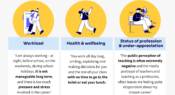
A new study from Monash University draws upon a 2019 questionnaire of 2444 Australian primary and secondary school teachers, revealing that only 41% of respondents intended to remain in the profession. We look at some of the findings from the analysis in this infographic.
‘Being accountable for my wellbeing requires scheduling in time for my goals and passions outside of the classroom.’ Here, English teacher Marissa Lombardo shares how attending Italian classes to learn the language has helped her make new friends, connect with her family culture and challenge herself in new ways.
It can be hard to prioritise engaging in hobbies or learning something new among the busyness of day-to-day life. But there are many benefits to dedicating time to learning a new skill, and it’s never too late to start. Here, Monika Schmid, Head of Department of Language and Linguistic Science at the University of York, shares the benefits of learning a new language as an adult.
In the second part of our Q&A, author-educator Vanessa Hamilton discusses what consent education is (and some of the misconceptions), examples of what it looks like for students in primary and secondary, best practice for schools, and some of the challenges faced by teachers and leaders.
Age-appropriate consent education will be mandatory in all Australian schools from 2023. Kit and Arlo Find a Way: Teaching consent to 8-12 year olds is a fictional chapter book created for use in primary classrooms. In the first instalment of a two-part Q&A with author-educators Ingrid Laguna and Vanessa Hamilton, we find out more about the resource and research about the impact of consent education in schools.
‘If you’re short on time it’s a great one for dipping in and out of without losing the flow. I also love books that make you stop, reflect and want to share with others, and Phosphorescence certainly ticks all those boxes.’ Teacher editor, Jo Earp, shares her review of Phosphorescence by Julia Baird.
Facebook
YouTube
SoundCloud
Apple Podcasts
Spotify
RSS feed
Linkedin