Filter by category
‘We know that mathematics anxiety and poor mathematics attitudes negatively impact mathematical learning and achievement-related choices.’ In this article, Dr Shani Sniedze and Dr Sarah Buckley share details of new resources to foster positive mathematics engagement for all students in the classroom and reduce the negative impact of mathematics anxiety.
Culturally responsive teaching (CRT) seeks to improve the experiences and academic achievements of marginalised and minoritised learners. In this edition of Researching education: 5 further readings, you can read research on CRT, including building cultural competence among teachers, how to further develop culturally responsive pedagogies, and more.
Professor Geoff Masters, CEO of the Australian Council for Educational Research, joins Teacher for a series on world-class learning systems. In Episode 2, he joins Editor Jo Earp to discuss how the 5 jurisdictions of British Columbia, Estonia, Finland, Hong Kong, and South Korea are creating the conditions for all students to learn successfully.
At St Joseph’s Primary School, teachers have had time to better understand how to effectively support each student to be intellectually, behaviourally, emotionally and socially engaged as learners. In last week's article, 3 teachers shared more about this opportunity and in today’s article 2 foundation teachers explain how they’ve benefited from examining their own practice.
The longstanding Prime Minister’s Prizes for Excellence in Science Teaching recognise one primary and one secondary STEM teacher for their outstanding contribution to the field. The 2023 winners were announced late last year and in this episode, we speak with them both about the work they’ve been recognised for.
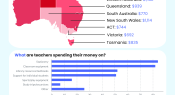
The latest 'State of our Schools' survey from the Australian Education Union - conducted in early 2023 - shows that of almost 6,000 respondents, a vast majority are spending hundreds of dollars of their own money each year on items for work.
School absence has an impact on student outcomes, so being aware of attendance rates for your class, year group, or whole school, and understanding the reasons behind the absence is important. With this information to hand, what will make a difference? That’s the topic of Dr Kirsten Hancock’s research.
Welcome to the first edition of Researching education: 5 further readings for 2024. When we asked you for the topics you’d like us to cover on Teacher in the next 12 months, artificial intelligence (AI) was the most frequently requested. So, in this edition, we’re taking a look at AI.
We know teachers are interested in how they could incorporate the use of generative AI to support them with managing their workload in general. In this edition of Teacher’s Bookshelf, we share an exclusive extract from Leon Furze’s new book Practical AI Strategies: Engaging with Generative AI in Education which focuses on ways to use generative AI to assist with lesson planning.
Welcome back to a new year of Teacher content. As usual, we are kicking things off with a look at some of the significant events, celebrations and themes for 2024 that you can use in your lesson planning. As well as the key dates in each term, we’ve also included links to more information and resources.
Facebook
YouTube
SoundCloud
Apple Podcasts
Spotify
RSS feed
Linkedin