Filter by category
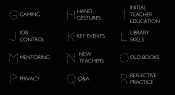
What do you need information on? Behaviour strategies? Embedding First Nations perspectives? Student engagement? Reflective practice? The 11th Teacher alphabet brings you quick links to popular content that you might find useful. Download the PDF for a hyperlinked version.
School Assembly is the podcast that explores what it takes to build a new school from the ground up. In Series 1 we’re following Principal Dr Ray Boyd and Associate Principal Rachael Lehr at Dayton Primary School in Western Australia. In Episode 9 we talk about how educational research is the foundation for everything at the school – from classroom teaching to leadership.
As an educator, finding the time to discuss matters you are finding challenging with colleagues, to seek advice and reflect on your practice, might seem impossible. In this episode, we’re joined by Dr Anne Southall and Associate Professor Fiona Gardner to hear about their development of a reflective circles education model.
It is widely acknowledged that teaching is a stressful job, and the global events of the past few years have added an enormous amount of extra pressure on those working in education. In today’s episode we share some of the pieces we’ve published on the topic of teacher health and wellbeing.
‘It's one of those things that people don't feel comfortable talking about. Why is it so difficult to have that conversation when it is absolutely critical for our social wellbeing as well as our health?’ Bronwyn Robinson, Education Manager at the Continence Foundation of Australia, explains not all students start school toilet trained, others need ongoing support, and some who have previously had no problems can start to have difficulties.
The new country report Education Policy Outlook in Australia has highlighted the fact that 'The disciplinary climate in schools in Australia was among the least favourable in the OECD according to students' reports in PISA 2018'. In this infographic we take a look at those PISA survey statistics, and how Australia compares with 11 other countries.
School Assembly is the podcast that explores what it takes to build a new school from the ground up. In Series 1 we’re following Principal Dr Ray Boyd and Associate Principal Rachael Lehr as they navigate the exciting challenge at Dayton Primary School in Western Australia. In Episode 8 we’re talking about building the school ethos and culture.
‘There is a need for schools to have consistent and clear approaches to behaviour that set and maintain behaviour expectations ...’ Katherine Dix, Tom Cain, Karina Stocker and Susannah Schoeffel discuss 6 key recommendations from a new guidance report, and share some common challenges and implementation tips for how to overcome them.
In our latest submission, researchers from Macquarie University and the University of Wollongong share findings from a study that identified 4 different types of teacher-student relationships, and how these relationships are associated with high school students’ science motivation.
Effective teaching and learning go hand in hand with supporting the health and wellbeing needs of students and, just as importantly, staff and school leaders. In this Q&A we speak to high school teacher Sue Webb, whose book Teachers Cry Too shares her struggle with and recovery from mental illness.
Facebook
YouTube
SoundCloud
Apple Podcasts
Spotify
RSS feed
Linkedin