Filter by category
In this episode in our School Improvement series, we hear from Dr Jason Zagami from Griffith University, who shares some of the current challenges and opportunities of computer education in Australian schools, and how teachers can better prepare for future technological advances.
New research has shown that while the use of immersive virtual reality (IVR) increases student enjoyment and presence in a task, when used on its own it does not improve procedural or declarative knowledge when compared to the more traditional learning activity of watching a video.
With the rapid growth in digital technologies, digital writing skills are becoming more and more relevant for students. A new research project from Deakin University will look at the potential to complement traditional writing tasks in schools with contemporary forms of digital writing.
To be fit for purpose well into the future, learning spaces within schools will need to be flexible. Two schools in Victoria, Australia, have recently undergone refurbishments to develop new, flexible facilities, and have both been recognised at the 2022 Learning Environments Australasia Awards.
Early-career teacher at Tasmanian eSchool, Ruby Lyons-Reid, has recently been recognised for her use of digital resources to engage students in learning about First Nations histories and cultures, and in this article, she shares the learning activities she’s found to have the most impact.
‘For those Australian teachers affected by remote delivery of teaching, many found the value and utility of engaging their students through Instructional Video.’ English and History teacher Steven Kolber shares the six common approaches to apply Instructional Video within a classroom or educational setting.
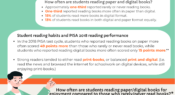
An OECD report 21st-Century Readers: Developing Literacy Skills in a Digital World analyses data from the 2018 PISA test and student survey to report on the reading habits of 15-year-olds in OECD countries. Find out more about how reading in digital and paper formats affects students’ reading performance and enjoyment in today's infographic.
Helping students to develop their skills in the general capabilities is essential for preparing them to succeed in a modern society. At St Hilda’s Anglican School for Girls in Perth, Western Australia, primary school students are given these opportunities through the school’s STEAM program.
‘The metaverse is upon us. Soon it will be as omnipresent as TikTok, Instagram, and Facebook (now Meta).’ So reads the first line of a new Policy Brief exploring the potential of the metaverse to enhance teaching and learning in the future, and why we need to start planning for it now.
‘[The Sacúdete strategy] shows to others what the future of school could look like when we put learners at the centre and make the "extracurricular" the curriculum. That is the lesson that other countries can learn from.’ In his new Teacher column, Andreas Schleicher shares details of a successful program in Colombia that sees educators work as mentors and coaches.
Facebook
YouTube
SoundCloud
Apple Podcasts
Spotify
RSS feed
Linkedin