‘Alongside asking, “What do students need to know and be able to do?”, we might ask, “Where will students need to stop an immediate response in order to learn successfully, and how can we help them get better at doing that?”’ In his latest Teacher column, Professor Martin Westwell, Chief Executive of the South Australian Department for Education, argues self-regulation is a powerful yet underused contributor to successful learning.
‘Our ambition was never a polished framework that looked impressive on a classroom wall. It was to strengthen the quality of teaching inside every classroom, every day.’ In today’s article, Michael Rosenbrock and Martine Gill unpack key lessons from Clover Hill State School’s journey to develop and implement a pedagogical model that impacts teacher practice.
Ahead of the National Education Summit in Melbourne this September, we sat down with Andrew Fuller – clinical psychologist, author and family therapist – to discuss his work on converting neurodiversity into neuro-advantage. In this episode, we explore transitions and regulation, school belonging and finding your people, and how educators can help turn neurodivergence into a genuine advantage for young people.
When students are in the early stages of developing skills, knowledge and understanding, or encountering new material and concepts, explicit teaching, and the gradual release of responsibility are crucial for progressing the learning. In today’s article, teacher, instructional coach and researcher Dr Nathaniel Swain discusses the importance of structured approaches, teacher judgement, being responsive to students, and the potential benefits and caveats around shared curriculum materials.
We are lucky to have the opportunity to work with experts across all areas of education. We interview these experts for articles, record podcasts with them, accept submissions they’ve written specifically for our readers, and share exclusive excerpts from their books. In today’s episode of Teacher Staffroom we’re going to run you through some of the highlights.
In his new Teacher column, Professor Martin Westwell – Chief Executive of the South Australian Department for Education – shares findings from a major systematic review of persistence and academic resilience across K-12 education. He highlights how persistence and resilience are not fixed personality traits but rather a part of the learning process, shaped by task design, classroom conditions, and how teachers respond when students struggle.
In a 3-part series for Teacher, the leadership team at Warriapendi Primary School in Perth are sharing how they have built staff instructional capacity to improve student outcomes in literacy. In their final article, they present the impact their work is having on student outcomes so far.
What are the persistent teaching dilemmas you find yourself thinking about in your spare time and circling back to time and again? Professor Brianna Kennedy from the University of Glasgow joins the podcast to talk about a 2-stage process for cracking persistent challenges in the classroom, how teachers can use it in practice, and the impact it has on student learning and engagement.
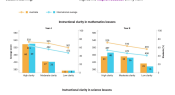
Latest Trends in International Mathematics and Science Study (TIMSS) data show the degree to which teachers are clear in the way they deliver the mathematics and science curriculum is likely to influence student learning. This includes ensuring students understand the learning goals for each lesson, being able to explain key concepts, and giving students helpful feedback. Find out more in this infographic.
Effective feedback drives improvements in teaching and learning. What happens to the feedback that you give students? In our latest reader submission Andreas Katsanos – Berwick Campus Head of Commerce at Beaconhill College in Melbourne, Victoria – shares how he’s been improving his own practice in this area by implementing a 3-stage feedback loop.
Facebook
YouTube
SoundCloud
Apple Podcasts
Spotify
RSS feed
Linkedin