Filter by category
How can we make assessment work for learners and learning in a rapidly changing world? How can we establish where students are at in their learning, including in the hard-to-measure skills and attributes they need to flourish in life? These questions will be explored at ACER’s Research Conference 2022, where the theme is ‘Reimagining assessment’.
With plenty of ‘get rich quick’ hype circulating around social media, and well-marketed trading apps luring people in to investing, it’s important to understand cryptocurrency. In this context, schools and teachers have an important role to play. Here, Dr Carly Sawatzki, Dr Jill Brown and Peter Saffin explore how teachers can understand students’ learning needs in this area.
Students miss school for a whole range of different reasons, such as illness, suspension, or family holidays. Today, we’ll be speaking with Kirsten Hancock, Honorary Research Associate from Telethon Kids Institute in Western Australia about how different types of absences affect student outcomes, and what families and schools can do to tailor their support to students who are missing school.
‘One way of making full use of reclaimed classroom spaces, whilst building collaborative and pro-social skills and behaviours, is Socratic Circles.’ English and History teacher Steven Kolber explains how to use this technique in your own classroom, the benefits and outcomes for students, and the role of the educator.
Age-appropriate consent education will be mandatory in all Australian schools from 2023. Kit and Arlo Find a Way: Teaching consent to 8-12 year olds is a fictional chapter book created for use in primary classrooms. In the first instalment of a two-part Q&A with author-educators Ingrid Laguna and Vanessa Hamilton, we find out more about the resource and research about the impact of consent education in schools.
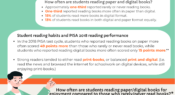
An OECD report 21st-Century Readers: Developing Literacy Skills in a Digital World analyses data from the 2018 PISA test and student survey to report on the reading habits of 15-year-olds in OECD countries. Find out more about how reading in digital and paper formats affects students’ reading performance and enjoyment in today's infographic.
How have things changed for schools over the last two years of the pandemic, and what are the improvement priorities now for teachers, principals and communities on the ground? Professor Pauline Taylor-Guy joins us for the latest episode in our School Improvement podcast series.
As a primary school teacher, are you aware of how many students in your class are finishing their lunch each day? How many are taking food back home? New Australian research has found that most primary school students have just 10 minutes to eat their lunch during the school day. Find out more in today’s article.
As a teacher, how has work impacted your wellbeing during the pandemic? What wellbeing initiatives are offered at your school, and how can they be improved to better support teachers? In this article, we outline five further readings which explore educator wellbeing in Australia and internationally.
‘[The Sacúdete strategy] shows to others what the future of school could look like when we put learners at the centre and make the "extracurricular" the curriculum. That is the lesson that other countries can learn from.’ In his new Teacher column, Andreas Schleicher shares details of a successful program in Colombia that sees educators work as mentors and coaches.
Facebook
YouTube
SoundCloud
Apple Podcasts
Spotify
RSS feed
Linkedin