Filter by category
Professor Geoff Masters AO shares details of a special ACER five-webinar series, where expert practitioners, researchers and policymakers will revisit the major challenges in school education he wrote of six years ago, and ask what progress has been made on each, and what needs to happen next.
How do schools successfully engage and retain students alongside promoting academic achievement? In today’s reader submission Margaret Gurney, Assistant Director-General, State Schools Operations at the Queensland Department of Education, shares research findings on practices common in high performing schools.
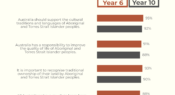
In Australia, one of the aims of civics and citizenship education is to develop understanding and appreciation of Indigenous histories and cultures. This infographic looks at students’ attitudes towards Aboriginal and Torres Strait Islander cultures, traditions and peoples.
How can teachers go about identifying the underlying causes of a student’s behaviour, and then approach responding to this behaviour in a respectful and effective way? To dissect these questions, we’re joined by Dr Erin Leif and Russell Fox from Monash University.
Pamela Macklin and Vic Zbar have just released an updated second edition of Driving School Improvement: Practical strategies and tools. In this Q&A they discuss a common improvement challenge faced by leaders, and share examples of how different schools are meeting this challenge.
Why is language development so important in the early years? What does optimal language development look like? In this edition of Researching education: Five further readings, we share five resources which investigate the development of oral language in the early years.
Welcome back to a new school year. Over the past few weeks, the Teacher team have been busy putting together content to help support you for the year ahead, and in today’s episode we’re going to take you through some of the highlights. We’ll be discussing school leadership, gifted education, setting up your classroom, and resources for planning.
The winners of the annual Prime Minister’s Prizes for Excellence in Science Teaching in primary and secondary schools have been announced. Darren Hamley from Willetton Senior High School in Western Australia and Sarah Fletcher from Bonython Primary School in the ACT were awarded with the prizes, and they both join us in today’s episode.
Leaders and teachers moved swiftly to ensure continuity of children’s learning during the COVID pandemic, and parents and carers in Australia certainly appreciated their efforts, with a new survey showing high levels of satisfaction with how schools adapted.
Large scale research into school break times suggests relatively simple changes to daily routines could drastically reduce teachers’ exposure to UV radiation and risk of skin cancer. Ben Dexter tells Teacher more about the findings.
Facebook
YouTube
SoundCloud
Apple Podcasts
Spotify
RSS feed
Linkedin