Filter by category
Ahead of the 2026 ACEL National Conference – presented in partnership with ACER – Teacher editor Jo Earp is joined by Lisa Newland, CEO of ACEL, and Lisa Rodgers, CEO of ACER, to unpack the conference’s theme of bold leadership. Lisa and Lisa tell us about their approach to leadership, what they’ve learned over the years, and more.
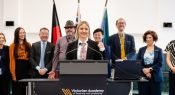
The transition from being a 'good' teacher to an 'exceptional' one often requires more than just experience; it can be enabled by a deliberate, evidence-informed space for reflection and inquiry. This is the core mission of the Victorian Academy of Teaching and Leadership, whose flagship Teaching Excellence Program and Teaching Impact Fellowships are reshaping the professional landscape. Find out more in today’s article.
It’s National Science Week – a time to celebrate curiosity, inquiry and shared learning. In today’s article, we learn more about the Victorian Space Science Education Centre and how its immersive STEM experiences contribute to knowledge acquisition, but also to the development of teamwork, communication, resilience, and connection.
Ahead of the National Education Summit in Melbourne this September, we sat down with Andrew Fuller – clinical psychologist, author and family therapist – to discuss his work on converting neurodiversity into neuro-advantage. In this episode, we explore transitions and regulation, school belonging and finding your people, and how educators can help turn neurodivergence into a genuine advantage for young people.
This week we're celebrating Australian Primary Principals Day. To mark the occasion, we sat down with Anthony Boys, Principal of Marist Catholic College, North Shore in Sydney to discuss his approach to instructional leadership and hear how distributed leadership works in practice at his school.
When students are in the early stages of developing skills, knowledge and understanding, or encountering new material and concepts, explicit teaching, and the gradual release of responsibility are crucial for progressing the learning. In today’s article, teacher, instructional coach and researcher Dr Nathaniel Swain discusses the importance of structured approaches, teacher judgement, being responsive to students, and the potential benefits and caveats around shared curriculum materials.
‘How can schools help young people learn to use AI thoughtfully, ethically and effectively?’ In today’s article Kara Baxter – Deputy Principal, Learning and Teaching, at Strathcona Girls Grammar School in Melbourne, Victoria – shares the thinking and process behind the development of the school’s AI policy.
In our latest reader submission, Dr Aylie Davidson, Lecturer in Mathematics Education at Deakin University, explains that planning for learning necessitates intellectual and collaborative effort, and outlines what an effective planning meeting for maths looks like in practice.
To address staffing concerns and improve language provision in primary schools, an innovative program known as TCL (Teachers as Co-Learners) supports the provision of languages through daily allocation of 15-minute chunks during the school day, run by a classroom teacher with the support of a language assistant.
In today’s article Samantha Ephraims from Kalkie State School in Queensland uses the teen fandoms of Taylor Swift and television show Stranger Things as examples of students mirroring the scientific process, and suggests that the fandoms can be used to address a decline in scientific engagement in students.
Facebook
YouTube
SoundCloud
Apple Podcasts
Spotify
RSS feed
Linkedin