‘As a school teacher or leader, you will understand the challenge of addressing gaps in students’ literacy and numeracy skills.’ In this article, Adam Inder shares findings from AERO’s 'Implementing effective tiered interventions in secondary schools' project.
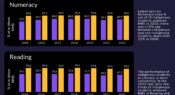
In the National Assessment Program — Literacy and Numeracy (NAPLAN) tests, the national minimum standard (NMS) is the ‘agreed minimum acceptable standard of knowledge and skills without which a student will have difficulty making sufficient progress at school’. This infographic looks at the performance of Indigenous and non-Indigenous students in Year 9, over time.
ACER’s Global Academic Challenge was held for the first time this year and offers higher-performing students in Years 4, 6 and 8 the opportunity to attempt the kinds of questions sat by students in international schools around the world. ACER Senior Research Fellow Frances Eveleigh, who led the development of the challenge, shares some of the insights in this article.
‘Children with dyscalculia lack basic number sense, which affects every aspect of their ability to process numbers including performing arithmetic operations, understanding fractions and algebra.’ Rachel Parker, Senior Research Fellow at the Australian Council for Educational Research, gives an introduction to the neurological condition dyscalculia, including the signs, diagnostic tools and evidence-based ways to support students.
‘Our strong recommendation is to get creative and put real life contexts front and centre of your lessons, making mathematics relevant, engaging and meaningful…’ Justine Sakurai, Carly Sawatzki and Dave Tout discuss contextualised teaching and learning of mathematics through the exploration of six numeracy contexts, and provide several examples of what this could look like in the classroom.
In today’s article, Dave Tout, Justine Sakurai and Carly Sawatzki discuss numeracy and its relationship with mathematics, and the importance of real-world contexts. They’ll also share a problem-solving cycle to help students develop their skills, and a classroom example of health numeracy, using trampolining as a focus for mathematical investigation.
Who was the Greatest of All Time (GOAT) of women’s tennis in 2018? Teams participating in this year’s International Mathematical Modeling Challenge (IM2C) were tasked with developing and applying a model to determine just that.
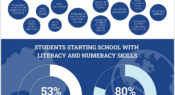
In the Trends in International Mathematics and Science Study (TIMSS) 2019, Year 4 principals were asked to report how many students in their school could do foundational literacy and numeracy skills such as ‘write their names’ and ‘recognise written numbers from 1 to 10’ when they began their first year of primary school. Find out how Australian data compare to the international average in this infographic.
‘One of the biggest challenges facing educators is to find better ways to meet the learning needs of the many students who fall behind in our schools.’ In her latest Teacher column, Dr Sue Thomson explores the issue in an Australian context, and the progress made in recent years.
Research indicates that Indigenous children’s participation in organised sport leads to an increase of two to seven months’ learning in numeracy. Here, we look at the findings and the implications of this research for closing the learning gap between Indigenous and non-Indigenous students.
Facebook
YouTube
SoundCloud
Apple Podcasts
Spotify
RSS feed
Linkedin