Filter by category
Age restrictions preventing under-16s in Australia from creating or keeping accounts on major social media platforms come into force today. The responsibility rests with platforms like Instagram, TikTok and YouTube to take ‘reasonable steps’ to comply. We look at how teachers can help students and families navigate the change, what the legislation means for schools, and resources out there to support educators.
In a Teacher exclusive, Minister of Education and Research for Estonia Dr Kristina Kallas joins editor Jo Earp for this special podcast to talk about setting teachers and students up for success, the early years foundations for Estonia's impressive PISA performance, and the next big challenge – AI in education.
We’ve called on 2 of our expert colleagues here at the Australian Council for Educational Research (ACER) – Dr Tim Friedman and Bethany Davies – to look at what the latest Australian research says about teaching and learning with artificial intelligence, and what you can do in the classroom to address some of the challenges.
In this expert Q&A Amy Ayres – President of the Science Teachers’ Association of New South Wales – discusses integrating technology into science instruction and improving students’ critical thinking or inquiry skills. These were 2 areas of future PD need highlighted in the latest Australian TIMSS teacher questionnaire findings.
As the implementation of social media legislation for under-16s draws closer, many young people are feeling confused, anxious and unsettled. Here, Danni Rowlands from the Butterfly Foundation discusses what to expect from the incoming changes, the concerns already voiced by young people, how it all connects to body image, and why educators are uniquely positioned to support students through the changes.
From inside the classroom to the school’s outdoor spaces, there’s plenty to consider when it comes to learning spaces. In this edition of Researching education: 5 further readings, we share 5 resources on the topic of learning spaces.
‘The feedback from students reflects a growing desire for partnership. They aren’t just asking for permission to use AI, they’re asking for guidance, collaboration, and trust.’ Georgia Wignall shares new insights from a Queensland school research partnership on why students are leaning on AI tools and how they want teachers to support them.
Teacher editor Jo Earp sits down with Mali Jorm, Madison Dearnaley and Tracy Kelly to talk about managing school library and reading spaces, including building a student-driven collection, creating fresh and welcoming spaces, and strategies to encourage reading for pleasure. They also share their personal and student book recommendations.
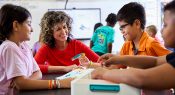
Education has the potential to foster curiosity and empower future scientists through engaging hands-on learning, proven to positively impact students and teachers. In this Q&A, Bo Stjerne Thomsen, Head of Education Impact at LEGO Education explores the vision, development, and potential of LEGO® Education Science.
It is important that teachers feel confident to respectfully and effectively address religion and beliefs in diverse classrooms. In today's podcast, Professor Peter Sherlock discusses why it’s important for schools to engage with religion and belief systems, how to engage students in meaningful conversations about religion in a respectful way, and resources available to help teachers build their confidence in this space.
Facebook
YouTube
SoundCloud
Apple Podcasts
Spotify
RSS feed
Linkedin