Filter by category
Planning ahead to meet the professional learning needs of staff to improve teaching effectiveness in your school is an important aspect of a principal’s work. But, what happens when these plans get overtaken by events?
‘While we found that a lot of elements in our lives can be replaced by an online substitute, after a year of lockdowns we still have not been able to replicate the “human” element. The lack of peer-to-peer interaction was perhaps felt most by children.’ Professor John Toumbourou discusses the role of peer support programs in rebuilding student resilience.
Teachers play an important role in the mitigation of bullying, particularly in the early years, where children are more likely to rely on their teachers to help them fix their problems. So, as an early years educator, how do you approach assessing behaviour to decide whether it is bullying?
Learning to read is a complex task for children, and there are many evidence-based approaches to teaching children to read. So, how do children learn to read? How can teachers be most successful in reading instruction? We share five resources which seek to answer these questions.
How are teachers and school leaders accessing and using research and evidence? What challenges do they face when doing so? And, what enables quality use of research and evidence? Members of the research team for the Monash Q Project join us in today’s episode to explore these questions.
Self-regulation is a critical factor for success in learning and life. In today’s article, Dr Karen Peel shares details about the Capabilities for Life & Learning Model – a tool she developed that informs teachers’ lesson design and enhances students’ self-awareness about learning.
‘There can be no more important time to reflect on teachers, their performance and their wellbeing than following the pandemic’s disruption to normal schooling.’ In today’s reader submission, Professor Jenny Gore says in addition to helping students, there must also be a focus on helping teachers recover.
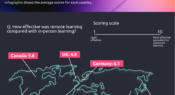
McKinsey surveyed teachers around the world for their views on the effectiveness of remote learning during the COVID-19 school closures. Teachers were asked to reflect on their experiences in the first few months of the pandemic, scoring the effectiveness on a scale of one to 10. Find out the results in today’s infographic.
In today’s article, Daisy Christodoulou and Jeanette Breen share details of the Australian Writing Assessment Project, which brings together 25 schools to trial a technique called Comparative Judgement, and some of the early feedback and findings.
‘If anyone asks, I would definitely tell them that it is healthy to put yourself first on a regular basis; to do something that is just for you.’ Michelle Feely, College Librarian at St Patrick’s College for Girls, shares how yoga has become part of her weekly routine and gives her the opportunity to put herself first.
Facebook
YouTube
SoundCloud
Apple Podcasts
Spotify
RSS feed
Linkedin